
Combining Relativity Effects
Imagine you are trying to sync two watches while standing on a moving train. One watch stays on the platform while the other travels with you, creating a difference in how time flows for each device. This simple scenario highlights the core struggle of satellite engineering where clocks must account for two different types of time distortion at once. Because satellites move at high speeds and exist within a weaker gravitational field than we do on Earth, they experience a double-layered shift in time that requires precise mathematical reconciliation.
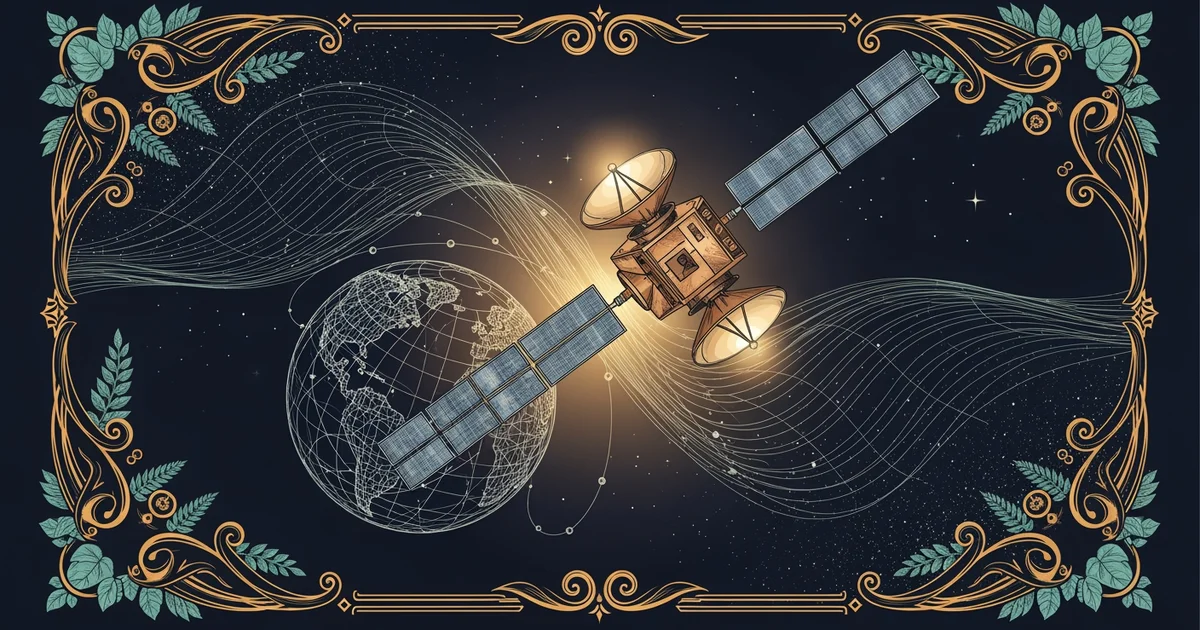
The Dual Nature of Time Distortion
When we look at how satellites operate, we must combine two distinct effects from the theories of relativity. First, the high speed of the satellite causes time to move slower for the craft compared to a stationary observer on the ground. This phenomenon is known as special relativity, which dictates that moving clocks tick at a slower rate than stationary ones. Second, the satellite orbits far above the Earth where the gravitational pull is much weaker than it is at sea level. According to general relativity, clocks tick faster in regions with weaker gravity because time is less affected by the curvature of space.
These two effects act like opposing forces in a financial budget where one expense removes money while another adds it back. If you only accounted for the speed of the satellite, your navigation data would drift by several kilometers each day. If you only accounted for the lower gravity, your error would grow in the opposite direction. Engineers must calculate the net result of these two competing factors to ensure that the time signals sent to your phone remain accurate. The final adjustment is not just a simple addition but a complex synthesis of these two physical realities.
Key term: Relativistic offset — the total correction applied to satellite clocks to account for the combined effects of velocity and gravity.
To understand how these combine, consider the daily drift rates for a single clock in orbit:
- Special relativity causes the satellite clock to lose about seven microseconds per day because of its rapid orbital velocity around the Earth.
- General relativity causes the satellite clock to gain about forty-five microseconds per day because it sits in a weaker gravitational field.
- The net result is a gain of approximately thirty-eight microseconds per day, which must be corrected by the system to maintain sync.
Managing the Cumulative Clock Drift
Because the satellite clock gains thirty-eight microseconds every single day, the ground control team must adjust the hardware before the craft launches into space. They physically tune the frequency of the atomic clocks to tick slightly slower than they would naturally. By slowing the clock down on the ground, the engineers ensure that the clock runs at the exact same rate as Earth clocks once it reaches its final orbit. This proactive adjustment is the only way to prevent the buildup of massive location errors that would otherwise render your map applications entirely useless within a few hours of operation.
| Effect Type | Physical Cause | Impact on Time | Magnitude per Day |
|---|---|---|---|
| Special | High Speed | Slower Ticking | -7 microseconds |
| General | Weak Gravity | Faster Ticking | +45 microseconds |
| Net Effect | Combined | Faster Ticking | +38 microseconds |
This table illustrates why we cannot ignore either side of the equation when designing space technology. If we ignored the seven-microsecond loss, our final correction would be wrong by a significant margin. If we ignored the forty-five-microsecond gain, the error would be even larger in the opposite direction. By synthesizing these two effects, scientists have turned a complex theoretical problem into a reliable tool for global navigation. The harmony between these two distinct relativistic principles allows your device to pinpoint your location with incredible accuracy every time you check your map.
Accurate navigation depends on balancing the clock-slowing effects of high orbital speeds against the clock-accelerating effects of reduced gravity.
But what does it look like in practice when we actually begin to build the hardware that performs this correction?
Want this with sources you can check?
Premium Learning Paths for Astronomy & Space Exploration are researched against open-access libraries — PubMed, arXiv, government databases, and more — with their distinctive claims cited to real sources and independently checked.
See what Premium includes