
Airtight Construction Methods
Imagine wearing a thick winter coat that has a giant hole in the side seam. Even if the coat is made of the best down insulation, the cold wind will cut through that opening and ruin your warmth immediately. Buildings function in the exact same way when they lack proper seals against the outdoor air. You can install high-quality insulation throughout your walls, but that effort is wasted if air leaks through gaps in your structure. Creating a continuous, unbroken barrier against air movement is the most vital step in achieving true energy efficiency.
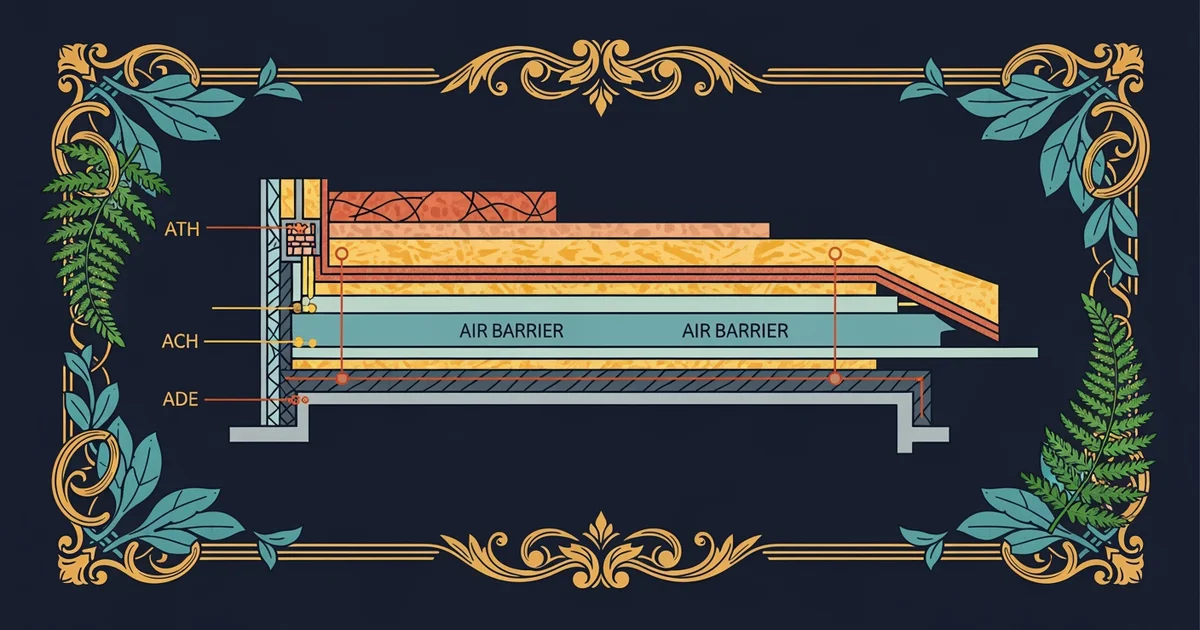
The Mechanics of Airtightness
When we discuss airtightness in modern construction, we are focusing on the total control of air flow through the building envelope. An air barrier is a system of materials designed to stop the uncontrolled passage of air into or out of a conditioned space. Think of this barrier like the specialized windbreaker shell worn by a mountain climber during a blizzard. The shell does not provide heat on its own, but it stops the wind from stripping away the warmth generated by the climber inside. Without this shell, the internal heat escapes rapidly, forcing the body to work harder to stay warm. Buildings require this same protective layer to maintain a stable internal climate while using minimal energy resources.
Key term: Air barrier — a continuous physical layer that prevents uncontrolled air leakage through the building enclosure to maintain thermal comfort.
Many people mistakenly believe that insulation and air sealing are the same thing, but they serve very different purposes. Insulation slows down the transfer of heat through materials, while air sealing stops the actual movement of air molecules. If you have a hole in your wall, the insulation acts like a sieve, letting cold air pass right through the fibers. By sealing every joint, corner, and penetration, you ensure that the air you pay to heat or cool stays exactly where you want it. This process requires great attention to detail during the construction phase because once the walls are closed up, fixing a leak becomes extremely difficult and expensive.
Strategies for Continuous Sealing
Achieving a high level of airtightness depends on the seamless connection of all building components. You must treat the entire house as a single, sealed unit rather than a collection of separate parts. Builders use specialized tapes, membranes, and liquid sealants to bridge the gaps between different materials like wood, concrete, and metal. When these materials meet, they often create tiny pathways for air to escape. Proper sealing techniques ensure these junctions remain closed throughout the lifespan of the building. The following table outlines the most common areas that require dedicated sealing strategies during the construction process.
| Area of Concern | Sealing Method | Primary Benefit |
|---|---|---|
| Window Frames | Expanding foam | Prevents drafts at edges |
| Electrical Outlets | Airtight gaskets | Blocks air from wall cavities |
| Floor Joists | Taped membranes | Stops stack effect leakage |
| Pipe Penetrations | Elastomeric sealant | Maintains pressure integrity |
These strategies rely on the principle of a continuous loop of protection around the entire structure. If you leave even a small gap, the pressure difference between the inside and outside will pull air through that hole. This is often called the stack effect, where warm air rises and escapes through the top of the building while pulling cold air in at the bottom. By systematically addressing these weak points, you create a building that performs like a sealed thermos. This level of control allows mechanical ventilation systems to provide fresh, filtered air without wasting energy on heating or cooling outside air that leaks in through cracks.
True energy efficiency requires a continuous air barrier that functions like a windbreaker to stop heat loss through uncontrolled air movement.
The next Station introduces thermal bridge mitigation, which determines how structural elements bypass your insulation and airtight layers.