
The Physics of Thermal Comfort
Imagine standing next to a single-pane glass window on a cold winter night while the biting wind whistles outside. You feel an immediate chill radiating from the glass surface even though the air in the room feels warm. This sensation happens because your body is losing heat to the cold surface through a process called radiation. Understanding how heat moves through a building is the first step toward building a comfortable home that requires almost no extra energy. By controlling these invisible flows, we can maintain perfect indoor temperatures regardless of what the weather is doing outside.
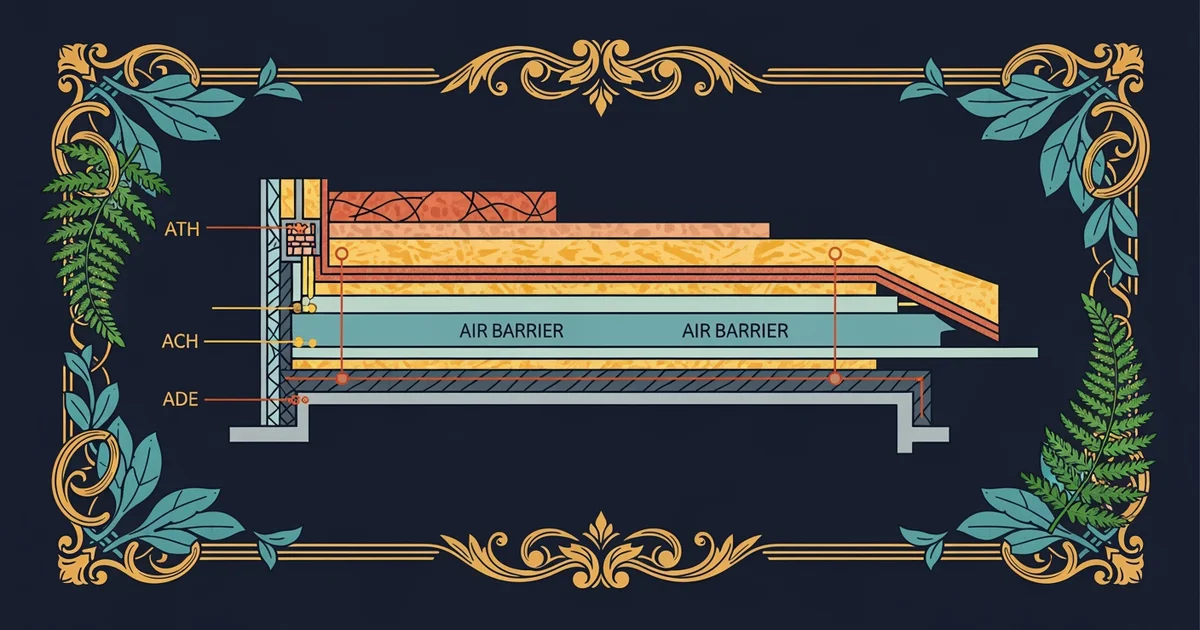
Heat Transfer Mechanisms
Heat energy always moves from a warmer area to a cooler area until the temperatures eventually balance out. In a house, this movement happens through three distinct ways that impact your comfort every single day. First, conduction occurs when heat travels directly through solid materials like wood studs or glass panes. Second, convection happens when air currents carry heat around a room as warm air rises and cool air sinks. Third, radiation involves heat moving as invisible waves through space from a warm surface to a colder one. These three forces constantly pull warmth out of your home during the winter months.
Key term: Thermal bridge — a specific area of a building envelope that allows heat to pass through more easily than the surrounding materials.
Think of your house like a warm, insulated thermos filled with hot coffee sitting out in the snow. If you leave the lid off or press a metal spoon against the side, the heat will escape much faster. In your home, the walls act as the thermos walls, and the windows act as the lid that needs to be sealed tight. A thermal bridge acts exactly like that metal spoon by creating a shortcut for heat to escape directly to the outside. Eliminating these bridges ensures that your home stays as efficient as a high-quality vacuum flask.
Managing the Building Envelope
The building envelope is the physical barrier that separates the indoor environment from the harsh outdoor climate. To keep a space comfortable, we must manage how heat moves across this shell using specific design choices. We use insulation to slow down conduction, and we use airtight seals to prevent convection from leaking warm air away. Proper windows are also vital, as they must stop radiation from stealing your indoor heat while still allowing natural light to enter. The table below compares how different parts of a wall system handle these various heat transfer forces.
| Element | Primary Function | Heat Transfer Target |
|---|---|---|
| Insulation | Slows conduction | Solid materials |
| Airtight Seal | Stops convection | Air movement |
| Low-E Glass | Blocks radiation | Invisible waves |
These components must work together as a single system to be truly effective for long-term comfort. If you have thick insulation but leave a small gap for air to leak, the system fails. We must view the entire structure as one connected unit rather than a collection of separate parts. This holistic approach is the secret to achieving high performance in residential architecture today. By carefully selecting materials that resist heat flow, we create a stable environment that requires minimal mechanical heating or cooling.
Understanding these physical rules changes how we think about the walls and windows surrounding us. Instead of relying on a furnace to fix temperature drops, we design the structure to hold onto the heat we already have. This simple shift in perspective allows us to build homes that are both sustainable and incredibly cozy. The goal is to make the building do the heavy lifting so that our mechanical systems can take a permanent vacation. We are essentially learning to manage energy flow just like a master architect would manage a complex structural load.
Thermal comfort relies on controlling the movement of heat through conduction, convection, and radiation by treating the entire building envelope as a single, unified barrier.
Next, we will explore the historical evolution of energy efficiency standards that led us to these modern design principles.