
Room Modal Analysis
Have you ever sat in a small room and noticed that some bass notes seem to boom while others vanish into thin air? This strange acoustic phenomenon occurs because sound waves become trapped between parallel walls, creating a physical pattern that defines how we hear music in confined spaces.
Understanding Room Resonance
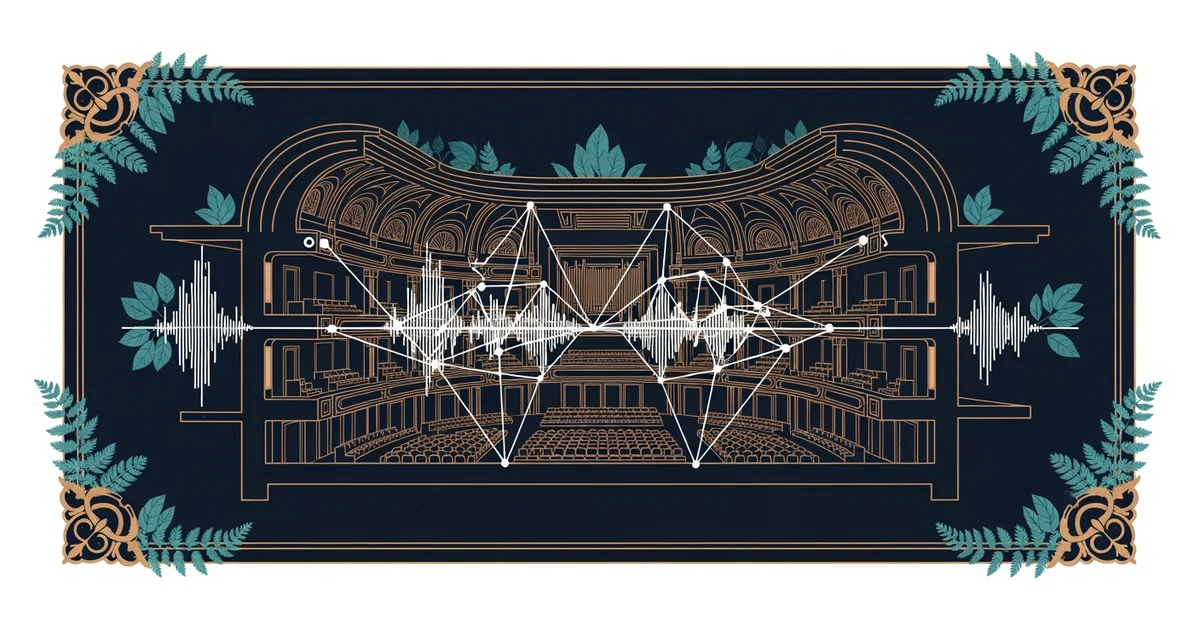
When sound waves travel within a room, they bounce off hard surfaces and reflect back across the space. If the distance between two walls matches a specific sound wave length, the waves overlap to create standing waves. These waves do not travel through the room like normal sound energy. Instead, they appear to hover in place, oscillating between high pressure and low pressure points. You can think of this like a guitar string that is plucked; it vibrates in a fixed pattern because both ends are pinned down. In a room, the walls act as the pins that hold the sound energy in a rigid, repeating loop. This creates an uneven distribution of sound intensity throughout the room.
Key term: Standing waves — stationary patterns of sound energy that form when waves reflect between parallel surfaces and reinforce one another.
These patterns cause major problems for listeners because the room dictates which frequencies are heard clearly and which are obscured. Some spots in the room will experience a massive boost in bass volume, while other spots will suffer from a total loss of low-end detail. This happens because the pressure peaks and troughs are fixed in space. If your chair sits in a pressure trough, you will hear almost no bass at all. If you move your chair just a few feet, the bass might suddenly become overwhelming and muddy. This inconsistency makes it nearly impossible to listen to music or record audio with any level of accuracy.
Identifying Modal Patterns
To manage these issues, we look at the specific dimensions of the room to calculate its resonant frequencies. Every room has a unique set of room modes based on its length, width, and height. These modes determine which frequencies will naturally amplify or cancel out within the space. Smaller rooms are particularly prone to these issues because their dimensions are often close to the wavelengths of low-frequency sound. When the room is small, these modes are spread far apart, making the gaps in sound quality much more noticeable to the human ear.
To visualize how these modes affect a space, we can categorize the types of standing waves that form between surfaces:
- Axial modes occur when sound bounces back and forth between two parallel surfaces, creating the strongest and most problematic pressure peaks.
- Tangential modes involve four surfaces of the room, which results in a weaker but still audible interaction that complicates the acoustic environment.
- Oblique modes involve all six surfaces of the room, creating the most complex interactions that are generally less intense than axial modes.
By understanding these patterns, we can predict where the problem areas will be before we even place furniture. Architects use this data to avoid square rooms, which are the worst offenders for modal issues. A square room forces all modes to pile up on the same frequencies, creating massive peaks and nulls. Instead, designers prefer rooms with irregular dimensions or specific ratios that spread the modes out evenly across the frequency spectrum. This spreading effect ensures that no single note is overly boosted or completely silenced by the room geometry.
| Mode Type | Surfaces Involved | Intensity Level | Impact on Sound |
|---|---|---|---|
| Axial | Two walls | Very High | Strong peaks/nulls |
| Tangential | Four walls | Moderate | Medium interference |
| Oblique | Six surfaces | Low | Subtle coloration |
Managing these modal interactions requires a strategy of either absorbing the excess energy or diffusing it to break up the standing waves. If you cannot change the room dimensions, you must use bass traps in the corners to soak up the pressure peaks. By reducing the energy that reflects off the walls, you prevent the standing waves from gaining strength. This creates a much more balanced listening environment, allowing the audio to remain clear and consistent regardless of where you sit in the room.
Room modes are predictable patterns of sound reinforcement that dictate the acoustic quality of a space based on its physical dimensions.
But what does it look like in practice when we try to quiet the room's noise floor?
Want this with sources you can check?
Premium Learning Paths for Architecture & Design are researched against open-access libraries — PubMed, arXiv, government databases, and more — with their distinctive claims cited to real sources and independently checked.
See what Premium includes