
The Science of Sound Waves
Imagine you are standing in a crowded room where every person is talking at once. You hear a chaotic jumble of noise, yet your ears somehow manage to pick out a single voice. This happens because sound travels through the air in invisible ripples that carry information to your brain. Understanding these ripples is the first step toward mastering how we design the spaces where we live and work.
The Mechanics of Sound Waves
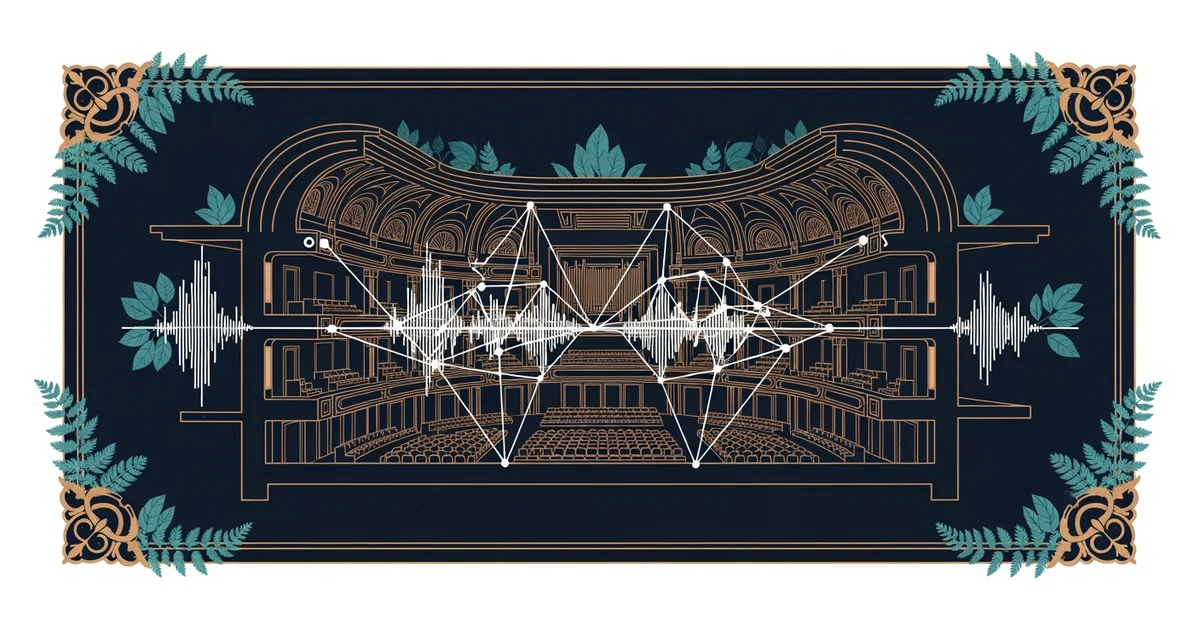
Sound starts when an object vibrates and pushes against the molecules in the air around it. These molecules bump into their neighbors, creating a chain reaction that moves outward from the source of the noise. Think of this like a line of dominoes falling one after another across a long floor. The air molecules do not travel all the way from the source to your ear. Instead, they simply nudge each other forward and backward in a repeating pattern of pressure changes.
Key term: Compression — the area of a sound wave where air molecules are packed tightly together by energy.
These pressure waves consist of areas where molecules crowd together and areas where they spread out. We call these packed areas compression, and the stretched areas are known as rarefaction. The speed at which these patterns repeat determines the pitch of the sound you finally hear. A high-pitched whistle creates these cycles very quickly, while a deep drum beat creates them much more slowly. This rhythmic movement is exactly how energy travels through a medium like air, water, or even solid walls.
How Spaces Shape Sonic Energy
When these waves hit a solid object, they do not just stop moving or vanish into thin air. Depending on the material, the wave might bounce off the surface, pass through it, or get absorbed by the material. A hard surface like concrete acts like a mirror for sound, reflecting the energy back into the room. This reflection creates echoes that can make a space feel loud and confusing for listeners. Architects must choose materials that manage these reflections to keep the environment comfortable for human ears.
| Surface Type | Sound Behavior | Typical Result |
|---|---|---|
| Hard Stone | High Reflection | Strong Echoes |
| Soft Fabric | High Absorption | Muffled Noise |
| Wood Panels | Partial Bounce | Natural Tone |
Soft materials like heavy curtains or thick carpets work differently by trapping the energy inside their fibers. Instead of reflecting the sound, these materials convert the energy into tiny amounts of heat. This process is similar to how a thick sponge absorbs water, preventing a puddle from spreading across the entire floor. By balancing hard and soft surfaces, designers can control how long a sound lingers in a room. This practice is essential for building spaces that sound clear, professional, and pleasant for everyone inside.
Understanding these physical properties allows architects to build better environments for music, speech, and daily life. You now have the foundation to explore how our own ears process these complex signals. By the end of this learning path, you will understand how to manipulate physical spaces to create perfect acoustic environments for any purpose.
Sound travels through the air as a series of pressure waves that interact with surfaces by reflecting, absorbing, or passing through materials.
In the next station, we will examine how the human ear captures these waves and translates them into the sounds we perceive.