
Reflection and Surface Geometry
Imagine standing inside a large, empty stone hallway while you clap your hands loudly. The sound does not just disappear into the air, but instead bounces off the hard walls to reach your ears again. This simple act reveals how specular reflection dictates the path of sound waves inside any given architectural space. Architects must treat sound like a beam of light hitting a mirror to ensure that listeners hear clear audio. When a sound wave strikes a flat surface, the angle at which it hits equals the angle at which it leaves. Controlling this geometry allows designers to direct sound toward the audience or away from unwanted areas.
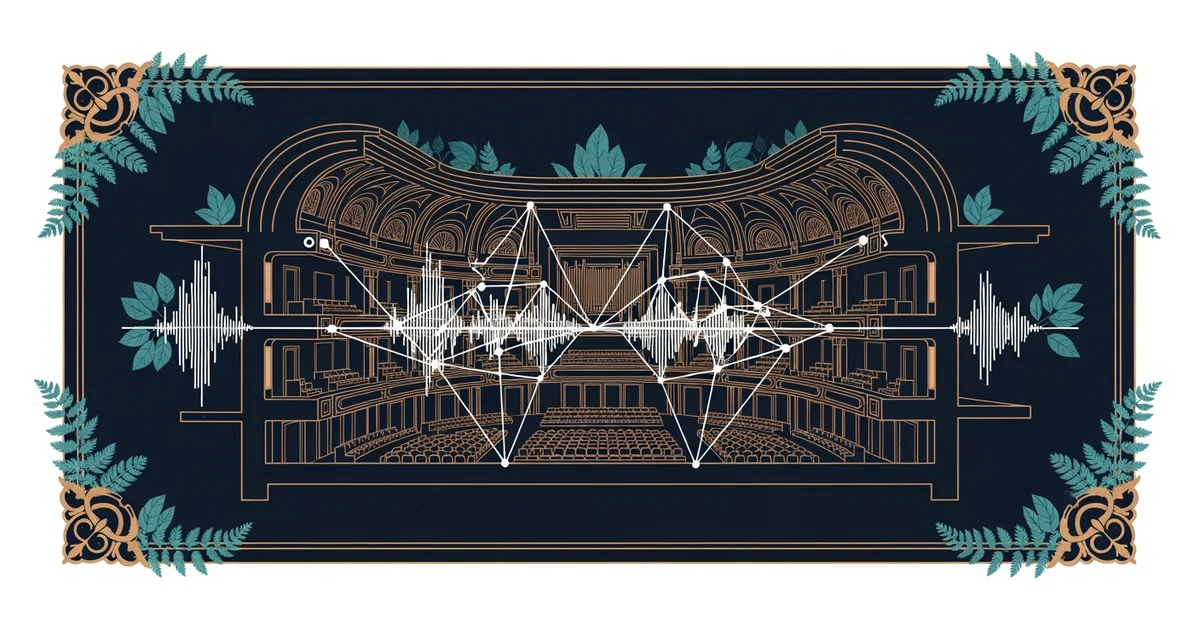
The Mechanics of Sound Geometry
Because sound waves behave predictably, architects use specific shapes to manipulate the energy within a room. Think of this process like aiming a flashlight at a reflective metal surface to light up a dark corner. If the wall is perfectly flat, the sound bounces off in one single direction with high intensity. If the wall is curved, the sound might spread out or focus on one tiny spot. This ability to steer sound energy is the primary tool for managing how listeners perceive music or speech. Without careful planning of these surface angles, the room would suffer from poor clarity and distracting echoes.
Designers often use a variety of surface shapes to manage these reflections effectively throughout a room:
- Flat surfaces act like standard mirrors, sending sound energy in one predictable direction that is useful for bouncing audio toward the back of a large hall.
- Concave surfaces work like a magnifying glass for sound, focusing energy into a small, intense point that can create hotspots or cause unpleasant acoustic feedback issues.
- Convex surfaces scatter sound waves in many directions, which helps create a more natural and balanced sound field by preventing the buildup of harsh, singular echoes.
Predicting Reflection Patterns
Now that you understand how surface shapes influence sound, you can see why the layout of a room matters for acoustics. Architects use geometric mapping to draw lines representing sound paths from a stage to the seats. By adjusting the tilt of a ceiling panel or a side wall, they ensure that the reflected sound arrives at the listener's ear shortly after the direct sound. This timing difference must be very small to maintain clarity and avoid the muddying effect of late reflections. If the reflected sound takes too long to arrive, the listener hears a distinct echo rather than a boosted volume.
Key term: Acoustic shadow — an area where sound waves are blocked or diverted by an object, resulting in a zone of silence or reduced volume.
To manage these complex interactions, designers often rely on a standard set of geometric strategies to improve the listening experience for everyone in the room.
| Surface Shape | Acoustic Effect | Best Use Case |
|---|---|---|
| Flat | Directs energy | Large auditoriums |
| Concave | Concentrates energy | Focused performance |
| Convex | Diffuses energy | Small concert halls |
By comparing these shapes, architects can balance the need for volume with the need for even sound distribution. Using these tools, they prevent sound from getting trapped in corners or creating dead zones where the audio quality drops significantly. Every angle is calculated to maximize the listener's experience and ensure that the sound remains crisp and uniform across the entire venue. This geometric precision turns a simple room into a high-performance space for sound.
Architects shape physical spaces by using surface geometry to direct, focus, or scatter sound waves to ensure listeners receive clear and balanced audio.
The next Station introduces absorption and reverberation, which determines how those sound waves decay once they strike a surface.