
Elasticity in Soft Tissues
Imagine pulling a thick rubber band until it reaches its breaking point after repeated stretching. Human tissues behave much like that band when they face physical forces during daily movement. Your ligaments and tendons serve as the body's natural springs to absorb energy and stabilize joints. Understanding how these tissues react to tension helps us define the physical limits of human performance. We must look at how force creates change within these structures to grasp the mechanics of injury.
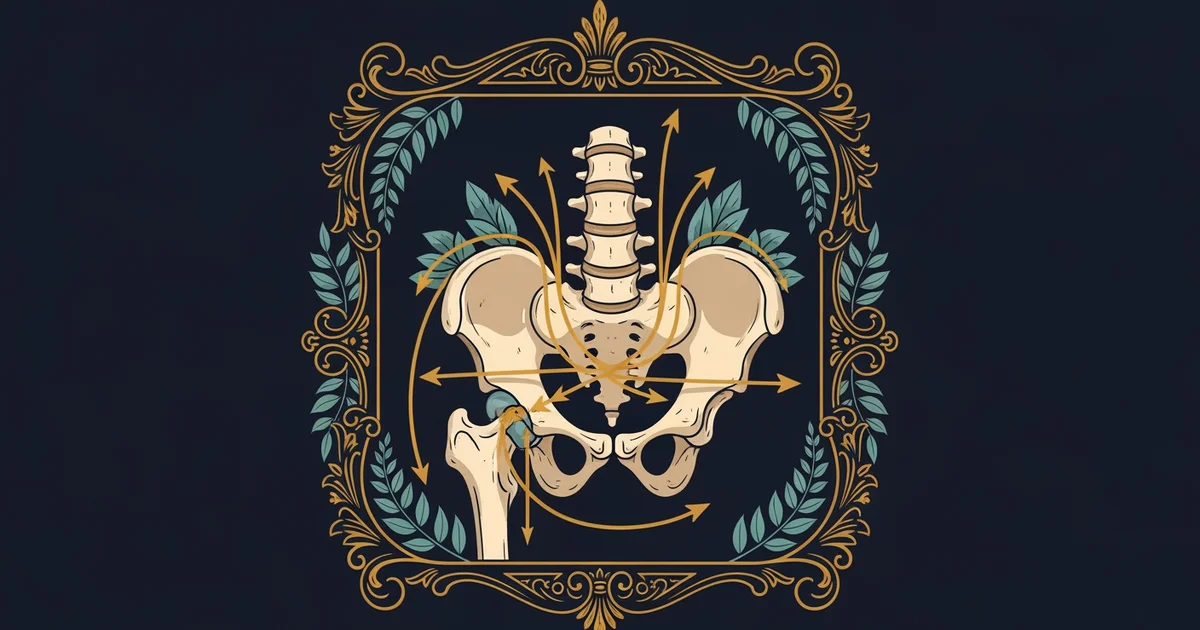
The Mechanics of Tissue Deformation
When you apply force to a biological structure, you create a state of stress that acts across the material. This internal pressure causes the tissue to change its shape, which we define as strain. Imagine a credit line at a bank where you can borrow money and pay it back without any lasting penalties. Elastic tissues operate in this safe zone where they return to their original shape once the force disappears. If the force exceeds the material's capacity, the tissue suffers permanent damage or structural failure. This behavior is predictable through the study of material science applied to living biological systems.
Key term: Elasticity — the physical property of a material that allows it to return to its original shape after a deforming force is removed.
Biological tissues do not behave like simple metal springs because they contain complex fiber networks. These fibers rearrange themselves when you stretch them, which changes how they resist further pulling. Scientists use a specific mathematical relationship to describe how much a tissue stretches under a given load. The ratio of stress to strain tells us about the stiffness of the tissue itself. A stiffer tissue requires more force to produce the same amount of deformation as a flexible one. This measurement is vital for doctors who treat athletes recovering from sports injuries or structural joint problems.
Measuring Limits Through Tension
To visualize these limits, we represent the relationship between force and stretch on a standard graph. The x-axis shows the amount of strain while the y-axis represents the applied stress. The curve starts with a linear region where the tissue acts like a perfect spring. As the force increases, the curve flattens out to show that the tissue is becoming less stiff. Eventually, the curve reaches a peak point where the material can no longer handle the added load. If the force continues to rise, the fibers start to snap and the tissue fails completely.
We can compare the mechanical properties of different body parts by looking at their typical stress limits:
- Ligaments possess high levels of collagen fibers that provide stability by resisting sudden changes in joint position.
- Tendons act like stiff ropes that transfer large forces from muscles to bones during explosive physical movements.
- Skin contains a mix of elastin and collagen that allows it to stretch and recover its shape.
These differences exist because each tissue type must perform a unique task to keep the body functioning. Ligaments keep bones aligned, while tendons must be stiff enough to ensure that muscle contraction moves the skeleton.
| Tissue Type | Primary Function | Relative Stiffness |
|---|---|---|
| Ligament | Joint stability | Moderate to High |
| Tendon | Force transfer | Very High |
| Skin | Elastic covering | Low to Moderate |
By plotting these values, we can determine the exact point where a tissue will likely tear during high-impact sports. This knowledge allows trainers to design exercise programs that strengthen tissues without pushing them past the breaking point. Physics provides the framework to predict these failure points before an actual injury occurs in the field. When you understand the math behind the stretch, you gain control over how your body handles physical stress.
The physical limits of human connective tissues are determined by the mathematical relationship between applied stress and the resulting material strain.
The next Station introduces Thermoregulation Physics, which determines how the body manages energy release during these intense mechanical activities.