
Structural Equilibrium Basics
Imagine standing on a narrow balance beam while trying to hold a heavy backpack. You naturally shift your body weight to avoid falling off the edge. This constant adjustment demonstrates how your skeletal framework manages forces to keep you upright. Your body acts like a complex machine that must balance internal weight against the pull of gravity. Understanding this process reveals how we maintain stability in a world that constantly pulls us toward the ground. You rely on these physical principles every single time you stand or walk.
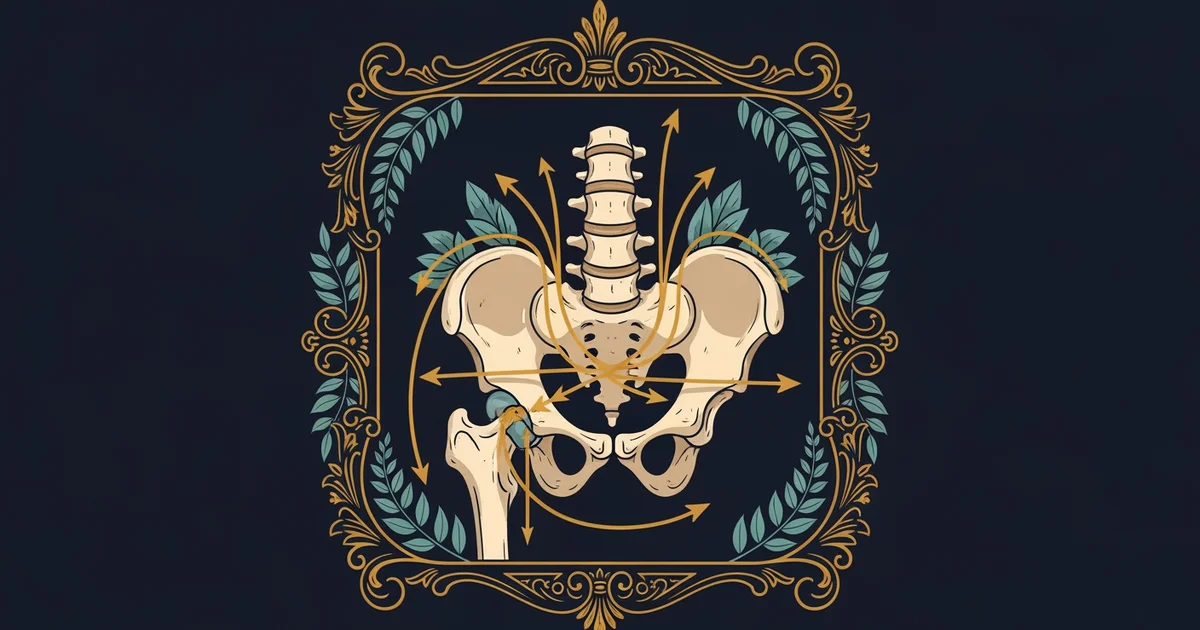
The Mechanics of Static Balance
Structural balance depends on the center of mass, which acts as the average position of all your body weight. When you stand perfectly still, your body must align this point directly over your base of support. Think of this like a stack of blocks where each piece must align to prevent the entire tower from collapsing. If your center of mass shifts outside this base, the force of gravity creates a rotational effect that pulls you over. Your muscles work to counteract these forces by making tiny, automatic adjustments to your posture. This process happens without you thinking about it, yet it remains the foundation of all human movement.
Key term: Center of mass — the specific point in an object where the total mass is concentrated and balanced in all directions.
Maintaining this balance is similar to a business managing its budget to stay in the black. Just as a company must balance its spending against its income to avoid bankruptcy, your body must balance its weight against gravity to avoid falling. If the expenses exceed the income, the business loses its stability and faces a crisis. Similarly, if your center of mass leaves your base of support, your body loses its structural integrity. You must constantly adjust your internal distribution to stay within your operational limits.
Calculating Stability and Support
To analyze how your skeleton handles these forces, we look at how different body positions change your stability. A wider base of support allows for more movement of your center of mass before you lose your balance. When you spread your feet apart, you increase the area where your weight can safely reside. This simple change makes it much harder for external forces to tip you over. Scientists use specific variables to measure these forces and predict how the body will react to shifts in weight.
| Body Position | Base of Support | Stability Level |
|---|---|---|
| Standing tall | Very narrow | Low stability |
| Feet apart | Moderate width | Medium stability |
| Sitting down | Wide and stable | High stability |
We can represent the relationship between force and distance using a simple equation. The torque, or rotational force, is defined by the product of the force and the distance from the pivot point. We express this relationship as . When you lean forward, you increase the distance between your center of mass and your feet. This creates a larger torque that your muscles must overcome to keep you upright. Your skeletal system acts as a rigid frame that resists these bending forces through its internal geometry.
Understanding these limits helps explain why we feel tired after standing for long periods. Your muscles must fire continuously to correct the small drifts in your center of mass. This physical effort is the cost of staying upright in a gravitational field. If you ignore these basic laws of physics, you lose the ability to move with efficiency and grace. Every movement you make is a negotiation between your skeleton and the constant pull of the earth. We are essentially living structures that must solve complex math problems just to remain standing in place.
Structural equilibrium occurs when the body aligns its center of mass over its base to neutralize the rotational forces generated by gravity.
The next station will explore how your bones and muscles function as mechanical levers to create movement.