
Biological Forces and Motion
Imagine you are standing perfectly still while waiting for a bus on a busy street. Even though you feel motionless, your body is working hard to fight the constant pull of the earth. This invisible tug of war defines how your skeleton remains upright against the relentless force of gravity. Understanding these physical demands allows you to see your body as a complex machine governed by universal laws.
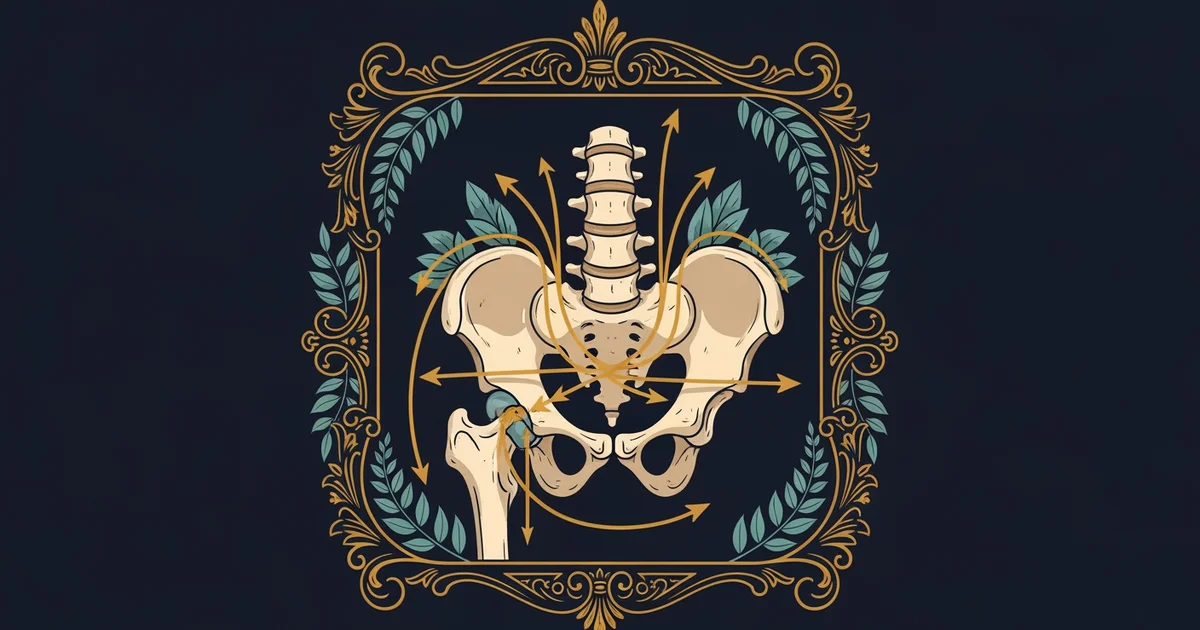
The Mechanics of Human Stability
Gravity acts upon every part of your frame by pulling mass toward the center of the earth. To remain standing, your muscles must exert internal tension that balances this downward acceleration. Think of your skeleton like a tall tower built with rigid beams and flexible cables representing your bones and muscles. If the center of mass moves outside your base of support, the structure will naturally begin to tip over. Your brain constantly monitors your posture by adjusting muscle tone to keep your balance within safe limits. This process happens automatically so you can focus on your surroundings instead of your feet.
Key term: Center of mass — the unique point where the weight of an object is evenly distributed in all directions.
When you move, these forces change rapidly as your body shifts its weight from side to side. Your joints act as pivots that allow for rotation, while your muscles act as engines that provide force. These components work together to manage the momentum generated during each step you take across the ground. If you walk on a slippery surface, your brain must calculate the friction needed to prevent sliding. This constant adjustment shows that human movement is a sophisticated series of physical calculations performed in real time.
Balancing Internal and External Forces
Your bones serve as the primary structure that resists compression while your muscles resist the pull of gravity. The way these parts interact determines your physical limits during daily tasks like lifting heavy objects. If you lift a box, you create a lever system where your joints act as the fulcrum. The force required depends on the distance between the load and your joint, which follows standard mechanical principles. Efficiency improves when you keep the load close to your body to minimize the torque on your spine.
Different types of tissues handle these mechanical stresses in unique ways to keep your body functioning properly:
- Bones provide a rigid framework that resists compression and supports the weight of your entire body structure.
- Muscles generate active force by contracting to move your skeleton or to maintain a static upright position.
- Ligaments act as strong stabilizers that connect bones together to prevent excessive motion at your various joints.
These tissues rely on specific properties to ensure your body remains intact during intense physical activity or exercise. By analyzing these interactions, you can understand how physics defines the structural boundaries of your physical capabilities. The following table outlines how different structures respond to the forces you encounter during your typical daily routine.
| Structure | Primary Function | Response to Force |
|---|---|---|
| Bones | Structural support | Resists compression |
| Muscles | Force generation | Active contraction |
| Ligaments | Joint stability | Passive tension |
By studying these basic interactions, you gain a clearer picture of how your body manages physical reality. This path will eventually reveal how energy moves through your systems to power every single movement you make. You are learning the fundamental rules that govern how biological structures interact with the physical world around them.
The human body functions as a complex mechanical system that constantly balances internal forces against the external pull of gravity to maintain stability.
By mastering these foundational forces, you will soon explore the deeper energy transfers that fuel your cells and drive biological motion.