
Passing Concept Spacing
Imagine you are trying to exit a crowded stadium through a single narrow door. If everyone crowds into the same exit, the flow of people slows down to a crawl. Football offenses face this exact problem when they design passing plays. If two receivers run routes into the same area, they effectively guard each other for the defense. Successful passing relies on smart spacing to force defenders to make impossible choices. By spreading the field, an offense creates open windows that allow for easy completions against zone coverage.
The Geometry of Field Coverage
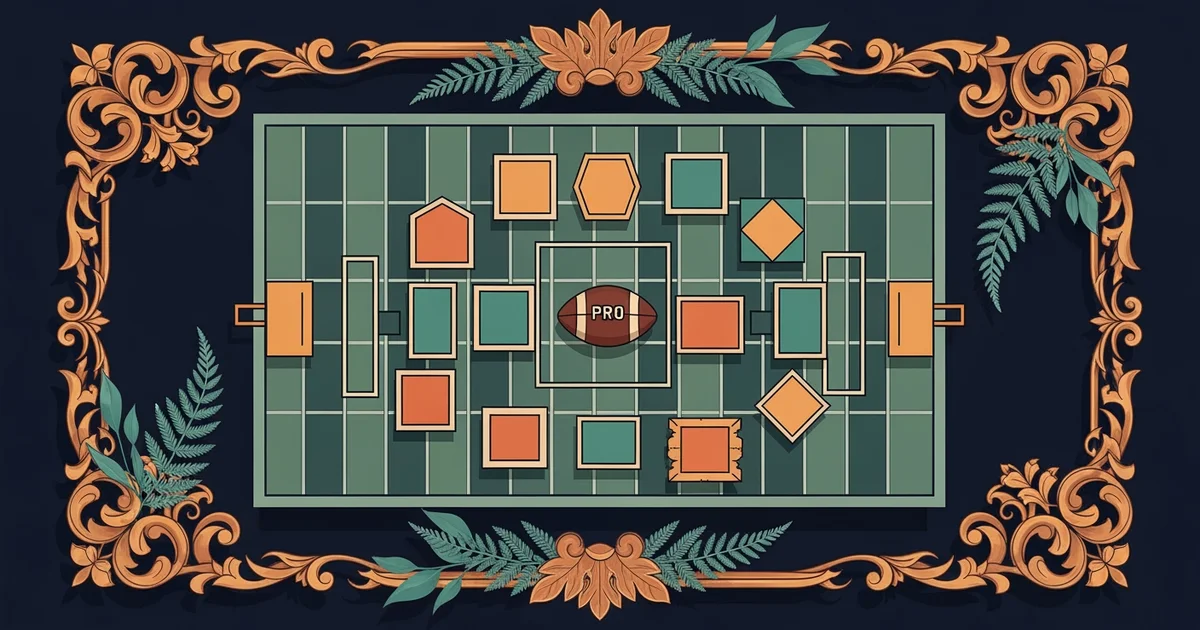
Offensive coordinators treat the football field like a grid that requires constant management. Each player on the field occupies a specific zone that defenders must cover during a play. When receivers run routes, they must move into spaces that pull defenders away from one another. This creates a geometric advantage where the offense has more targets than the defense has bodies. Think of this like managing a retail store with limited staff members. If you place all your products in one corner, your employees only need to watch that single area. If you spread your products across the entire store, your employees must constantly run back and forth to monitor everything. This movement creates gaps in coverage that savvy quarterbacks exploit for big gains.
Key term: Spacing — the deliberate placement of offensive players across the field to stretch defensive coverage and create open lanes.
Effective spacing requires that every route serves a specific purpose in the overall design. Some routes act as clearing agents to pull defenders deep or toward the sidelines. Other routes occupy the space left behind by those clearing actions. If a receiver runs a deep post, he forces the safety to retreat toward the goal line. This movement opens up a shallow crossing lane underneath for a teammate. Without this coordinated movement, the defenders would remain stationary and clog the passing lanes. The offense must force the defense to move because stationary defenders are much harder to beat.
Maximizing Route Distribution
To achieve optimal results, offensive playbooks use specific route combinations that maximize field coverage. These combinations ensure that all levels of the defense remain under constant pressure. The following table outlines how different route depths interact with common defensive zones:
| Route Depth | Primary Objective | Defensive Impact |
|---|---|---|
| Shallow | Quick completion | Forces linebackers to react |
| Intermediate | Moving the chains | Stretches the zone gaps |
| Deep | Stretching the field | Pulls safeties away from center |
Coordinators must ensure that these routes do not overlap at any point during the play. If a shallow route and an intermediate route occupy the same vertical line, one defender can cover both players easily. This is a failure of logic known as route crowding. To prevent this, players must maintain consistent distance from each other throughout their routes. When players respect this spacing, they force the defense to choose between two open targets. One defender cannot cover two areas at once, which mathematically guarantees that one receiver will remain open for the ball.
- Clear-out routes force defenders to run away from the intended target area by threatening the deep zones of the field.
- Flood concepts involve three receivers attacking three different levels of the same zone to overwhelm the local defender.
- Spacing routes require receivers to find the soft spots between zone defenders by sitting down in open gaps.
By layering these routes, the offense creates a mathematical problem that the defense cannot solve. The quarterback simply identifies which defender is out of position and delivers the ball to that spot. This systematic approach turns a chaotic game into a predictable series of logical outcomes. When the offense executes these concepts with precision, the defense becomes reactive rather than proactive. This shift in control is the ultimate goal of any well-designed passing attack on the field.
Strategic spacing forces defenders to choose between multiple open targets by stretching their coverage capacity across the entire field.
But what does it look like when we move from simple spacing to more complex setups that trick the defense?