
Spread Offense Logic
Imagine you are trying to guard a room full of people while standing in the very center. If everyone stays clustered in a tight group near you, guarding them is easy because you only need to watch one small area. If those same people suddenly scatter to the far corners of the room, your ability to watch them all at once becomes impossible. This simple spatial problem defines the primary logic behind how modern football teams attack a defense.
Horizontal Spacing and Defensive Geometry
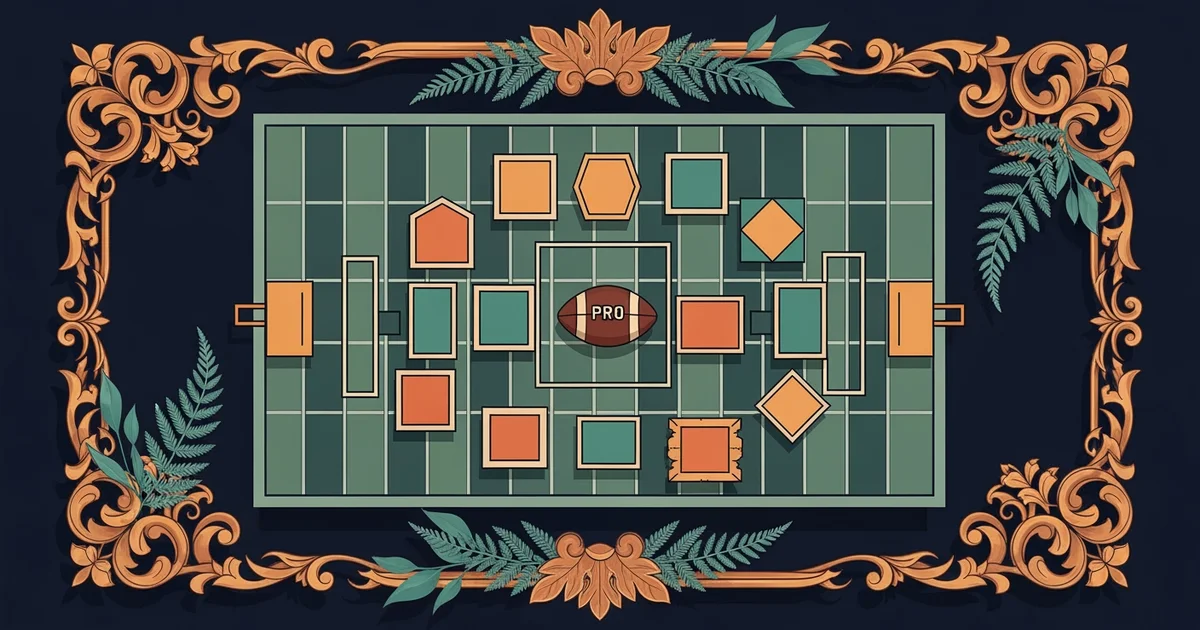
When an offense uses a spread offense, they align their players across the entire width of the field. By moving receivers and running backs away from the quarterback, the offense forces the defense to make a difficult choice. The defenders must decide whether to stay near the middle to stop runs or move wide to cover the receivers. This choice creates a mathematical dilemma for the defensive coordinator. If the defense stays compact, they leave the outside edges vulnerable to quick passes. If they move to cover the edges, they create gaps in the middle of the field for the offense to exploit. The total area the defense must protect increases as the offense spreads out its players.
Key term: Spread offense — a formation designed to stretch the defense horizontally by positioning players across the full width of the field.
By increasing the horizontal distance between players, the offense forces defenders to cover more ground. This creates a situation where the defense cannot rely on extra help from nearby teammates. In a tight formation, a defender might have support from two or three others nearby. In a spread formation, that same defender is often left alone on an island. This isolation makes it much easier for an offensive player to win a one-on-one battle. The offense uses this geometry to identify which defender is the weakest link in the coverage scheme.
The Logic of Defensive Stretching
Once the players are spaced out, the offense can use simple logic to find the open area. The defense has a finite number of players to assign to specific zones or individuals. When the offense forces these defenders to move far apart, the gaps between them grow larger. The quarterback uses this visual information to decide where to throw the ball before the play even starts. If the defense pulls two players to one side, the other side will naturally have fewer defenders. This is a classic example of balancing a scale where adding weight to one side removes it from the other.
| Defensive Strategy | Effect on Field Coverage | Risk to the Defense |
|---|---|---|
| Tight Alignment | Strong interior defense | Vulnerable to outside passes |
| Wide Alignment | Strong perimeter defense | Vulnerable to interior runs |
| Balanced Coverage | Moderate overall defense | Vulnerable to quick mismatches |
This table shows how defensive choices create predictable weaknesses based on alignment. The offense observes these shifts and adjusts their play call to attack the most vulnerable zone. It is a game of shifting resources to create a numerical advantage at the point of attack. If the offense can force the defense into a disadvantageous alignment, they have already won half the battle before the ball is even snapped. Logic dictates that the side with more space and fewer defenders will have the highest probability of success on any given play.
Strategic horizontal spacing forces defenders to choose between guarding wide areas or protecting the middle, creating exploitable gaps for the offense.
The next Station introduces shotgun vs under center, which determines how these spread formations influence the timing of the quarterback's movements.