
The Geometry of the Gridiron
Imagine you are trying to move a heavy desk through a narrow doorway while holding several boxes. You must position your body and the items to create the most efficient path forward. Football teams face a similar challenge when they organize players on the field to gain ground against a defense. Every player acts as a coordinate on a giant grid, and their placement dictates how much space they can control. By spreading players across the field, an offense forces the defense to cover more ground than they can handle. This simple spatial logic turns a game of physical strength into a complex puzzle of geometry.
The Spatial Logic of Offensive Sets
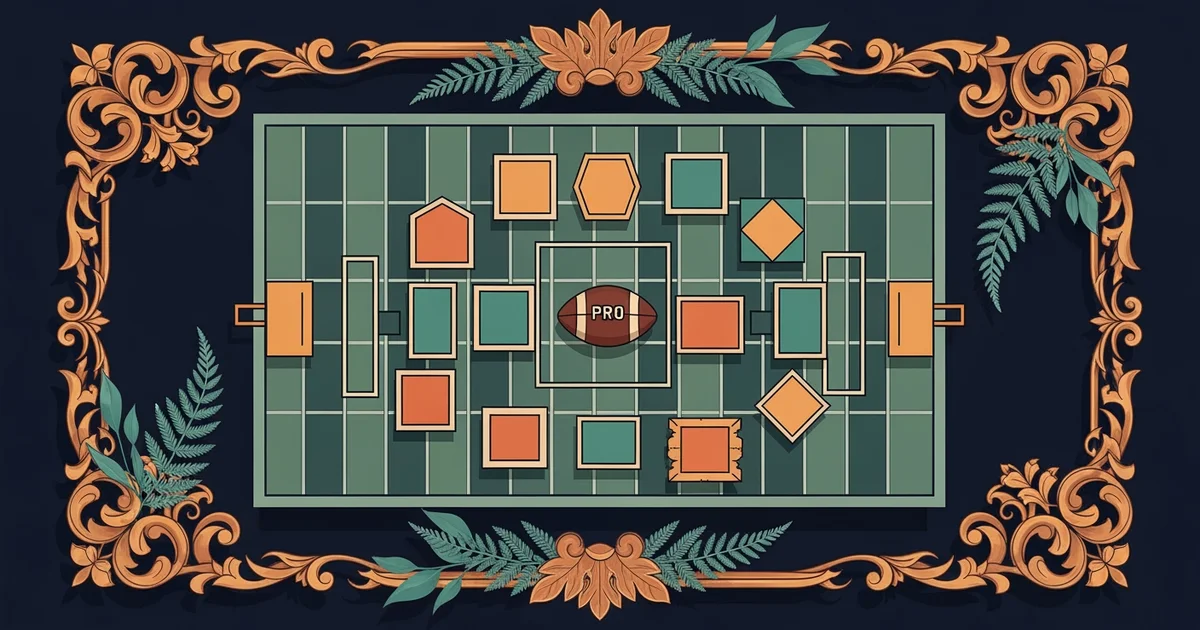
When an offensive team lines up, they form a formation to dictate the starting positions of their players. This layout acts like a blueprint for the play, ensuring that every person knows their specific area of responsibility. If players stand too close together, the defense can easily crowd the area and stop the movement. By spacing out receivers and running backs, the offense creates gaps that the defense must choose to cover. Think of this like a shop owner arranging items on shelves to guide customers through the store. If the items are spread out, the customers walk past more products and spend more time looking at the inventory. An offense uses this same principle to stretch the defensive players across the entire width of the field.
Key term: Formation — the specific arrangement of players on the field before the ball is snapped to begin a play.
Strategic placement allows the offense to manipulate the defensive geometry by forcing defenders to commit to specific zones. If the offense places a fast player on the far edge of the field, the defense must send a player to guard that spot. This requirement removes that defender from the middle of the field where the ball might travel. The offense effectively uses space as a weapon to isolate defenders and create favorable matchups for their teammates. Every inch of distance gained by spreading the field makes the defense work harder to maintain their structural integrity. When the defense is stretched thin, they are more likely to make mistakes or leave open lanes.
Roles and Responsibilities in the Grid
Every player within an offensive set occupies a unique role that contributes to the overall success of the play. These roles are defined by their position relative to the line of scrimmage, which is the imaginary line where the ball rests. Some players act as blockers to provide protection, while others function as targets to catch the ball. The specific responsibilities are outlined in the following table to show how different roles interact within the team structure:
| Player Role | Primary Function | Spatial Focus |
|---|---|---|
| Offensive Line | Provide protection | Interior space |
| Wide Receiver | Stretch the field | Exterior space |
| Running Back | Carry the ball | Dynamic space |
By assigning these specific roles, the coach ensures that the team covers all necessary areas of the field. The offensive line stays tight to create a wall, while receivers move wide to pull defenders away from the center. This division of labor allows the offense to attack multiple points at once. If the defense focuses on the interior, the receivers find open space on the outside. If the defense moves wide to stop the receivers, the running back finds room to move through the middle. This constant tension between the offense and defense creates the dynamic flow of the game.
Understanding these spatial relationships provides the foundation for every strategy you will encounter in this path. You will learn how to read these patterns to predict where the ball will go next. By mastering these concepts, you gain a professional perspective on how logic and geometry shape the outcome of every drive.