
Degenerative Joint Disease
Imagine you are walking through a busy city on a pair of very old, worn-out shoes. Just as the soles of those shoes thin out from constant friction against the hard pavement, the joints in a human skeleton face a similar fate over a long lifetime. This process is known as degenerative joint disease, or more commonly, osteoarthritis. When archaeologists examine ancient remains, they look for specific patterns of bone wear that tell a story about how people lived, worked, and moved across their environment. By studying these skeletal markers, we can infer the daily activities that defined life for these past populations.
Understanding Skeletal Wear Patterns
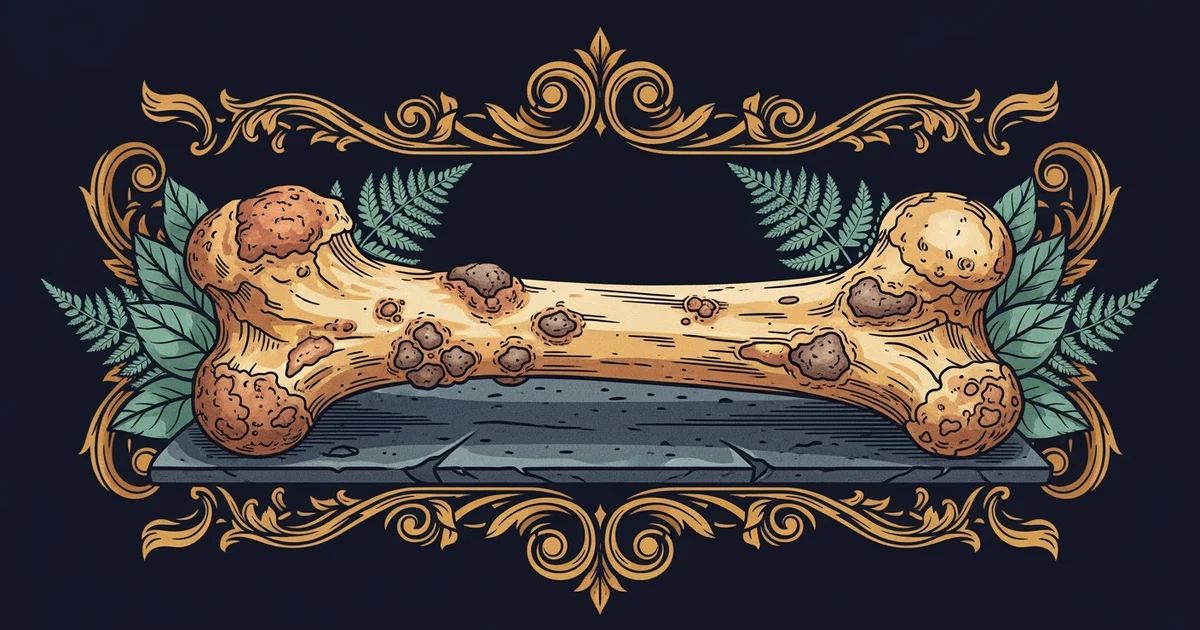
When we analyze ancient bones, we are essentially reading a permanent record of physical stress. Joints are designed to glide smoothly because they are covered in cartilage, which acts like a shock absorber between two moving bones. Over time, heavy use or repetitive motions can cause this protective layer to break down completely. When the cartilage wears away, the bones begin to rub directly against each other. This friction triggers the body to respond in a way that leaves a visible mark on the bone surface. These marks reveal which joints were under the most pressure during a person’s life.
Key term: Eburnation — the process where bone surfaces become polished and smooth like ivory because the protective cartilage has worn away completely.
This physical response to stress is quite predictable. As the cartilage disappears, the underlying bone becomes denser and harder to compensate for the lost cushion. In some cases, the bone might grow extra edges or small bumps, which are often called osteophytes. These changes are not random accidents but are direct results of chronic mechanical loading. If a specific joint shows significant signs of this wear, we can often correlate that damage with the types of labor that were common in that specific culture.
Interpreting Activity Through Joint Damage
To understand how these patterns form, consider the analogy of a heavy factory machine that operates for decades without proper maintenance. If that machine only performs one specific motion, such as lifting heavy crates, the gears involved in that motion will degrade much faster than the others. Similarly, if an ancient person spent their entire life grinding grain with a heavy stone tool, the joints in their wrists and shoulders would show distinct patterns of degradation. This specific type of wear provides evidence of the repetitive tasks that were essential for survival in their community.
We categorize these skeletal changes by looking at three main indicators of joint health:
- Joint surface porosity: Small pits appear on the bone surface when the protective layer is compromised, indicating that the bone is reacting to increased friction and inflammation.
- Osteophyte formation: The body attempts to stabilize a failing joint by growing extra bone spurs along the edges, which effectively limits the range of motion to prevent further damage.
- Bone eburnation: This occurs when the surfaces are so worn that they rub together, creating a shiny, polished appearance that indicates the total loss of the cartilage cushion.
By comparing these signs across different joints, researchers can map out the physical history of a person. For example, if we see heavy wear in the knees and lower back, we might conclude that the individual frequently carried heavy loads over long distances. If the wear is concentrated in the hands, it suggests a life centered on craft production or intensive food processing. These findings help us reconstruct the daily labor patterns of people who left no written records behind. Understanding how these joints failed gives us a window into the physical challenges that shaped human societies throughout history.
Degenerative joint disease serves as a biological archive that records the cumulative impact of repetitive mechanical stress on the human skeleton.
The next Station introduces microscopic bone analysis, which determines how chemical signatures inside the bone reveal dietary habits and migration patterns.