
Infectious Disease Signatures
When a person studies ancient bones, they often find strange holes or rough patches that do not belong on healthy skeletons. These physical marks act like a diary that records the long battle between a human body and a persistent germ. Just as a heavy storm leaves lasting damage on a coastal cliff, chronic infections carve permanent signatures into the very structure of human bone. By examining these patterns, researchers can reconstruct how past societies managed the silent spread of illness.
Understanding Skeletal Lesions
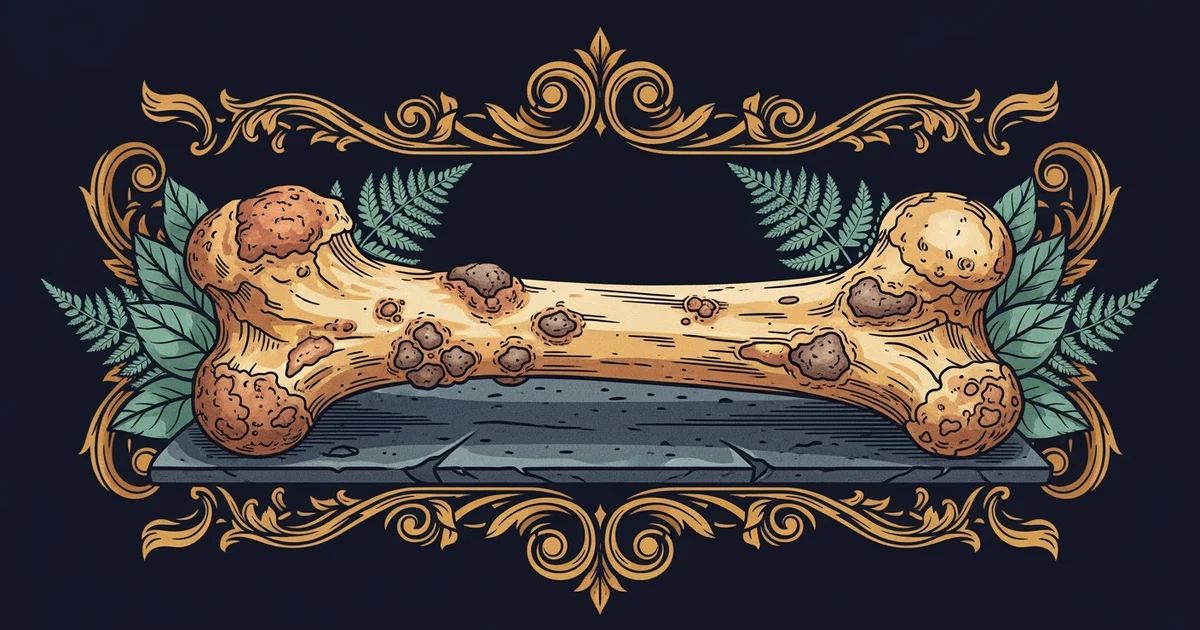
To identify these signatures, one must first understand how bone tissue reacts to a long-term visitor like a bacterium. Bone is a living material that constantly remodels itself through a cycle of breaking down and building up. When a chronic infection like tuberculosis takes hold, the body tries to wall off the invading germs by creating a protective layer of new bone. This process often leaves behind small pits or areas of abnormal, porous growth that look like lace. These markers remain visible for thousands of years, providing clear evidence of a disease that lasted for many months or even years during an individual's lifetime.
Key term: Lesion — a localized area of abnormal tissue damage or structural change on a bone caused by disease or injury.
Think of the bone as a sturdy bank vault that keeps records of every transaction. When an infection enters the body, the immune system acts like a frantic clerk trying to repair the vault while a thief is still inside. The clerk leaves behind messy patches of extra metal and jagged dents as they work to seal the doors. Because the infection is chronic, the clerk never finishes the job perfectly. These messy repairs are exactly what scientists look for when they examine remains from centuries ago to determine if a person suffered from a specific illness.
Identifying Specific Diseases
While many infections leave a mark, certain diseases create patterns that are unique to their specific bacterial behavior. For instance, the bacteria responsible for leprosy tend to attack the small bones of the hands, feet, and the face. Over time, the infection causes the bone to slowly disappear or reabsorb, leading to a visible shortening of the fingers or toes. This specific pattern of bone loss is a telltale sign that helps experts distinguish one type of chronic infection from another. By comparing these markers, researchers can map the movement and impact of different diseases across human history.
| Disease | Primary Bone Impact | Visual Characteristic |
|---|---|---|
| Tuberculosis | Spine and joints | Porous, lace-like bone |
| Leprosy | Hands, feet, face | Bone loss or shortening |
| Syphilis | Skull and shins | Thick, rough bone growth |
The table above shows that different pathogens leave distinct signatures on the skeleton. Scientists use these differences to narrow down the cause of death or the chronic health issues of ancient people. By identifying these markers, we learn that infectious disease was not just a modern problem but a constant companion throughout our long history. These skeletal clues allow us to understand how our ancestors lived, suffered, and eventually adapted to the threats in their environments.
Ancient skeletal remains act as permanent biological archives that reveal the presence and long-term impact of chronic bacterial infections through distinct physical signatures.
The next Station introduces nutritional stress markers, which determine how food scarcity impacts bone development.