
Urban Infrastructure Systems
When you flip a light switch or turn on a faucet, you rarely think about the vast machine operating beneath your feet. A city functions much like a living organism that requires constant energy and hydration to survive the day. Every building in your neighborhood acts as a cell within this larger body, drawing resources through a complex network of pipes and wires. This infrastructure remains invisible until a storm or a power failure reminds you of your total dependence on it. Understanding these systems reveals how engineers manage the flow of resources to keep millions of people living in close proximity.
The Architecture of Utility Networks
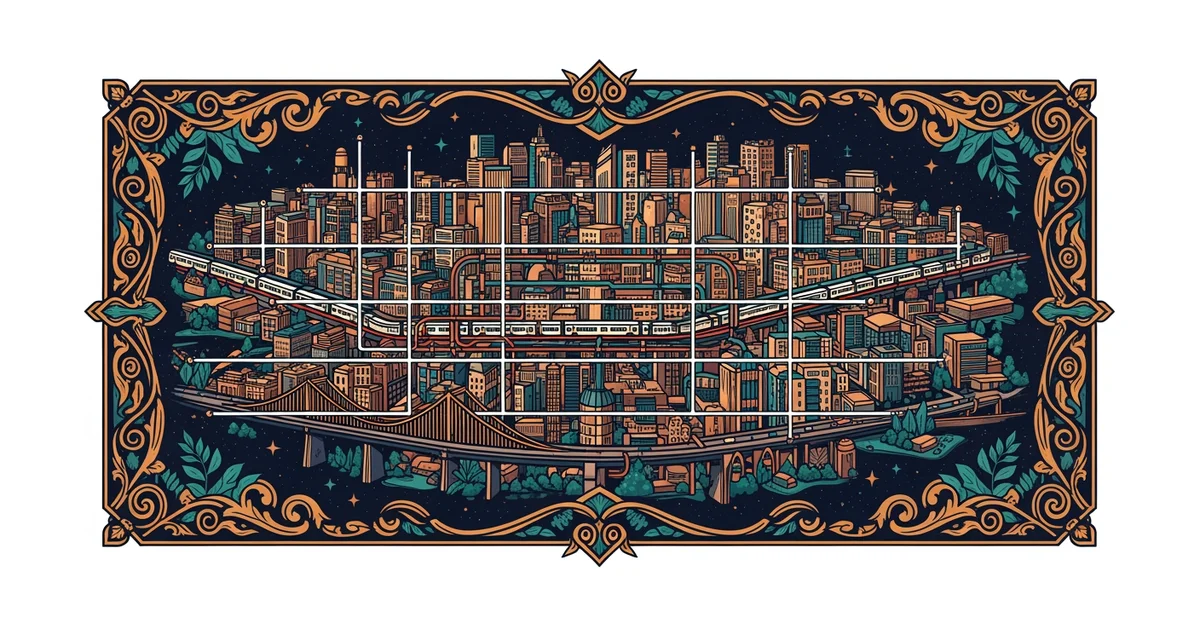
Modern cities rely on urban infrastructure to distribute vital resources across dense environments. These networks function as the circulatory system of a metropolis, moving water, electricity, and data to every corner of the grid. Think of the city as a massive kitchen where the main water line is the supply pipe and every individual apartment is a separate faucet. If the pressure drops in the main line, every faucet in the building loses its flow immediately. This interconnected design ensures that resources reach high-density housing and commercial zones without requiring every building to generate its own power or collect its own rain. Engineers must carefully calculate the capacity of these pipes to prevent overflows during heavy usage hours.
Key term: Urban infrastructure — the physical systems and structural networks that support the daily operations of a city and its population.
Water management requires a dual system to keep the environment safe and clean for all residents. Fresh water enters through pressurized pipes to provide drinking and sanitation services for the entire population. Once that water is used, it travels through a separate network of sewer lines to a treatment facility. This process mimics the way human veins and arteries work together to cycle blood through the body. Without this closed-loop system, cities would quickly become uninhabitable due to the buildup of waste and the lack of clean water. The design of these pipes must account for gravity to ensure that waste flows away from homes without needing excessive pumping.
Powering the Modern Metropolitan Grid
Electrical systems represent the most complex part of the city because electricity cannot be easily stored in large amounts. The power grid must generate exactly the amount of energy that users demand at any given second. When people turn on their air conditioners on a hot afternoon, the grid must instantly increase production to meet the sudden spike in load. This process involves a delicate balance of distribution substations that step down high voltages into levels safe for home use. If the supply fails to match the demand, the entire system can become unstable and lead to widespread blackouts.
To manage these complex flows, engineers monitor several critical components within the city:
- The distribution network uses transformers to lower voltage levels so that residential wiring does not melt under high current loads.
- Water treatment plants utilize chemical filtration and biological processes to remove contaminants before the water reaches the public tap system.
- Stormwater management systems employ large underground tunnels to divert floodwaters away from critical infrastructure during heavy seasonal rain events.
Maintaining these systems requires constant upgrades as the population grows and the demand for energy increases. Older cities often struggle with aging pipes and wires that were never designed to support modern technology. Replacing this infrastructure is expensive and disruptive because it often requires digging up major roads and interrupting daily traffic. However, failing to maintain these systems leads to frequent service outages and potential health risks for the residents. City planners must balance the need for immediate repairs with the long-term goal of building a more resilient and sustainable urban environment.
Reliable city life depends on the seamless integration of invisible utility networks that balance resource supply with the ever-changing demands of a dense population.
But what happens when too many people move into a small space and these systems begin to reach their limits?
Want this with sources you can check?
Premium Learning Paths for Earth Sciences & Geography are researched against open-access libraries — PubMed, arXiv, government databases, and more — with their distinctive claims cited to real sources and independently checked.
See what Premium includes