
Sector and Nuclei Patterns
Imagine you are building a vast city from scratch on a flat, empty piece of land. Would you place all the factories next to the houses, or would you keep them in their own separate zones? Most modern cities do not grow in simple rings, but instead follow complex patterns that shift based on land value and transport access. These patterns dictate where you live, where you work, and how much time you spend in traffic every single day.
Sector and Nuclei Patterns
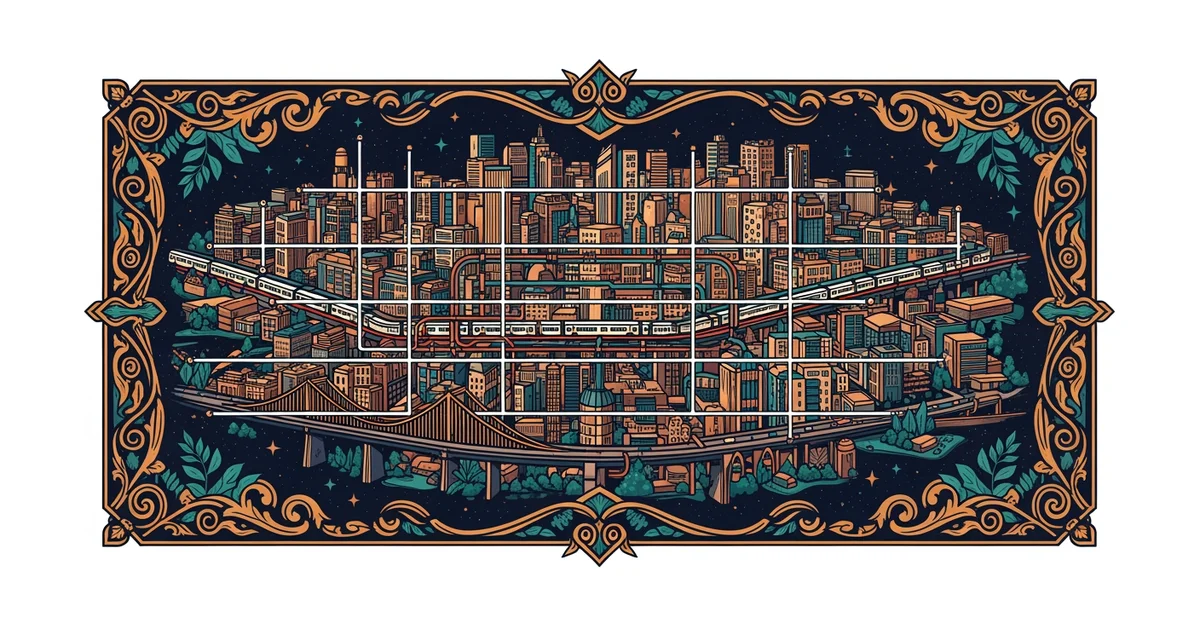
When planners look at how cities develop, they often notice that growth follows specific sector patterns that push outward along major highways or rail lines. Instead of expanding in perfect circles, a city might stretch its industrial districts along a river or a major road. This creates wedge-shaped zones that radiate from the center like slices of a pie. High-income housing often pushes outward in one direction, while low-income housing stays near the factories to minimize the commute for workers. This structure happens because businesses and residents compete for the most accessible land near the city core.
Key term: Sector model — a theory of urban development where land use grows in wedges radiating outward from the central business district along transportation routes.
As the city expands, the pressure for space creates a different arrangement known as the multiple nuclei model. This concept suggests that cities have many centers of activity rather than just one single downtown area. Think of a city like a large shopping mall that has several major anchor stores scattered at different corners. Each anchor store draws its own crowd and creates a mini-hub of activity around it. A university might form one nucleus, while a high-tech business park forms another, and a heavy industrial zone forms a third.
These centers operate independently but influence the growth of the surrounding neighborhoods in unique ways. A hospital district will attract medical offices and pharmacies, creating a specialized cluster of services that does not rely on the main downtown core. This decentralized approach allows cities to grow larger without forcing everyone to travel to the same central point every morning. By spreading out these hubs, the city functions more like a collection of smaller towns that are stitched together into one large urban landscape.
To better understand how these two growth models differ in their spatial organization, consider the following points of comparison regarding their development:
- Sector growth relies on the expansion of existing wedges, meaning that a neighborhood usually stays the same type of land use as it moves further from the city center.
- Multiple nuclei growth depends on specialized centers, which means that different activities like education, retail, and manufacturing can exist in separate pockets across the entire metropolitan area.
- Both models recognize that land value determines location, as businesses that need high visibility will always pay more to occupy the most central or accessible land parcels.
| Feature | Sector Model | Multiple Nuclei Model |
|---|---|---|
| Growth Pattern | Wedge-shaped zones | Scattered activity hubs |
| Primary Driver | Transport corridors | Specialized land use |
| City Center | Single downtown core | Multiple independent nodes |
These models show that cities are dynamic systems that adapt to the needs of the people living within them. When a city grows, it must balance the need for efficient movement with the need for specialized space. Understanding these patterns helps planners design better roads and public transit systems that serve these diverse hubs. If we ignore these natural patterns, we end up with cities that feel disconnected and difficult to navigate, leading to wasted time and increased costs for everyone involved.
Cities grow in specialized patterns that reflect how different land uses compete for access and space within an urban environment.
The next Station introduces transportation corridors, which determines how modern infrastructure connects these various urban hubs.