
Global Synthesis
Imagine a global map where every single person is a tiny pulse of light moving across the dark surface. When environmental pressures like rising sea levels or droughts strike, these lights shift toward safer, more stable regions of the planet. This movement is not random, but follows complex patterns driven by the need for survival and better economic security. We must view these patterns as a massive, interconnected system rather than isolated events occurring in distant lands. By synthesizing our knowledge, we see how the human story is constantly rewritten by our physical environment.
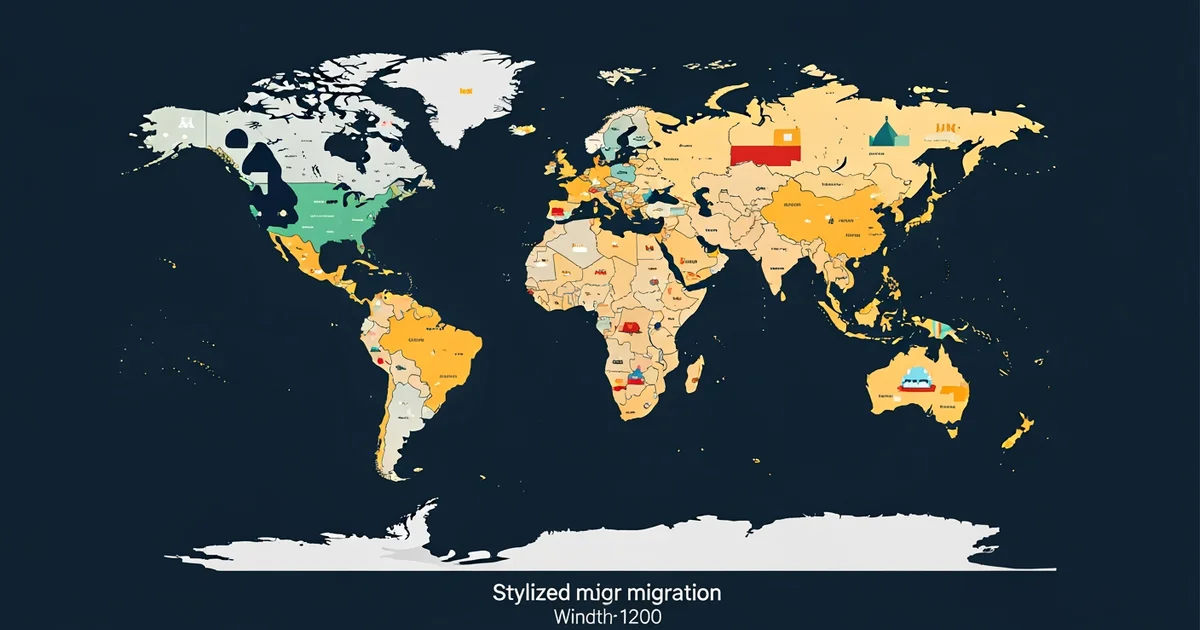
The Interplay of Resource Scarcity and Human Choice
Human migration functions much like a household budget where every decision involves balancing limited resources against future needs. When a family faces a sudden loss of income, they cut back on luxury goods to ensure their basic survival remains intact. Similarly, populations facing severe climate shifts or resource depletion must move to secure their fundamental needs for water and food. This economic analogy helps us understand that migration is rarely a choice of preference but a calculated response to external stress. We see this tension when environmental degradation forces communities to abandon ancestral lands that no longer support their basic agricultural cycles.
Key term: Environmental displacement — the forced movement of people caused by sudden or progressive changes in the environment that negatively impact their lives.
These movements interact with social pressures to create complex outcomes that often surprise local governments and global policy planners. We previously studied how economic opportunities attract workers, but we must now combine that with how environmental risks push those same people away. This dual pressure creates a cycle where the most vulnerable populations are often the first to move when conditions deteriorate. Understanding this synthesis requires us to look at both the pull of new cities and the push of failing ecosystems simultaneously. Without this dual perspective, we fail to grasp the true scale of modern human movement across our changing world.
Global Patterns and the Future of Mobility
We can organize these diverse factors into a clear framework to better visualize why and how populations shift across international borders. The following table highlights the primary drivers that influence the decision-making process for individuals and families facing significant environmental or social instability:
| Driver Category | Primary Factor | Resulting Action | Impact Level |
|---|---|---|---|
| Environmental | Extreme Drought | Rural to Urban | High |
| Social | Job Markets | Urban to Urban | Medium |
| Political | Policy Shifts | Regional Migration | High |
| Infrastructure | Resource Access | Permanent Relocation | Moderate |
These factors do not act in isolation, but they often overlap to create a compounding effect that accelerates the speed of human migration. For instance, a drought might trigger a move to a city, where the lack of jobs then forces a second move across a national border. This process shows that migration is a multi-stage journey rather than a single event. We must recognize that as environmental conditions worsen, the traditional pathways of human movement will likely shift toward more stable, resource-rich zones.
- Initial stress triggers a local search for better conditions within the same home region.
- When local options fail, families seek employment in larger, more stable urban centers.
- International migration becomes the final step when domestic resources cannot meet basic survival needs.
This sequence highlights how human resilience adapts to the changing landscape of our planet. We must acknowledge that the research community still struggles to predict exact migration flows because human behavior is inherently unpredictable. While we can map environmental risks with great precision, the social reaction to those risks remains a subject of ongoing debate. We are witnessing a global transformation where the physical limits of our earth define the boundaries of human possibility. Recognizing this connection allows us to better prepare for a future where mobility becomes a primary strategy for survival and growth.
Human migration is a complex global feedback loop where environmental limitations and social aspirations force populations to continuously seek stability.
Understanding the drivers of human movement provides a roadmap for managing the challenges of our shifting global population.