
Gravity Model Theory
Imagine two cities separated by a vast desert where travel is expensive and quite difficult. You would likely find that fewer people move between these distant, isolated locations compared to two neighboring towns connected by a high-speed train line. This simple observation forms the bedrock of how geographers predict human movement across the globe.
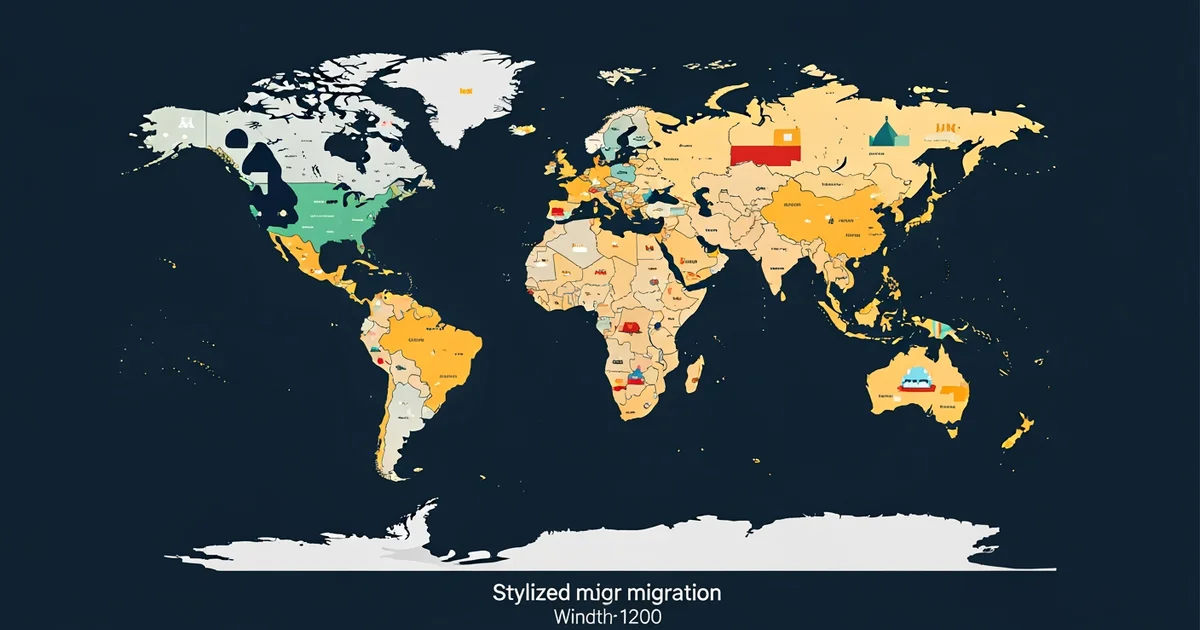
Predicting Population Shifts
When researchers analyze how people relocate, they often rely on the Gravity Model to estimate the volume of migration between two distinct places. This model suggests that the flow of migrants between two locations is directly proportional to their population sizes and inversely proportional to the distance between them. Just as larger planets exert a stronger gravitational pull on nearby objects, larger cities exert a stronger pull on potential migrants. If two cities are both massive, the model predicts a high volume of interaction because both sides have plenty of resources and opportunities to offer. However, the model also accounts for the friction of distance, which acts like a barrier that reduces the likelihood of people moving far away.
Key term: Gravity Model — a mathematical formula used to predict the level of interaction or migration between two places based on their population size and physical distance.
Distance serves as a natural deterrent for most people because moving long distances requires significant financial investment and emotional labor. When you consider the effort required to relocate across a country versus moving to a neighboring suburb, the difference becomes clear. The gravity model treats this distance as a cost that must be overcome for migration to occur. If the distance is doubled, the potential for migration does not just drop by half, but often drops by a much larger margin. This relationship helps planners anticipate how new infrastructure, such as highways or airports, might change the way populations shift over time.
Applying Spatial Interaction
To apply this theory, geographers look at the specific variables that influence the strength of the bond between two regions. Population size represents the total number of potential migrants who might leave a place, as well as the number of available jobs in the destination. The distance variable captures the various costs of travel, including fuel, time, and the social difficulty of leaving one's local community behind. By plugging these figures into a standard equation, analysts can generate a numerical value representing the expected migration intensity. This calculation allows governments to prepare for future growth by predicting where individuals will likely settle based on existing economic centers.
| Variable | Role in Migration | Influence on Movement |
|---|---|---|
| Population A | Origin size | Increases potential flow |
| Population B | Destination size | Increases pull effect |
| Distance | Travel barrier | Decreases interaction |
These factors interact to create a predictable pattern of movement that experts use to model regional development. While the model is a simplification of complex human behavior, it remains a powerful tool for understanding broad demographic trends. It provides a baseline for comparing actual migration data against theoretical expectations. When real-world migration numbers differ significantly from the model, geographers know that other factors, such as cultural ties or political policies, are playing a major role. This helps researchers isolate the specific reasons why people choose to move beyond simple economic necessity.
- Calculate the population pull based on size.
- Determine the physical distance between origin and destination.
- Apply the inverse square law to account for travel costs.
- Compare the resulting value against historical migration trends.
By following these steps, planners can identify which cities are likely to experience rapid growth in the coming decades. This insight is vital for managing urban sprawl and ensuring that resources are distributed efficiently to support rising populations in high-demand areas. Understanding these mechanics helps us see that human movement is not random but follows clear, observable patterns that respond to the forces of size and proximity.
Human migration follows predictable spatial patterns where larger populations attract more people while distance acts as a consistent barrier to movement.
But how do social connections and existing networks influence these gravity-based predictions in the real world?
Want this with sources you can check?
Premium Learning Paths for Earth Sciences & Geography are researched against open-access libraries — PubMed, arXiv, government databases, and more — with their distinctive claims cited to real sources and independently checked.
See what Premium includes