
Global Weather Synthesis
Imagine a giant spinning top that wobbles while it carries a complex network of invisible rivers. These rivers are not made of water but are instead massive currents of moving air. When the sun heats our planet, it does not warm every single region with the same intensity. This uneven heating drives the movement of air across the entire globe in a predictable way. We can think of this process like a massive budget system where heat represents currency. The planet constantly tries to balance its energy accounts by moving heat from hot areas to cold ones. This ongoing circulation creates the weather patterns we experience every single day across different climates.
The Mechanics of Global Heat Exchange
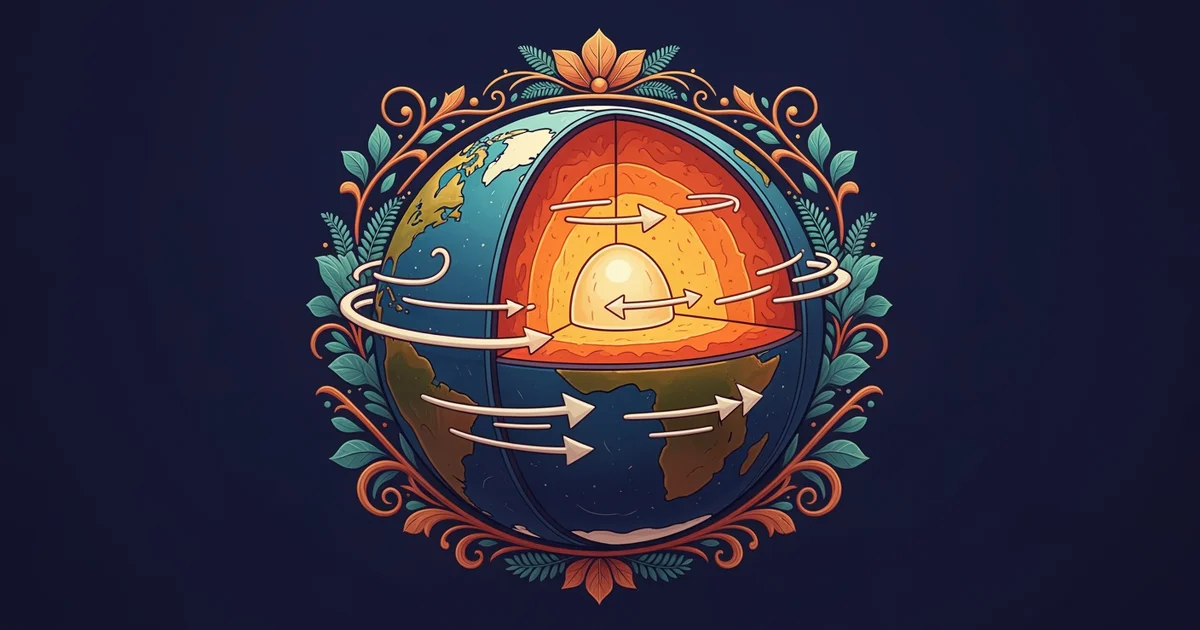
To understand how these winds move, we must look at how energy interacts with the surface of Earth. Warm air near the equator rises because it is less dense than the cooler air above it. As this air rises, it creates a region of low pressure that draws in cooler air from the north and south. Once the air reaches the upper atmosphere, it travels toward the poles where it eventually cools down. This cooling process makes the air denser, causing it to sink back toward the surface of the planet. This cycle forms large, rotating loops known as Hadley Cells that dictate the climate of the tropics.
Key term: Hadley Cells — the large-scale atmospheric circulation patterns that move warm air from the equator toward the subtropics.
These cells are not the only players in this global game of heat distribution. Further away from the equator, other circulation cells take over to push air toward the polar regions. These cells act like a series of gears in a giant clock that are all connected to one another. If one gear changes its speed or direction, the entire system must adjust to maintain balance. This interconnected nature means that a change in tropical heat can eventually alter weather patterns in temperate zones. The way these systems interact shows how our climate is a unified global machine rather than a collection of isolated events.
Mapping the Patterns of Air Circulation
We can organize these circulation patterns into a clear structure to see how they influence our local environment. The following list describes the three primary layers of global air movement that keep our planet habitable:
- The tropical cell moves warm air upward at the equator and pushes it toward the subtropical regions where it cools. This process creates the lush rainforests near the equator and the dry deserts located at roughly thirty degrees latitude.
- The mid-latitude cell functions like a secondary gear that captures air from the tropical cell and moves it toward higher latitudes. It creates the shifting weather systems that bring rain and storms to temperate regions during the changing seasons.
- The polar cell acts as the final stage of the energy transfer process by forcing cold, dense air toward the equator. This movement ensures that the frigid air from the poles does not stay in one place but instead mixes with warmer air.
These circulation patterns interact with the rotation of our planet to create the prevailing winds we study in geography. The rotation causes the air to curve as it moves, a phenomenon that complicates the simple path of heat. Because of this curve, the winds do not travel in straight lines from the poles to the equator. This interaction between heat and rotation defines the unique climate zones we observe on our maps today. Understanding this system allows us to see how invisible forces shape the living conditions of every creature on Earth.
The global climate is a self-regulating system that constantly moves heat energy through atmospheric currents to maintain a balance across the planet.
Now that we understand how these currents circulate, we will examine how scientists use this data to predict the future of our changing climate.