
Ferrel and Polar Cells
Imagine you are standing on a giant, spinning carousel that tilts and shifts its speed as you move from the center toward the outer edge. Air currents on our planet behave in a similar fashion, moving heat away from the equator through large, invisible loops that dictate our weather. While the Hadley cells handle the tropical heat near the middle of the globe, the rest of the world relies on two other systems to keep the temperature balanced. Without these massive air movements, the regions near the poles would freeze solid, while the mid-latitudes would experience extreme, unlivable heat waves every single year.
The Mechanics of Mid-Latitude Air
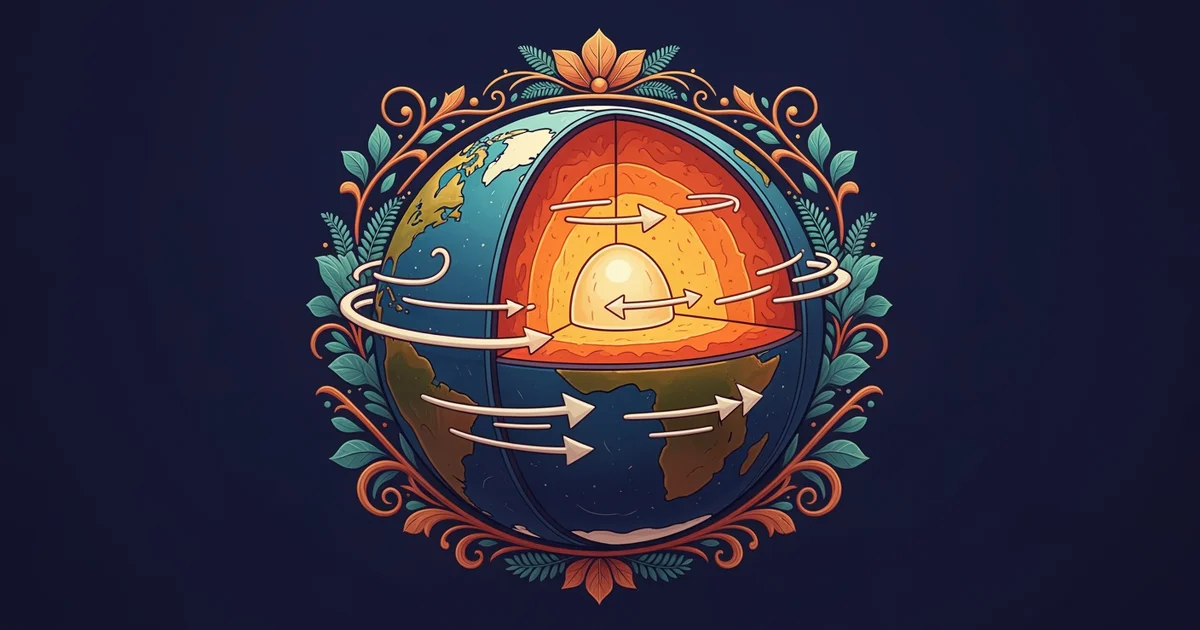
Because the Earth rotates, air does not simply flow in a straight line from the equator to the poles. The Ferrel cell acts like a giant gear in a mechanical clock, spinning in the opposite direction of the cells next to it. This middle system sits between thirty and sixty degrees latitude, where it pulls air toward the poles at the surface. As this air moves, it picks up moisture and heat from the oceans, which helps to create the unpredictable weather patterns we see in temperate zones. Think of this system like a conveyor belt in a busy factory that moves goods in a loop, but because the belt is flexible, the goods often shift and swirl rather than moving in a perfect, straight line.
Key term: Ferrel cell — a mid-latitude atmospheric circulation pattern that moves air toward the poles at the surface while creating complex, swirling weather systems.
This middle cell is unique because it is not driven by temperature alone, but rather by the movement of its neighbors. It essentially gets pushed along by the Hadley cell on one side and the polar cell on the other. This creates a zone of constant turbulence, where cold air from the north often clashes with warm air from the south. The result is a series of storms that travel across the globe, bringing rain and snow to millions of people living in these temperate regions. Without this specific gear in the global climate machine, the mid-latitudes would lack the moisture transport needed to support life and agriculture in many parts of the world.
Polar Dynamics and Global Balance
Moving further north or south, we encounter the polar cell, which serves as the final cooling stage for the planet’s energy. At the very top and bottom of the Earth, cold air sinks toward the surface because it is dense and heavy. This sinking air creates high-pressure zones that push surface winds away from the poles and toward the mid-latitudes. This process is essential for dumping excess cold air into the global system, which prevents the poles from becoming infinitely cold while warming the temperate regions nearby. The cycle is a delicate dance of energy exchange that keeps the entire biosphere within a habitable range for plants and animals.
To understand how these cells compare, consider the following table regarding their primary movement and location:
| Circulation Cell | Latitude Range | Primary Air Flow | Role in Climate |
|---|---|---|---|
| Hadley | 0 to 30 Degrees | Tropical Rising | Heat transport |
| Ferrel | 30 to 60 Degrees | Mid-latitude Swirl | Weather systems |
| Polar | 60 to 90 Degrees | Polar Sinking | Cold regulation |
These three cells work together to form a continuous chain of energy transfer across the entire surface of the planet. If one cell were to stop moving, the others would immediately struggle to maintain the balance of heat and moisture that we currently enjoy. The polar cell, specifically, acts as the exhaust vent for the planet, releasing the coldest air into the lower latitudes to maintain a stable global temperature. By understanding how these cells connect, we can see why weather patterns move in such predictable, yet complex, ways across our continents.
The Ferrel and polar cells distribute heat and moisture by creating a series of interconnected atmospheric gears that drive global weather patterns.
The next Station introduces the role of water vapor, which determines how these circulation cells carry energy across the planet.