
The Coriolis Effect Explained
Imagine you are throwing a ball to a friend on a spinning merry-go-round. While the ball travels in a straight line, your friend moves away from the target spot before the ball arrives. This simple movement shows how rotation changes the path of objects moving across a surface. On our planet, this same principle dictates how air flows across the globe. We call this phenomenon the Coriolis effect, and it acts as a silent force shaping our weather systems. Without this invisible influence, our winds would move in simple lines between hot and cold zones. Instead, they twist and turn into the complex patterns we see on global satellite maps.
The Mechanics of Planetary Rotation
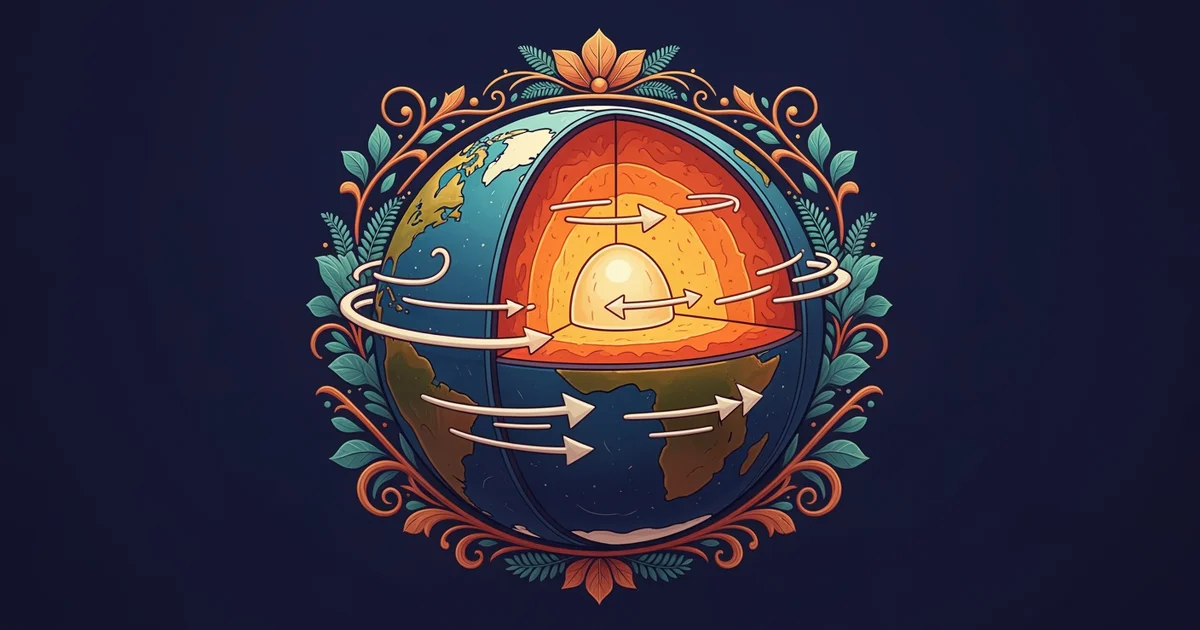
Because Earth spins on its axis once every twenty-four hours, different parts of the planet move at different speeds. Points near the equator travel much faster than points located near the poles. This speed difference happens because the circumference of the planet is largest at the equator. When air moves from the equator toward the poles, it carries its fast eastward momentum with it. This creates a fascinating mismatch between the air and the ground below it. As the air moves over slower-moving land, it appears to curve away from its original path. This perceived deflection is the core of how the atmosphere organizes its global circulation patterns.
Key term: Coriolis effect — the apparent deflection of moving air or water caused by the rotation of the Earth beneath the object.
To visualize this, consider a pilot flying a plane from the equator toward the north. The pilot aims for a city located directly north of the starting position. However, the Earth rotates eastward underneath the plane while it is in the air. By the time the plane reaches the target latitude, the city has moved toward the east. To an observer on the ground, the plane seems to have veered toward the right. This happens because the plane maintains its original eastward speed while the ground beneath it slows down. This deflection is a constant reality for every moving air mass on our planet.
Deflection Patterns Across Hemispheres
Understanding the direction of this curve requires looking at which hemisphere the air occupies. In the Northern Hemisphere, moving objects always veer toward the right of their intended path. This rightward turn creates the famous spinning motion seen in large storm systems like hurricanes. Conversely, air in the Southern Hemisphere experiences a deflection toward the left of its intended path. This opposite direction explains why storm systems rotate clockwise in the south while they rotate counter-clockwise in the north. These distinct rules ensure that global wind belts maintain their predictable and stable paths across the year.
| Hemisphere | Deflection Direction | Typical Storm Rotation |
|---|---|---|
| Northern | Toward the right | Counter-clockwise |
| Southern | Toward the left | Clockwise |
| Equator | Zero deflection | None |
This table summarizes how rotation influences wind behavior across the globe. You can see that the equator acts as a neutral zone where this effect disappears entirely. Near the equator, air moves without this specific curving force, which leads to different weather dynamics. As air travels further from this center point, the influence of the spin becomes more pronounced. This gradual increase in deflection strength is why major storms rarely form directly on the equator. The planet relies on this delicate balance to move heat from the tropics toward the colder polar regions.
The Coriolis effect acts as an invisible guide that curves global winds to the right in the north and to the left in the south due to Earth's rotation.
The next Station introduces Hadley Cell circulation, which determines how these deflected winds create permanent climate zones across our planet.