
Future Frontiers Research
Imagine a world where your doctor writes a prescription for a custom-coded software program instead of a pill. This digital medicine enters your system to repair broken cells by rewriting the logic of your own biology. Computational biology is currently moving beyond simple data analysis and into the realm of active, predictive molecular design. We are now standing at the edge of a new era where silicon chips and organic life become one.
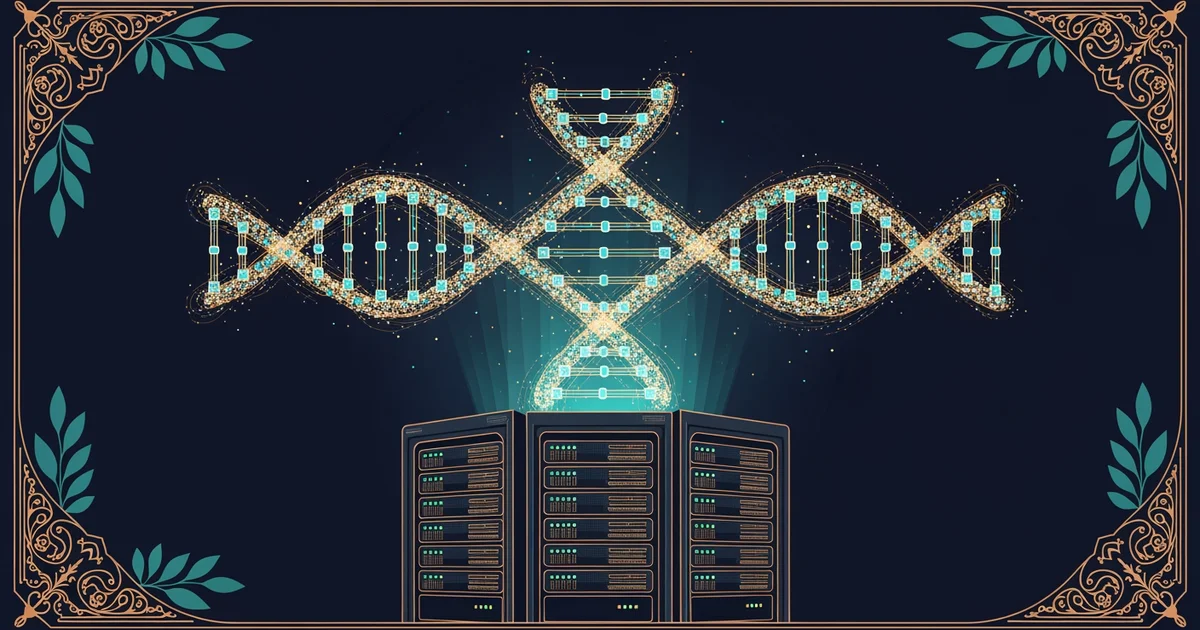
The Shift Toward Generative Design
Researchers are using advanced algorithms to dream up new biological structures that do not exist in nature. Think of this like an architect who uses a computer to draft a building that resists earthquakes before laying a single brick. Instead of finding existing proteins, these systems generate unique molecular shapes from scratch to solve specific health problems. These synthetic creations act like specialized keys designed for a single lock inside your body. By simulating millions of variations, the computer identifies the perfect fit without wasting resources on failed lab experiments. This method saves years of trial and error while increasing the precision of every new medical breakthrough.
Key term: Generative Design — a process where software uses parameters to create optimal molecular structures that solve complex biological problems.
This shift mimics how a professional chef might use a computer to balance flavors for a perfect meal. The computer processes all possible ingredient combinations to find the most efficient recipe for the desired outcome. In the same way, computational tools evaluate every possible protein interaction to ensure that a new drug will only target the intended disease site. This prevents unwanted side effects because the computer predicts exactly how the molecule will behave in different parts of the body. We are moving from observing nature to actively engineering it for human health and longevity.
Integrating Digital Biology Across Systems
To understand how these tools interact, we must look at how data flows from simple sequences into complex living systems. Previous stations explored the ethics of this power and the basics of genomic sequencing, but we must now synthesize these ideas. The future of this field lies in the seamless loop between digital models and physical laboratory results. The following table highlights how different computational layers work together to advance scientific discovery:
| Layer | Function | Goal | Impact |
|---|---|---|---|
| Data Input | Raw sequencing | Identify patterns | Map the genome |
| Logic Engine | Generative design | Create solutions | Build new proteins |
| Feedback Loop | Clinical testing | Refine accuracy | Improve outcomes |
This cycle creates a powerful engine for discovery that never stops learning from its own mistakes. When a computer designs a molecule, the laboratory tests it, and the results are fed back into the software. This constant loop allows the system to get smarter and faster with every single iteration. Scientists are no longer limited by their own intuition because the machine suggests paths that humans might never consider. This collaborative effort between human logic and machine speed is the core of modern research.
There is a major open question that remains unresolved for the research community regarding these systems. We do not yet know if these synthetic biological designs will maintain their stability over long periods inside a living human. While the software predicts a perfect result, the chaotic environment of a living cell might introduce unexpected variables. Researchers are currently struggling to bridge the gap between perfectly simulated models and the messy reality of organic life. This tension defines the next decade of work in the field of computational biology.
Future breakthroughs in computational biology will rely on the tight integration of generative design software and iterative physical laboratory testing to create precise medical solutions.
Computational biology allows us to master the code of life by turning biological mysteries into solvable engineering challenges that improve human health.