
Signal Amplification Techniques
Imagine you are trying to whisper a secret across a crowded, noisy stadium to a friend. Your voice fades quickly as it travels through the air, making it nearly impossible for them to hear you clearly. Deep space works in a similar way, as light signals lose energy over millions of miles of empty, cold vacuum. To bridge this gap, engineers must find ways to boost these faint signals without adding noise that might ruin the data. This process of refreshing a fading signal is the core challenge of long-range optical communication systems today.
The Mechanics of Optical Amplification
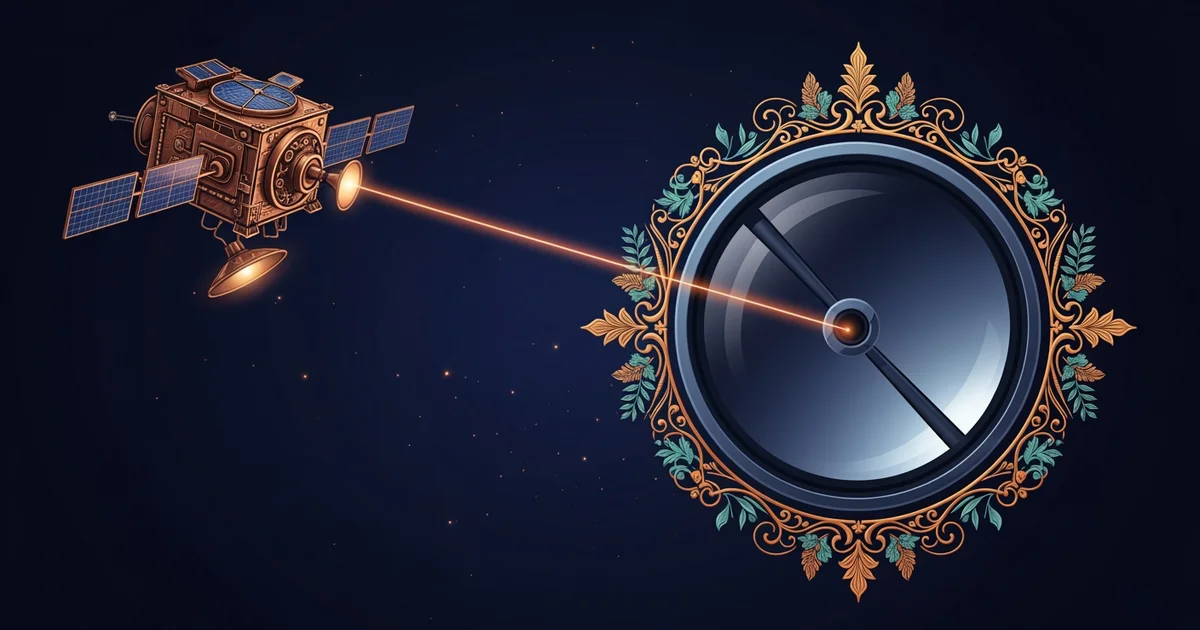
When a light signal travels through space, it interacts with the environment and naturally spreads out over time. This spreading, known as divergence, ensures that only a tiny fraction of the original light reaches the distant receiver. Because we cannot simply build larger telescopes to catch every single photon, we use optical amplifiers to increase the power of the signal before it arrives. Think of this like a water pump located midway along a long pipe, which pushes the water forward when the pressure begins to drop. By adding energy directly to the light beam, we ensure the message stays strong enough to be read accurately.
Key term: Optical amplifier — a specialized device that increases the intensity of a light signal by adding energy to the photons without converting them into electricity.
To achieve this boost, engineers rely on a process called stimulated emission within a specific medium. This medium is usually a fiber optic cable doped with rare earth elements like erbium. When an external energy source pumps power into this material, it excites the atoms to a higher energy state. As the weak signal light passes through, it triggers these excited atoms to release their stored energy as additional light. This new light perfectly mimics the original signal, effectively multiplying the number of photons while keeping the data pattern intact. This method is far more efficient than older electronic methods that required converting light into electricity and back again.
Managing Signal Quality and Noise
Maintaining the integrity of the data remains the most difficult part of the amplification process in deep space. Every time we amplify a signal, we risk adding unwanted background noise that can distort the original information. This noise acts like static on an old radio, making it harder for the receiver to distinguish the actual message from the background. To keep the signal clear, we must carefully balance the amount of gain we apply during each stage. The following table outlines how different factors influence the final quality of our transmitted deep space data.
| Factor | Impact on Signal | Mitigation Strategy |
|---|---|---|
| Signal Loss | Reduces total power | Use high-gain optical amplification |
| Thermal Noise | Adds random interference | Cool the receiver to lower temperatures |
| Pulse Distortion | Blurs the data bits | Use precision timing for signal recovery |
We must also consider the physical constraints of our spacecraft when designing these systems for deep space missions. Since space is limited and power is expensive, our amplifiers must be small, lightweight, and very energy efficient. We often use a series of smaller, distributed amplifiers rather than one massive unit to prevent overheating. By spreading the work across multiple stages, we maintain high signal fidelity across the vast distances of our solar system. This modular approach allows us to scale our communication networks as we explore further into the outer reaches of the galaxy.
Signal amplification ensures that faint light pulses retain enough energy to be detected clearly after traveling across the vast, empty distances of deep space.
But what does it look like in practice when we connect these amplified signals to the global network on Earth?