
Photonics Fundamentals
Imagine you are trying to signal a friend across a dark, crowded stadium using only a handheld flashlight. You must blink the light in specific patterns to share information, yet the distance makes every flicker seem faint and uncertain. Deep space communication relies on this exact principle, but the distances span millions of miles instead of mere stadium lengths. We use light to bridge the void because it travels faster than any other known signal in the universe. To master this, we must first understand how light behaves at the smallest possible scale.
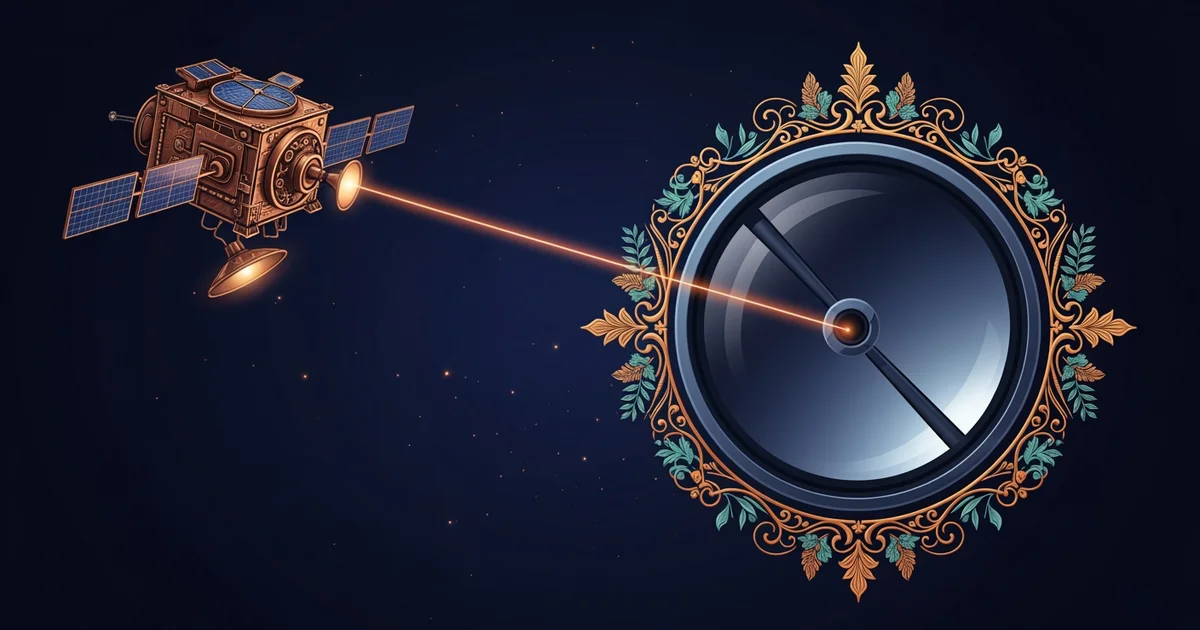
The Nature of Light Particles
Light behaves as both a wave and a stream of individual packets known as photons. These tiny units of energy serve as the carriers for all digital data sent through deep space. When we transmit information, we are essentially packing binary data into the timing or intensity of these photons. Think of them like a fleet of delivery trucks that must travel across an empty desert to reach a distant city. Each truck carries a piece of cargo, which represents a single bit of information in our digital code. If the trucks arrive in the right sequence, the receiving station can reconstruct the message perfectly.
Key term: Photons — the fundamental, massless particles of light that function as the primary carriers of information in optical communication systems.
Because these particles move at the speed of light, they provide the fastest way to transmit data across the solar system. However, space is not truly empty, and the vast distances cause the signal to weaken over time. We must ensure that our stream of photons remains coherent enough for the receiver to detect each pulse. If the stream of photons spreads out too much, the message becomes garbled and impossible to read. Managing this stream requires precise control over how we group and send these energy packets from our transmitters.
Encoding Data in Binary Streams
To send useful data, we must convert our complex information into a simple binary format that light can easily represent. We assign a value of one to a pulse of light and a value of zero to the absence of light. This creates a rhythmic pulse sequence that acts as a digital language for our space hardware. The receiver monitors the arrival of these photons and translates the pattern back into usable files or images. This method allows us to transmit high-resolution data from distant probes back to our home planet.
| Feature | Digital Representation | Physical Action |
|---|---|---|
| Binary One | High intensity pulse | Light is emitted |
| Binary Zero | Low intensity pulse | Light is blocked |
| Data Stream | Sequence of bits | Rapid pulse timing |
We must consider several factors when designing these systems to ensure the data arrives safely. The following list explains the primary challenges we face when sending these light pulses across deep space:
- Signal attenuation occurs when the photon stream encounters dust or debris, which reduces the total amount of energy reaching the receiver.
- Background noise from stars or solar radiation can interfere with our weak signal, making it harder to distinguish between data and interference.
- Timing precision is essential because even a tiny delay in the arrival of a pulse can cause the entire message to become corrupted.
By carefully managing these variables, we can maintain a steady stream of information across the galaxy. As we refine our ability to count and detect individual photons, our capacity for data transfer grows significantly. This progress will eventually allow us to send live video feeds from the outer planets or distant moons. We are currently moving toward a future where light serves as the primary backbone for all interplanetary networking needs.
Digital communication in deep space relies on using discrete packets of light to represent binary data that can be reconstructed by distant receivers.
The next Station introduces beam divergence, which determines how these light pulses spread out and lose intensity over long distances.