
Atmospheric Interference
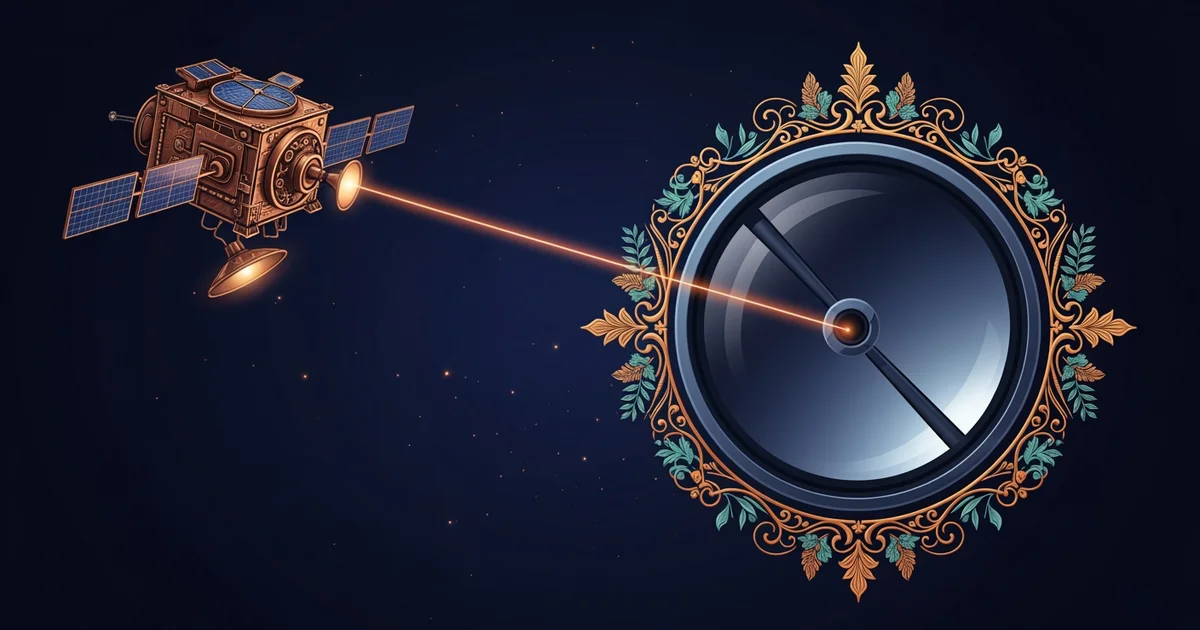
Imagine trying to send a clear beam of light through a thick, swirling fog bank. You might shine your brightest flashlight, yet the light scatters into a dull glow. This exact struggle happens when we attempt to send laser data from deep space to Earth. Our planet is wrapped in a thick blanket of air that behaves like a chaotic, shifting lens. The atmosphere is not a static block of glass, but a living, turbulent fluid that constantly moves. Every photon of light traveling from a distant probe must navigate this unpredictable, messy, and shifting maze. When light travels through the sky, it encounters pockets of air that change in temperature and density. These tiny fluctuations act like thousands of microscopic prisms, constantly bending and scattering the incoming signal. This process is known as atmospheric scintillation, which creates a shimmering effect similar to stars twinkling at night. While twinkling stars look beautiful to our eyes, this instability is a nightmare for precise digital data transmission. If the signal bends too much, it misses the receiver on the ground entirely. We must account for this constant motion if we want to maintain a reliable connection across the stars.
The Impact of Clouds and Water Vapor
Beyond the shifting air, the atmosphere contains moisture that presents a much more significant physical obstacle. Clouds are essentially floating collections of water droplets or ice crystals that block light paths. When a laser beam strikes a cloud, the light particles bounce off the water droplets in random directions. This scattering effect is so intense that it effectively kills the signal before it reaches the ground. Think of this like trying to watch a movie on a screen while someone throws handfuls of confetti between you and the projector. The confetti represents the water droplets, and the projector light is our deep space communication beam. Even thin, wispy clouds can disrupt the data flow enough to cause massive errors in the digital stream. Because clouds cover large portions of the planet at any given time, they act as massive, unpredictable shutters for our optical systems. We cannot simply look through them, so we must design networks that bypass these obstructions entirely.
Key term: Atmospheric attenuation — the reduction in intensity of a light beam as it passes through the atmosphere due to scattering and absorption.
To manage these disruptions, engineers use specific strategies to ensure that our data arrives safely despite the weather. We often place ground stations in areas with very few clouds, such as high, dry mountain deserts. By spreading these stations across the globe, we create a network where at least one site remains clear. If one station faces a storm, the signal automatically routes to a different location with clear skies. This redundancy is essential for maintaining a steady flow of information from deep space missions. Without this geographic diversity, our communication systems would be vulnerable to every passing storm system on the planet.
Managing Signal Quality and Reliability
| Strategy | Purpose | Benefit |
|---|---|---|
| Geographic Diversity | Avoiding local weather | Ensures constant uptime |
| Adaptive Optics | Correcting light bending | Maintains signal focus |
| High Altitude Sites | Reducing air density | Minimizes signal scattering |
We also use advanced technology to fix the light after it passes through the turbulent air. Adaptive optics involve using flexible mirrors that change shape in real-time to counteract the atmosphere. These mirrors move thousands of times per second to flatten the distorted incoming laser wavefront. By reversing the damage caused by the air, we can focus the light back into a sharp, readable point. This technology allows us to recover a signal that would otherwise be lost in the noise. Combining these hardware solutions with smart network planning helps us overcome the natural barriers of our own planet. We are slowly turning a transparent but turbulent sky into a reliable highway for data.
Reliable optical communication through the atmosphere requires combining geographic redundancy to avoid weather with active hardware systems that correct for air turbulence.
The next Station introduces precision pointing systems, which determine how we keep our lasers locked onto a receiver despite the massive distances involved.