
Beam Divergence and Focus
Imagine trying to shine a tiny laser pointer at a single grain of sand located three miles away. As the light travels across that distance, the beam naturally spreads out and loses its sharp focus, making it impossible to hit your target. Deep space communication faces this exact challenge because light beams do not stay perfectly parallel forever. They slowly widen over vast distances, which forces engineers to carefully manage how they focus light before it leaves the transmitter. Without precise control, the signal energy would scatter into the void instead of reaching the distant receiver.
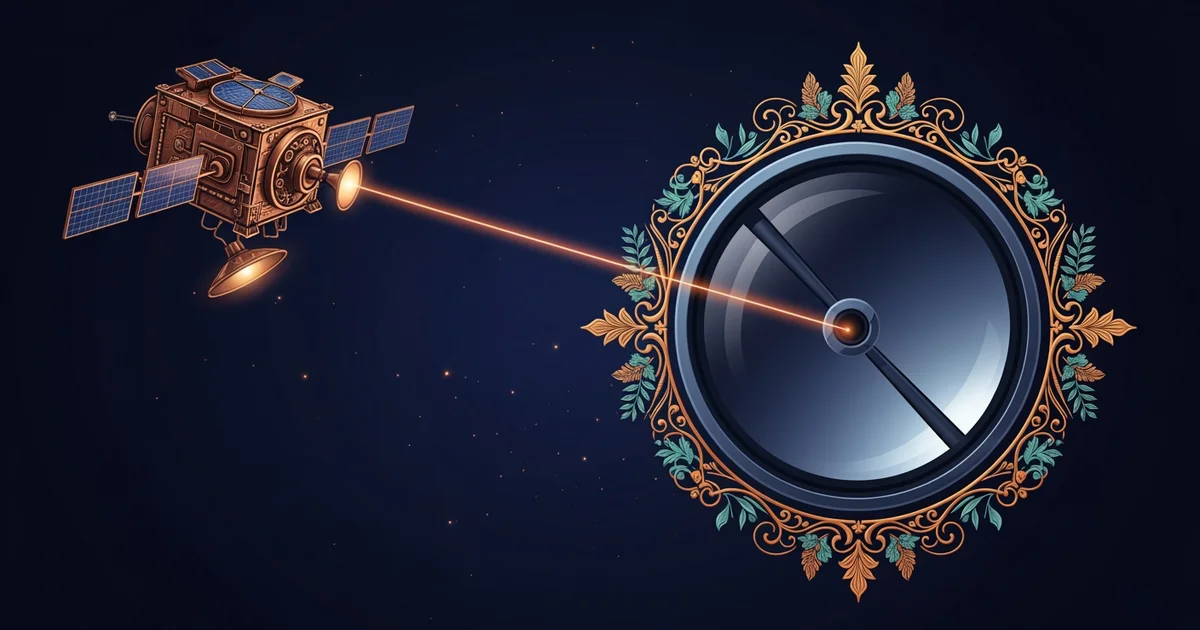
The Physics of Beam Spreading
When we send information through space using lasers, we must account for the physical law of beam divergence. This phenomenon describes the natural tendency of a light beam to spread wider as it travels further from its source. Even the most tightly focused laser will eventually cover a massive area if it travels for millions of kilometers. If the beam becomes too wide, the intensity of the light at the destination drops below the threshold needed for detection. Engineers calculate this spread to ensure the signal remains strong enough for the receiver to process the incoming data packets effectively.
Key term: Beam divergence — the natural expansion of a laser beam's diameter as it travels away from the source over long distances.
Think of this process like using a garden hose nozzle to spray water across a large yard. If you set the nozzle to a wide mist, the water covers a large area but hits the ground with very little force. If you adjust the nozzle to a tight stream, the water travels further and hits a specific point with much higher pressure. In space communication, we want that tight stream to ensure our data arrives with enough power to be read. We use large lenses and mirrors to focus the light into the narrowest possible path before the beam begins its long journey through the cosmos.
Precision Requirements for Deep Space
To maintain a stable connection, the transmitter must aim with extreme accuracy while managing the beam's width. If the beam is too narrow, even a tiny vibration in the spacecraft could cause the signal to miss the target entirely. If the beam is too wide, the energy is wasted across too much space, making the signal too faint to detect. We balance these two extremes by using specialized optical systems that adjust the focus based on the distance of the target. This ensures that the beam arrives at the receiver with the optimal diameter for collection.
We categorize the necessary precision levels based on the distance between the spacecraft and the Earth-based station. The following table outlines how different mission lengths require specific adjustments to maintain a reliable link:
| Mission Distance | Beam Focus Strategy | Primary Challenge |
|---|---|---|
| Near Earth | High focus intensity | Rapid tracking speed |
| Lunar Orbit | Medium focus spread | Precision pointing accuracy |
| Deep Space | Low divergence focus | Signal power loss |
By adjusting the optical components, we can compensate for the inevitable spreading of the light waves. This allows us to keep the signal concentrated even when the spacecraft is located at distances like km from our sensors. Maintaining this balance is the only way to ensure that we receive clear data from distant probes exploring the outer edges of our solar system. We do not just send light; we carefully shape it to survive the journey through the dark expanse of space.
Concentrating light into a narrow beam is essential because it prevents signal energy from scattering and becoming too weak to detect over astronomical distances.
The next Station introduces encoding digital data, which determines how we translate those focused light pulses into meaningful information.