
The Vacuum of Space Challenge
Imagine trying to shout a message across a crowded, noisy stadium while the wind carries your voice away. Deep space communication operates under similar constraints, but the wind is replaced by the vast, empty void of the cosmos. Sending data across these distances is not just difficult; it is a battle against the fundamental laws of physics that govern light and energy. As a signal travels further from its source, it spreads out, losing intensity until it becomes nearly impossible to detect. This phenomenon, known as signal degradation, serves as the primary obstacle for every deep space probe we launch into the darkness.
The Physics of Signal Spreading
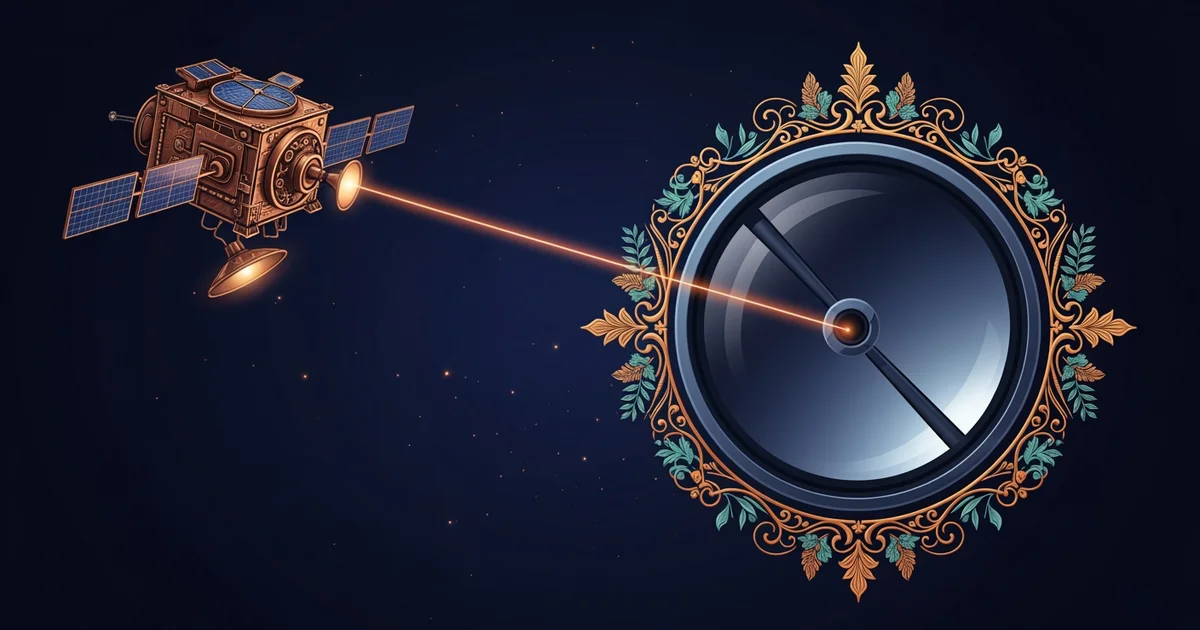
When we transmit data using light, we rely on photons to carry information across the vacuum. These photons do not stay in a tight, concentrated beam forever, even if we aim them with extreme precision. As the distance increases, the beam naturally widens, spreading its energy over a larger and larger area. Think of this like spraying water from a garden hose with a nozzle set to a wide mist. Close to the nozzle, the water hits with force, but the further you stand away, the thinner the spray becomes until you barely feel it. In space, this means the amount of energy reaching a receiver at the other end drops significantly as the distance grows.
Key term: Inverse Square Law — a physical principle stating that the intensity of a signal decreases proportionally to the square of the distance from the source.
Because of this law, doubling the distance between a transmitter and a receiver does not just cut the signal strength in half. Instead, it reduces the signal to one-fourth of its original strength, making long-distance communication exponentially more challenging. This creates a massive hurdle for engineers who must design systems capable of detecting incredibly faint signals after they have traveled for millions of miles. Without advanced amplification and sensitive receivers, the data would simply vanish into the background noise of the universe before it could ever be decoded by our ground stations.
Overcoming the Void
To manage these losses, scientists must optimize every part of the transmission process to ensure that the data arrives intact. Since we cannot change the distance of space, we focus on increasing the power of the transmitter and the sensitivity of the receiver. The following table highlights how different factors influence our ability to maintain a clear connection over extreme distances:
| Factor | Impact on Signal | Method of Improvement |
|---|---|---|
| Transmitter Power | Increases total signal volume | Use higher wattage lasers or radio transmitters |
| Beam Focus | Reduces energy scattering | Utilize precise optical lenses to tighten the beam |
| Receiver Sensitivity | Captures fainter incoming signals | Build larger mirrors to collect more incoming photons |
By balancing these three components, we can effectively push the limits of how far we send information. When we increase the size of our receiver mirrors, we effectively cast a wider net to catch those few remaining photons that have survived the journey. This approach is essential because even a tiny increase in signal strength can mean the difference between receiving a clear image from a distant planet or receiving only static and noise. We are essentially trying to hear a whisper in a hurricane, so every single photon counts toward the final data reconstruction.
Ultimately, the vacuum of space does not just hold back our physical ships; it tries to silence our voices as well. Understanding how light behaves over these immense gaps allows us to build better technology that bridges the silence. We must constantly refine our methods to ensure that the data we send remains coherent and useful for those waiting on Earth. As we look deeper into the void, our ability to manage these losses will define the success of our future exploration missions across the solar system.
The primary challenge in deep space communication is managing the natural spreading of light, which causes signal intensity to drop rapidly as distance increases.
Next, we will explore how photonics allows us to manipulate light at the smallest scales to improve these communication systems.