
Signal Transmission Delays
When a hiker in the remote Alaskan wilderness turns on a handheld receiver, they expect an immediate location fix. The device must capture signals traveling through the thin upper atmosphere before calculating a position on the ground. This process relies on timing, yet the atmosphere often delays these radio waves in ways that mimic errors. Understanding these delays is vital for precise navigation, as even tiny timing shifts lead to large errors. This is the application of signal delay principles first introduced in Station 10 regarding the nature of wave propagation in space.
The Role of the Ionosphere
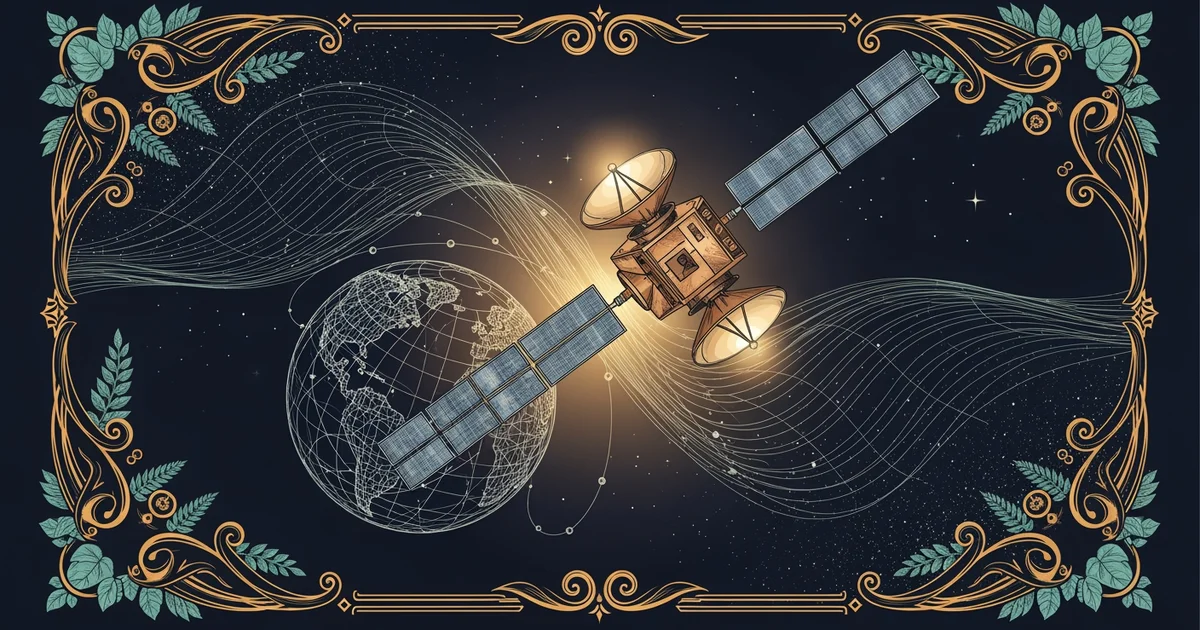
The ionosphere acts as a complex filter for signals sent from satellites orbiting high above the Earth. This layer contains a high density of free electrons and ions created by solar radiation hitting gas atoms. When satellite signals enter this region, the charged particles interact with the electromagnetic waves of the signal. This interaction causes the radio waves to slow down significantly compared to their speed in a vacuum. The delay is not constant because the density of the ionosphere changes throughout the day and with solar activity. If a receiver assumes the signal travels at the speed of light, it will miscalculate the distance to the satellite. This error creates a gap between the actual location and the map coordinates displayed on the screen.
Key term: Ionosphere — the region of the upper atmosphere containing many ions and free electrons that interacts with radio signals.
To manage this atmospheric interference, engineers use specific correction models within the hardware of the navigation system. These systems compare signals sent at different frequencies to measure the exact amount of delay caused by the particles. By analyzing the difference between two signals, the receiver can estimate the electron density along the path. This allows the device to subtract the delay and recover the true timing of the signal. Think of this like a runner moving through a deep pool of water compared to a track. The runner slows down in the water, but if you know the depth and the density, you can calculate the expected speed loss. Adjusting for this loss is the only way to maintain the high accuracy required for modern global positioning.
Atmospheric Interference Factors
Beyond the ionosphere, the lower atmosphere also affects the speed of the signals as they descend. The troposphere contains water vapor and varying air pressures that impact how radio signals travel downward. Unlike the ionosphere, these factors do not depend on the frequency of the signal being used. Instead, they relate to the temperature and humidity levels present at the time of the transmission. The following list highlights the primary variables that impact signal transmission speeds near the surface of the Earth:
- Atmospheric pressure levels change the refractive index of air, which alters the speed of the signal as it reaches the ground station or user device.
- Water vapor content creates a delay by absorbing and scattering energy, which forces the signal to take a slightly longer path through the dense air.
- Surface temperature variations create pockets of different air density, which can bend the signal path and cause minor timing discrepancies during the final descent phase.
| Variable | Impact on Signal | Mitigation Strategy |
|---|---|---|
| Ionosphere | Frequency dependent | Dual frequency check |
| Troposphere | Pressure/Humidity | Standardized models |
| Solar Flux | High variability | Real-time updates |
These variables require the receiver to perform constant calculations to keep the position data accurate and reliable. Without these adjustments, the system would fail to account for the physical reality of the atmosphere. The device must treat every signal as a unique data point influenced by the environment it just traveled through. By combining these corrections, the system provides the reliable location data that users depend on for travel and safety.
Accurate positioning requires compensating for signal delays caused by the interaction between electromagnetic waves and the Earth's changing atmospheric layers.
But how does the constant rotation of the Earth introduce new geometric complexities that further challenge these timing calculations?