
The Physics of Metals
Imagine a heavy steel beam supporting a skyscraper as it sways gently in a powerful wind. That beam does not snap because its internal structure is organized into tiny, repeating patterns that resist force. Metals are not solid, uniform blocks like a piece of plastic might appear to be at a glance. Instead, they consist of organized arrangements of atoms that form complex, microscopic structures known as crystals. Understanding these internal arrangements is the first step toward mastering the science of building materials.
The Nature of Metallic Crystalline Structures
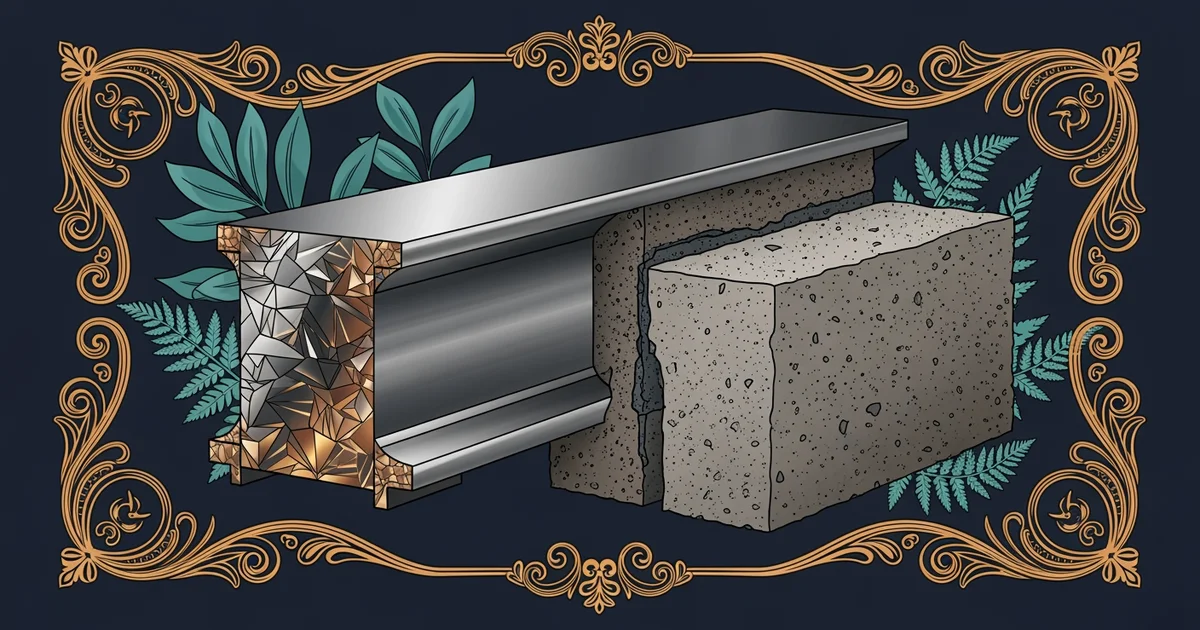
When we look at a metal component, we see a smooth surface that hides a chaotic internal landscape. These materials contain millions of tiny regions called grains that meet at specific borders. Each grain represents a cluster of atoms aligned in a single direction. Think of these grains like a mosaic made of thousands of small, differently angled glass tiles. If you push on the mosaic, the tiles might shift slightly against one another at their edges. This movement allows the metal to change shape without breaking apart immediately under heavy pressure.
Key term: Grains — the individual microscopic regions within a metal where atoms are arranged in a uniform pattern.
These grain boundaries act as natural barriers that prevent the internal structure from failing too quickly. When a force is applied to the metal, the atoms try to slide past each other along their crystal planes. The boundaries between grains stop this sliding action because the atoms on the other side are oriented differently. This resistance is exactly what gives structural steel its strength and durability. Without these boundaries, a metal piece would be soft and deform like warm butter under the slightest load.
Ductility and Structural Integrity
Building designers rely on the property of ductility to ensure that structures can bend safely before they break. A ductile material absorbs energy by stretching or deforming instead of snapping suddenly in a brittle fashion. The size and shape of the grains inside the metal dictate how much it can stretch before failure occurs. Smaller grains often provide more boundaries, which makes the material stronger but also potentially less flexible over time. Engineers must balance these internal features to match the specific needs of a project.
| Feature | Effect on Strength | Impact on Ductility |
|---|---|---|
| Large Grains | Lower yield point | Higher total stretch |
| Small Grains | Higher yield point | Lower total stretch |
| Mixed Grains | Unpredictable load | Moderate deformation |
We can organize these internal grain characteristics to better understand how they influence the behavior of common construction metals:
- Large grain structures allow for more movement along atomic planes, which increases the total amount of bending a beam can handle before it sustains permanent damage.
- Small grain structures create more frequent obstacles for atomic movement, which effectively prevents the material from yielding under high pressure but reduces its capacity to stretch.
- Uniform grain sizes provide predictable performance across the entire component, ensuring that stress is distributed evenly throughout the material rather than concentrating in one weak zone.
By controlling the cooling process during manufacturing, factories can influence the final grain size of steel products. Rapid cooling often results in smaller, stronger grains, while slower cooling allows for larger, more ductile structures. This physical manipulation of the atomic layout is how we turn raw ore into reliable, safe beams for our modern cities. Every architectural marvel stands because someone carefully tuned these invisible, microscopic grain structures to hold the weight of our world.
The hidden boundaries between microscopic crystal grains determine whether a metal will bend safely under pressure or snap unexpectedly.
The next Station introduces ceramics and glass properties, which determines how brittle atomic bonds behave compared to ductile metals.