
The Evolution of Looms
Imagine you are sitting at a small wooden frame, pulling every single thread through by hand to make a simple rug. You spend hours on just a few inches of fabric, feeling the slow pace of your own fingers against the tension of the warp. This manual process is how early humans created the textiles that protected them from the harsh elements of their environment. By understanding how this labor-intensive task evolved into machine-driven production, you can see the direct link between human ingenuity and the fabrics that surround you today. The history of the loom is a story of finding ways to save time while increasing the quality of the cloth we use every day.
The Shift to Mechanical Assistance
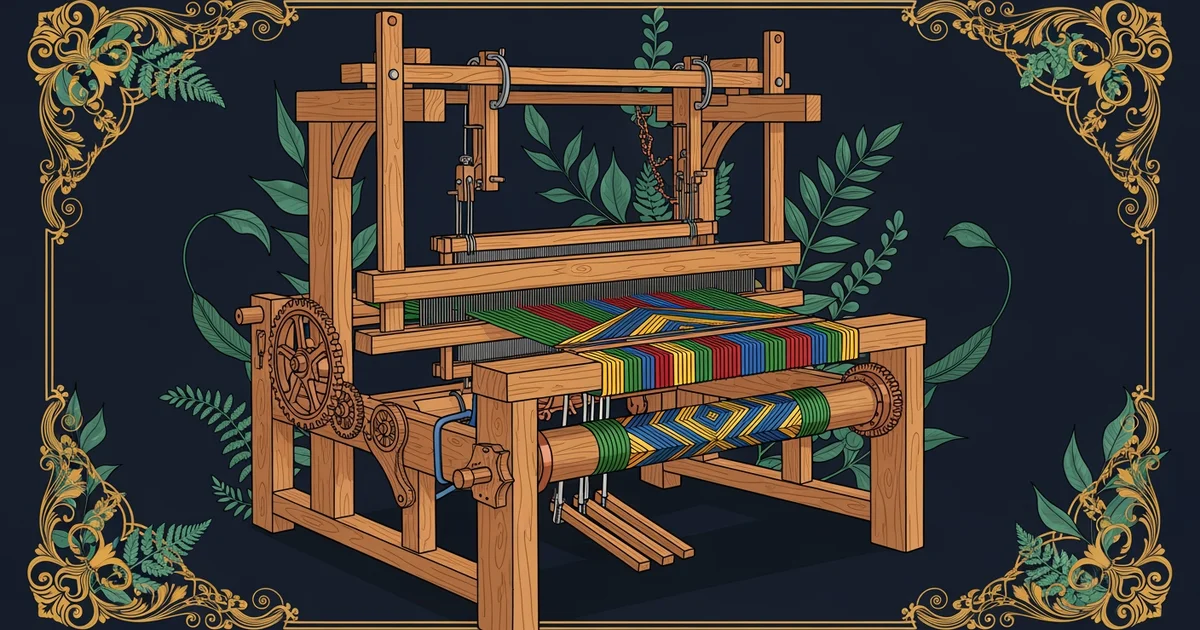
Early weaving relied entirely on the strength and patience of the weaver to manage the warp threads. A loom is simply a device that holds these threads in place, keeping them under enough tension to allow the crosswise threads to pass through easily. Think of the loom like a bicycle for your hands, where the frame provides the structure while the moving parts help you travel much faster than walking. Without this frame, the threads would tangle and shift, making it impossible to produce a consistent or durable piece of fabric. As weavers sought better ways to work, they added simple tools like the heddle to lift groups of threads at once.
This simple mechanical advantage allowed for faster output and more complex designs that would have been impossible by hand alone. The transition from a handheld frame to a floor-mounted unit changed the scale of textile production in every village. Weavers could now sit comfortably while using their feet to operate the shedding mechanism, leaving their hands free to pass the shuttle back and forth. This division of labor between the feet and hands represents the first major leap in industrializing the craft. It turned weaving from a slow survival task into a reliable way to create trade goods for the local community.
From Manual Power to Industrial Speed
As the demand for cloth grew, the limitations of human energy became the primary bottleneck for every textile producer. Inventors realized that replacing muscle power with external energy sources would allow for continuous production that never needed to rest. The introduction of water wheels and eventually steam power transformed the loom from a tool into a machine that could operate independently. This shift mirrors how a modern business automates repetitive tasks to increase profit margins while lowering the cost of the final product for the consumer. The following table highlights the progression of these mechanical capabilities over time.
| Stage of Evolution | Primary Power Source | Main Limitation | Production Speed |
|---|---|---|---|
| Handheld Frame | Human Muscle | Manual Dexterity | Very Slow |
| Treadle Loom | Human Feet/Hands | Weaver Fatigue | Moderate |
| Power Loom | Water or Steam | Machine Setup | High |
This evolution allowed for the creation of standardized fabrics that were identical, regardless of who operated the machinery. The consistency gained during this period laid the foundation for the modern garment industry that supplies our global markets. We no longer rely on the unique touch of a single weaver, but rather on the precision of automated systems that follow a set pattern. Each advancement in this field has focused on removing the human error that occurs during long hours of repetitive labor. By moving the burden of tension and speed from the weaver to the machine, the entire process became more predictable.
Key term: Shuttle — the tool used to carry the crosswise thread through the warp during the weaving process.
Efficiency in this field is measured by how quickly a machine can complete a single pass without breaking the delicate fibers. Even with modern automation, the core principle remains the same as it was thousands of years ago. You are still arranging threads in a grid to create a surface that holds together under pressure. The mechanical parts have simply become more refined to handle higher speeds and thinner, more delicate materials. Understanding this progression helps you appreciate the complex engineering behind the simple shirt you wear every day.
The evolution of the loom represents a continuous effort to replace human effort with mechanical precision to increase both speed and consistency in textile production.
Next, we will explore how these mechanical advancements allow for the creation of intricate weaving patterns that define modern fabric design.