
Social Network Analysis
Imagine a bustling city subway system where every station is a person and every track is a friendship. You can map out how people connect, seeing who acts as a hub and who sits on the edge. This is the essence of social network analysis, a method used to map and measure relationships between people or groups. By looking at these connections, researchers can spot hidden clusters, identify influential members, and understand how information flows through a community. It turns abstract social ties into clear, visual data that reveals the structure of human interaction.
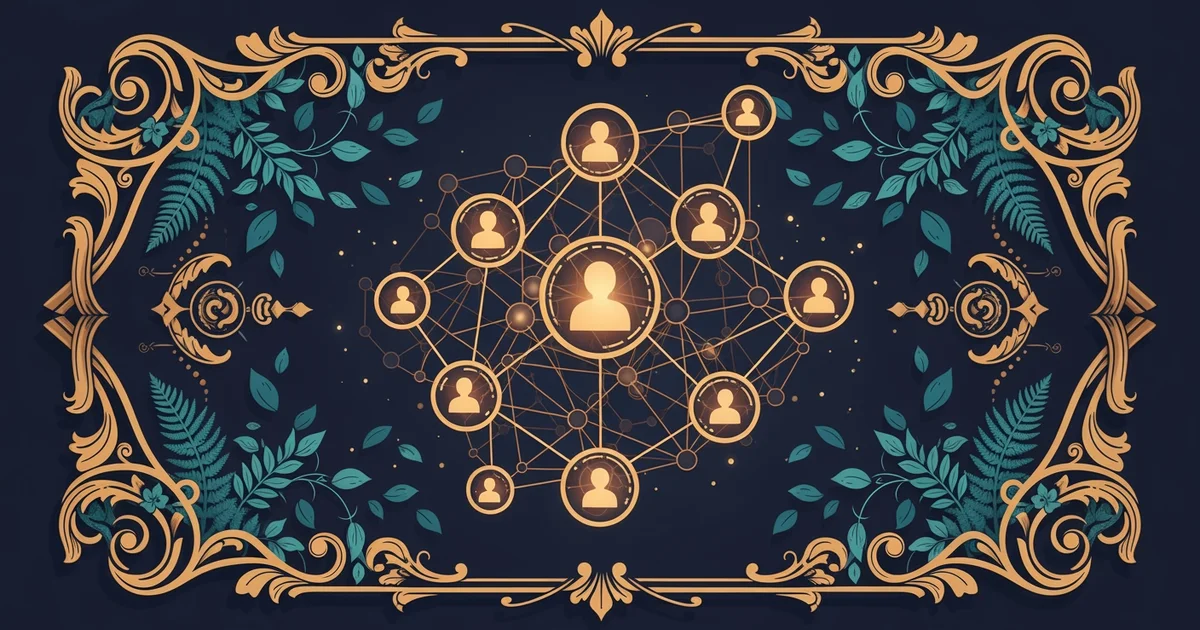
Mapping Social Connections
When we analyze these networks, we look for specific patterns that define how individuals relate to one another. The most basic way to measure this is through degree centrality, which counts the number of direct connections a person has in a system. Think of a popular person at a party who knows everyone in the room; that person has high degree centrality because they possess many direct links. In contrast, someone standing alone has low centrality. By counting these links, we can quantify who holds the most immediate influence within a specific social space.
Key term: Degree centrality — the metric that counts the total number of direct connections a single node has within a network.
To understand this concept better, consider how a small town business owner might operate their shop. If the owner knows every resident by name, they hold a central position because they maintain a high degree of connectivity. This allows them to spread news or gather opinions faster than anyone else in the town. Every connection acts like a bridge for information, and the more bridges you control, the more power you have to shape the flow of local events. This simple counting method provides a snapshot of influence that is both easy to calculate and highly revealing.
Analyzing Network Structure
Beyond simple counts, social network analysis helps us identify how groups organize themselves to share resources or ideas. Some networks are dense, meaning almost everyone knows everyone else, while others are sparse with many separate clusters. We can categorize these connections based on how they function in daily life, as shown in the following table:
| Connection Type | Primary Function | Typical Result |
|---|---|---|
| Strong Ties | Emotional support | High trust and deep cooperation |
| Weak Ties | Spreading information | Access to new, diverse ideas |
| Bridging Ties | Linking two groups | Reduced conflict and innovation |
Strong ties represent your closest friends, while weak ties are the acquaintances who connect you to different social circles. These weak ties are surprisingly important because they act as scouts, bringing fresh information from outside your normal bubble. If you only interact with your closest group, you will rarely hear new ideas or discover new opportunities. A healthy network requires a balance of both types to ensure that information moves freely and that individuals remain connected to the broader society.
When we view society as a web of these ties, we stop seeing individuals as isolated actors and start seeing them as parts of a larger system. This shift in perspective is vital for understanding everything from how diseases spread to how political movements gain momentum. By calculating the degree centrality of key players, we can predict which individuals will have the most impact on the group. This data-driven approach allows us to move beyond guesswork and into the realm of precise sociological measurement. It proves that the structure of our relationships is just as important as our individual choices.
Social network analysis uses the number and type of connections between individuals to map the hidden structures that influence how information and power move through a community.
The next Station introduces machine learning basics, which determines how computers automatically detect these complex patterns without human guidance.