
Rules of Complex Systems
Imagine a massive crowd of people standing in a dark room with no leader. Each person follows one simple rule: stay exactly three feet away from the person nearest to you. As they move, the entire crowd begins to flow like a liquid or form tight circles without anyone giving a single command. This is how complex systems work in our world, where local interactions create large patterns that nobody planned or designed. We often look at society and assume that big outcomes require big plans, but the truth is often much simpler than that.
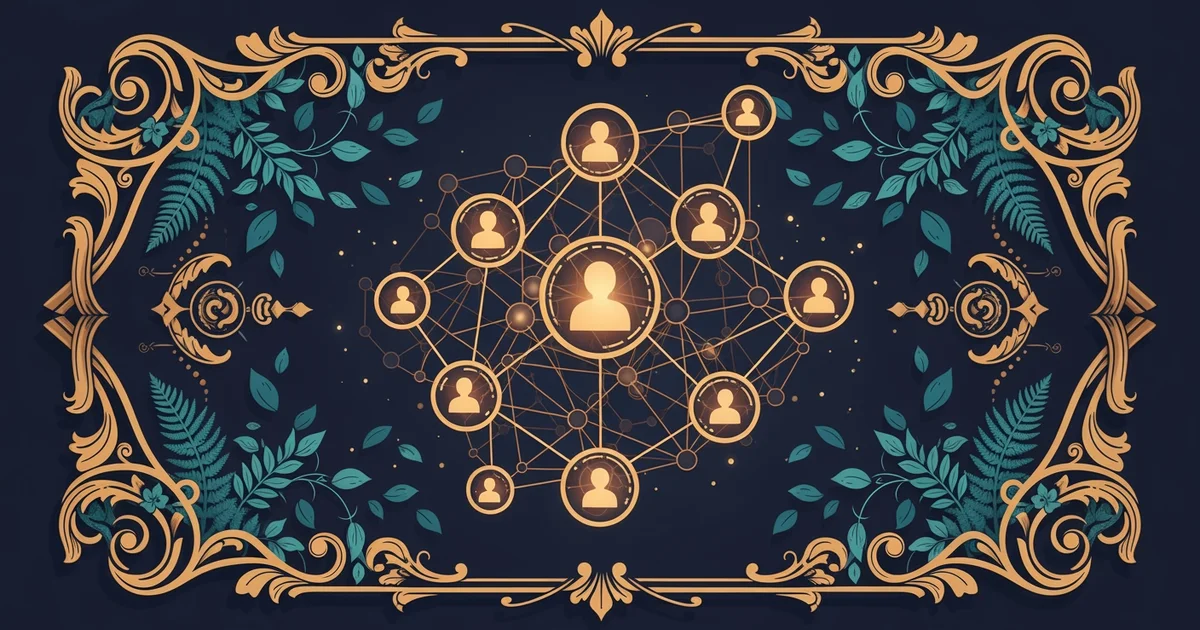
The Mechanics of Emergence
When we study these patterns, we call the phenomenon emergence. It describes how a system gains properties that the individual parts do not possess on their own. Think about a single grain of sand; it cannot form a dune, but millions of grains acting together create a massive, shifting landform. In sociology, this means that individual choices by people act as the building blocks for trends that shape our daily lives. These patterns emerge from the bottom up rather than being pushed from the top down by authorities.
Key term: Emergence — the way complex global patterns arise from the simple local actions of many individuals in a system.
Every person in a society acts according to their own local goals and immediate environment. When thousands of people make similar small decisions, the collective result looks like a coordinated movement. This happens because individuals react to their neighbors, which creates a chain reaction that spreads across the entire population. You can think of this like a traffic jam forming on a highway, where one driver slowing down causes a ripple effect that stops cars miles behind them. The drivers at the back of the line do not know why they stopped, yet they are part of the same complex pattern.
Understanding Interaction Rules
To understand why societies behave the way they do, we must look at the rules that guide individual behavior. These rules are rarely written down, but they govern how we interact with others in our social networks. When we change the rules of interaction, the entire system shifts its behavior in unpredictable ways. This makes complex systems very sensitive to small changes in how individuals treat each other or share information.
We can organize these system dynamics by looking at how individual actions influence the group outcome:
- Positive feedback loops occur when an action encourages others to do the same, which quickly amplifies a trend across the whole system.
- Negative feedback loops act as a balancing force that keeps the system stable by pushing back against extreme changes or sudden shifts.
- Threshold effects happen when a system stays quiet until a certain number of individuals act, triggering a sudden transformation of the group.
These dynamics explain why some social ideas disappear while others spread like wildfire through a population. If a new trend reaches a specific threshold of supporters, it becomes self-sustaining because the social pressure to join the crowd outweighs the desire to remain independent. This process does not require a central brain to manage the transition, as the individuals themselves provide all the necessary energy to keep the system moving forward. By mapping these interactions, we can see how hidden rules shape the way our society organizes itself over long periods of time.
| System Type | Primary Driver | Resulting Pattern |
|---|---|---|
| Stable | Negative feedback | Equilibrium state |
| Growing | Positive feedback | Rapid expansion |
| Tipping | Threshold effect | Sudden change |
Sociologists use these models to study everything from how neighborhoods change to how political movements gain momentum. By focusing on the local rules that people follow, we can predict how the larger social structure might react to new policies or economic shifts. This approach allows us to see past the noise of daily life and understand the underlying forces that drive our collective human experience.
Complex patterns in society emerge from simple, local interactions rather than from a single central plan.
Now that we understand how rules create patterns, we will explore how to simulate these behaviors using computational models.