
Aerodynamic Lift
When a Boeing 747 takes off from a busy international airport, it relies on complex physics to overcome gravity. This massive machine generates a force called aerodynamic lift to rise into the sky. This is the application of fluid dynamics we first explored in Station 11, where air acts as a flowing medium. You might think wings simply push air down, but the process is far more nuanced and relies on pressure gradients. Understanding these invisible forces is essential for mastering how objects interact with the air around them.
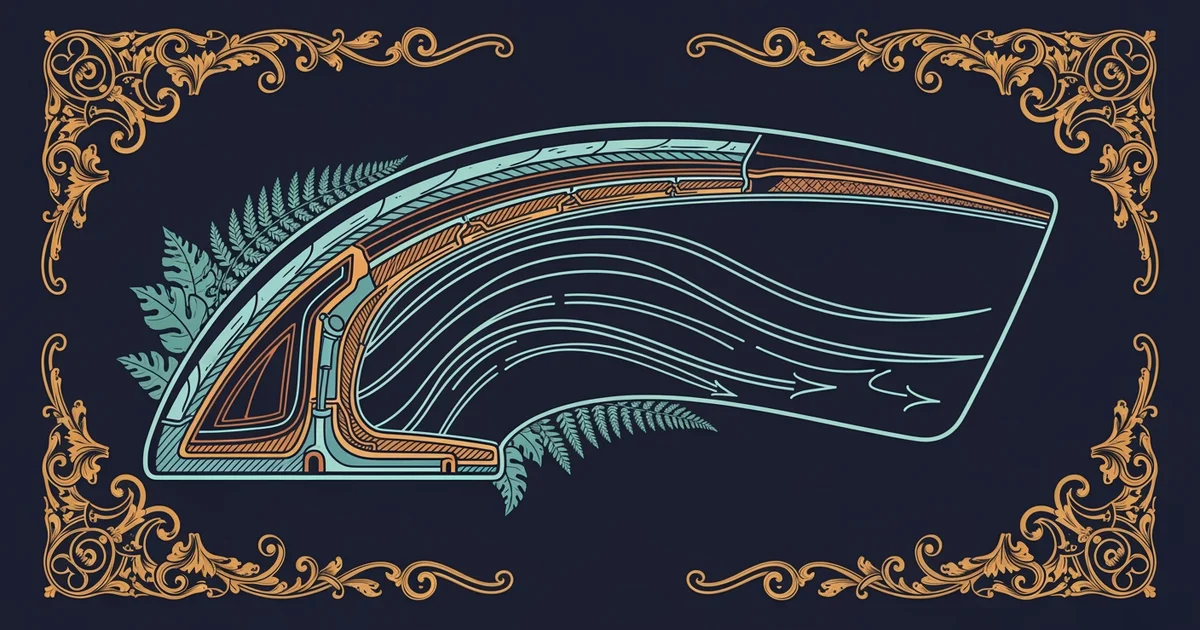
The Role of Pressure Differences
Airflow over a wing creates differences in pressure that result in a net upward force. As air moves across the curved surface of an airfoil, it must travel faster along the top than the bottom. This velocity change is governed by the principles of fluid dynamics that describe how air particles conserve energy. Because the air moves faster on top, the local pressure drops according to the laws of physics. This pressure difference creates a force pushing the wing toward the area of lower pressure. This is the primary mechanism for lift production in modern aviation.
Key term: Aerodynamic lift — the upward force generated by a wing moving through a fluid due to pressure differences.
Think of the wing like a toll road where the speed limit is higher on the top lane. Cars must move faster to get through the top lane, which makes that lane feel less crowded and more efficient. The bottom lane is slower and more congested, creating a higher pressure against the road surface. The wing experiences this as a push from the high-pressure bottom toward the low-pressure top. This analogy helps visualize how velocity changes translate into physical force.
Fluid Dynamics and Wing Performance
Performance depends on the shape of the wing and the angle at which it meets the air. We call this the angle of attack, which determines how much air is diverted during flight. If the angle is too steep, the smooth flow of air separates from the surface of the wing. This separation creates turbulence and causes the wing to lose its ability to generate lift. Pilots must balance the need for lift against the risk of losing smooth airflow over the structure.
| Feature | Function | Impact on Lift |
|---|---|---|
| Airfoil | Shapes flow | High efficiency |
| Leading edge | Splits air | Directs airflow |
| Trailing edge | Recombines | Controls stability |
These components work together to manage the air as it passes from the front to the back of the wing. The leading edge must split the incoming air cleanly to avoid creating unnecessary drag. The trailing edge then allows the air to leave the wing in a smooth path that maintains stability. By adjusting these surfaces, engineers can optimize wings for different speeds and weight requirements during flight.
Effective lift production requires a constant interaction between the wing surface and the surrounding air molecules. The air must stay attached to the wing for the pressure difference to remain consistent and strong. If the air detaches, the lift force drops instantly, which is a dangerous scenario for any aircraft. Designers use wind tunnels to test these shapes and ensure they perform well under various conditions. Maintaining this attachment is the core challenge for engineers building faster and more efficient aircraft.
Generating lift requires creating a pressure imbalance where air moves faster over the top surface than the bottom.
But this model of smooth airflow struggles to explain how wings function when moving through narrow pipe flow systems.