
Boundary Layers
When you watch a river flow past a large rock, the water near the surface moves differently than the water rubbing against the stone. This thin region of change defines how fluids interact with solid objects in our world.
The Nature of Fluid Friction
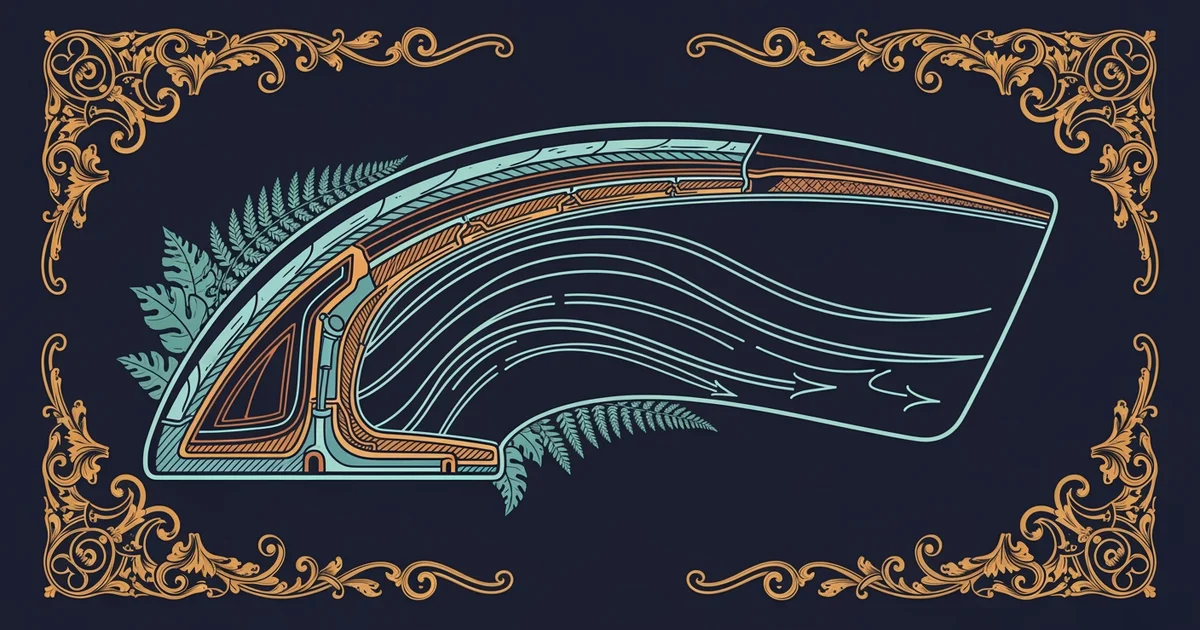
Fluids like water and air possess a property called viscosity which describes their internal resistance to flow. When a fluid moves past a stationary surface, the fluid molecules directly touching the wall experience a strong adhesive force. These molecules come to a complete stop relative to the surface while the layers further away continue moving forward. This creates a velocity gradient where speed increases as you move away from the solid wall. Imagine a stack of playing cards on a table where you push only the top card forward. The bottom card stays stuck to the table while the cards above slide at increasing speeds. This physical reality creates a boundary layer that dictates how drag forces act upon moving objects like planes or ships. Without this layer, objects would move through fluids with almost no resistance at all.
Key term: Boundary layer — the thin region of fluid near a solid surface where the velocity changes from zero to the free stream speed.
This layer grows in thickness as the fluid moves further along the surface of an object. At the start of the surface, the layer is very thin and the flow remains smooth and organized. As the fluid travels, it accumulates more energy and the layer expands to cover more space. If the object is long enough, the flow within this layer can transition from a smooth, orderly state into a chaotic, swirling mess. This transition point is critical for engineers who design everything from wings to pipes. They must manage this growth carefully to prevent unnecessary energy loss caused by turbulent mixing.
Velocity Gradients and Drag
Understanding how velocity changes near a wall helps us calculate the total force acting against movement. The rate of change in velocity across the layer is proportional to the shear stress exerted on the surface. We measure this change using the slope of the velocity profile near the boundary wall. High shear stress occurs where the velocity increases very rapidly over a tiny distance. This forces the fluid to work harder to overcome the friction generated at the interface. Engineers often use specific mathematical models to predict these gradients during the design phase.
| Flow Type | Velocity Profile | Energy State | Surface Impact |
|---|---|---|---|
| Laminar | Smooth curve | Very low | Minimum drag |
| Transition | Unstable wave | Medium | Fluctuating |
| Turbulent | Flat and mixed | High | Maximum drag |
These patterns show why the shape of an object matters so much for movement efficiency. A smooth, rounded shape keeps the boundary layer attached for longer distances, which reduces the total drag force. If the shape is too blunt, the fluid cannot follow the surface and it separates from the wall. This separation creates a large wake behind the object that pulls it backward.
- Adhesion occurs when fluid particles stick to the solid wall surface due to molecular attraction.
- Viscous shear happens when fast-moving fluid layers drag against the slower layers held by the wall.
- Flow separation takes place when the fluid can no longer follow the curved surface of an object.
These three stages represent the life cycle of a fluid moving across any solid boundary in nature. By managing these stages, we can control how much energy is lost during transport processes or flight.
The boundary layer acts as a mechanical buffer zone where fluid velocity transitions from zero at the wall to the full speed of the surrounding flow.
But how do these invisible velocity changes directly create the upward force needed for flight?