
The Nature of Flow
Imagine you are watching a calm river flow smoothly past a large, mossy rock. The water glides in neat, parallel layers that never seem to cross or mix with one another. This steady movement is how fluids behave when they have low velocity or high viscosity. When you speed up the flow or introduce an obstacle, that smooth motion suddenly breaks into chaotic, swirling patterns. These two distinct states of fluid motion define how air and water travel across the surfaces of our physical world.
The Characteristics of Orderly Motion
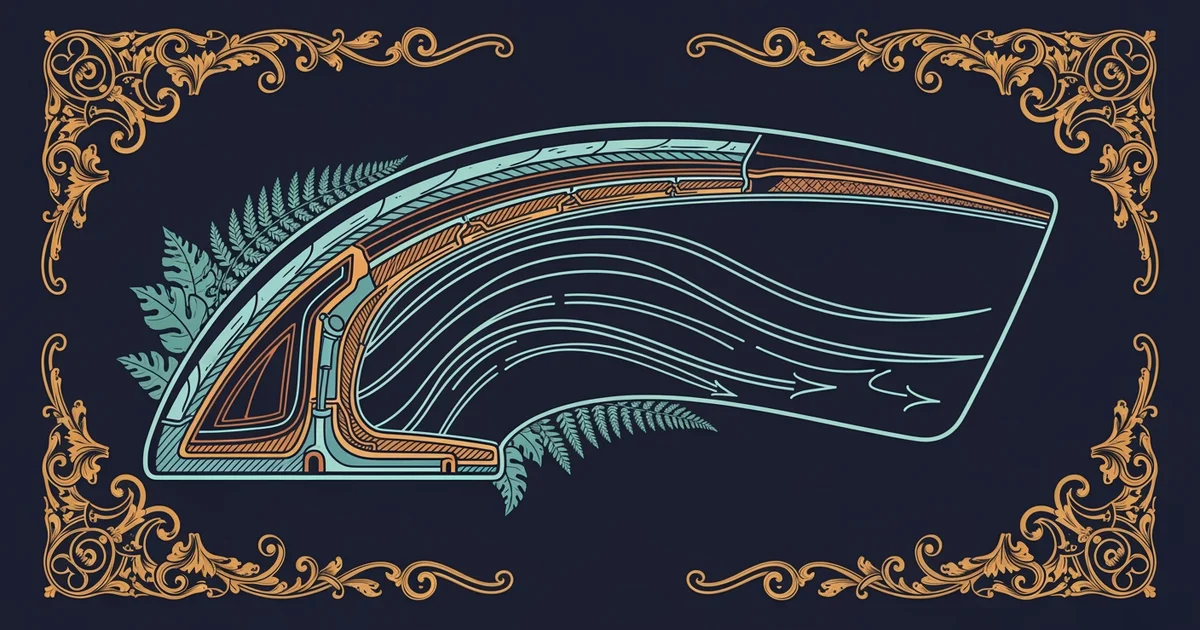
When a fluid moves in organized layers, scientists describe this behavior as laminar flow. You can visualize this as a deck of playing cards sliding over each other without any cards flipping out of place. Each thin layer of the fluid slides past the adjacent layer with minimal interference or mixing. This type of movement requires very little energy to maintain because there are no internal collisions to dissipate the kinetic energy. In nature, you see this in the slow, graceful movement of honey pouring from a spoon or blood flowing through tiny vessels. Because the layers remain distinct, the fluid maintains a predictable path that follows the shape of its container perfectly.
Key term: Laminar flow — a state of fluid motion where particles move in smooth, parallel paths without crossing or mixing.
This orderly state relies on the balance between the fluid's speed and its internal resistance to movement. If the fluid is thick or slow, it resists the urge to swirl and instead sticks to its laminar path. Think of a line of people walking slowly through a wide hallway with plenty of space. They can maintain their individual lanes without bumping into anyone else. This efficiency makes laminar flow ideal for systems that need to move fluids with precision and minimal friction. Engineers often design pipes to keep water in this state to save energy during transportation.
The Transition to Chaotic Mixing
As the velocity of a fluid increases, the smooth layers begin to lose their structural integrity. When the fluid reaches a critical threshold, it shifts into turbulent flow, which is characterized by erratic, swirling eddies and rapid mixing. Instead of sliding neatly, the fluid particles collide and tumble over one another in a chaotic frenzy. This transition is similar to a quiet crowd suddenly turning into a frantic rush toward an exit. The organized lanes vanish, and the fluid begins to absorb and dissipate energy at a much higher rate than before.
| Feature | Laminar Flow | Turbulent Flow |
|---|---|---|
| Motion | Smooth layers | Chaotic eddies |
| Mixing | Very minimal | Highly active |
| Energy | Low loss | High dissipation |
Turbulent flow creates complex forces that are often difficult to predict or calculate. These swirling patterns can be found in a rushing mountain stream or the wake behind a fast-moving boat. While turbulence seems messy, it is essential for processes that require rapid heat transfer or mixing. For example, the turbulent air inside a jet engine helps mix fuel and oxygen quickly to produce power. Without this chaotic mixing, the engine would fail to ignite efficiently or generate enough thrust for flight.
There are several key differences in how these two states behave under changing conditions:
- Laminar flow maintains a steady state where the velocity at any fixed point remains constant over time.
- Turbulent flow features fluctuating velocities where particles constantly change direction and speed due to internal collisions.
- The transition between these states depends on the fluid's density, velocity, and the geometry of the surrounding environment.
Understanding these states helps us master the invisible forces that shape our environment. Whether designing an airplane wing or a water pipe, engineers must choose between order and chaos. The choice determines how much energy is lost and how effectively the fluid performs its intended task. You might wonder how we can calculate the exact moment when the smooth river turns into a chaotic rapid.
Fluid dynamics is defined by the tension between smooth, layered movement and the chaotic, energy-dissipating swirls of turbulent mixing.
Next, we will explore how pressure differences and varying velocities dictate the specific path a fluid takes through a system.