
Stress Tensors
Imagine you are holding a heavy book in your hands while standing on a moving train. You feel the weight pressing down on your palms and the slight shift as the train turns a corner. Fluids behave in a similar way when they experience forces from different directions. These invisible internal pressures determine how water flows around a ship or how air moves over a wing. We use a special tool called a stress tensor to map these forces across every point in a fluid. This tool acts like a grid that captures how pressure and friction act on a tiny cube of liquid. By understanding this grid, we can predict exactly how a fluid will deform or change its motion over time.
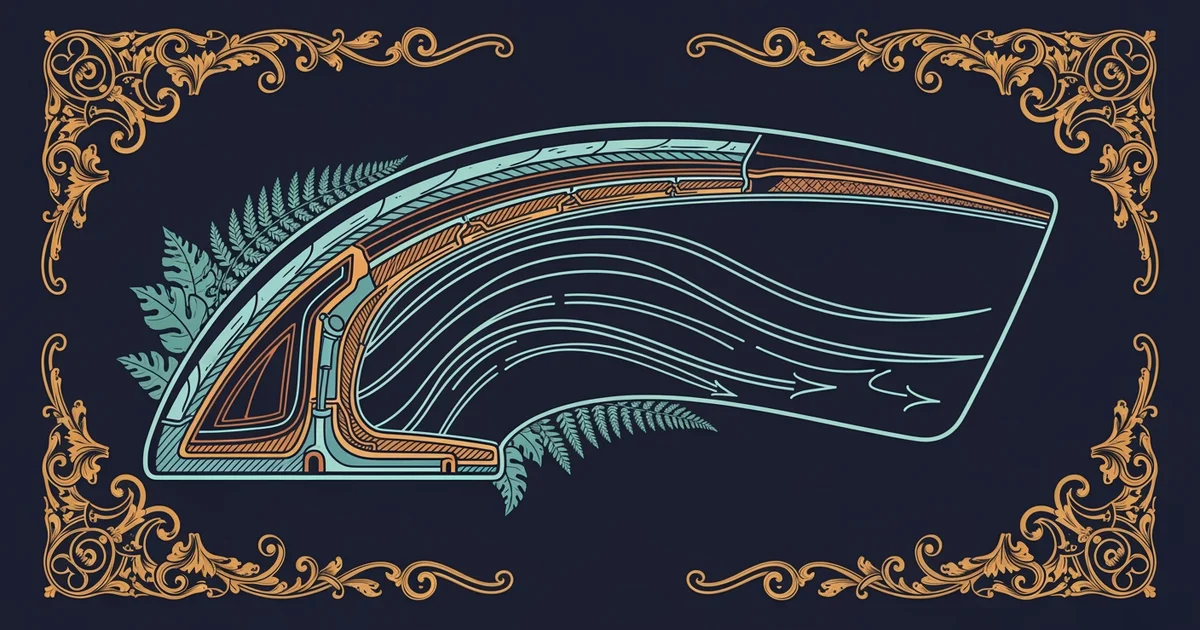
Mapping Forces in Three Dimensions
When we study fluids, we must track forces that act in three distinct directions at once. A single number cannot describe the complex state of stress inside a flowing liquid or gas. We represent this state using a matrix, which organizes nine individual components into a structured array of values. Each component tells us how a specific force acts on a specific face of our imaginary fluid cube. For example, some components measure normal stress, which pushes directly into the surface of the fluid. Other components measure shear stress, which slides along the surface to cause internal friction or movement. This matrix allows us to calculate how fluid particles interact with their neighbors as they travel through space.
Key term: Stress tensor — a mathematical object that describes the full state of stress at a point in a fluid by accounting for both pressure and shear forces.
Think of the stress tensor like a financial ledger for a busy retail store. Just as a store tracks money entering and leaving through different departments, the tensor tracks force entering and leaving through the faces of a fluid element. If the forces are balanced, the fluid remains stable and moves in a predictable, steady line. If one force becomes larger than the others, the fluid begins to rotate, stretch, or compress in response. This ledger ensures that we account for every push and pull acting on the fluid, no matter how small the volume might be. The total state of stress is the sum of these interactions across all three spatial dimensions.
Applying Stress to Fluid Motion
We organize these nine components into a standard grid to visualize the internal tension within the flow. The diagonal elements of this grid represent the normal stresses, while the off-diagonal elements represent the shear stresses acting on the fluid. This arrangement is essential for solving the complex equations that govern how fluids move through pipes or around obstacles. Without this structured approach, we would struggle to track how energy moves through a system. The table below shows how we categorize these forces based on their orientation and their effect on the fluid volume.
| Force Type | Direction | Physical Effect | Primary Role |
|---|---|---|---|
| Normal | Perpendicular | Compression | Resisting volume change |
| Shear | Parallel | Sliding/Flow | Creating internal friction |
| Pressure | Omni-directional | Pushing inward | Maintaining equilibrium |
These forces are not static, as they change constantly depending on the speed and shape of the flow. When a fluid encounters a narrow pipe, the shear stress increases because the particles must slide past each other more quickly. This increase in stress forces the fluid to adapt its velocity to maintain a balance of momentum. By mapping these vectors, engineers can design systems that minimize energy loss and prevent unwanted turbulence. Each component in the tensor provides a piece of the puzzle that describes the total internal state of the fluid. We must calculate these values at every point to build a complete map of the flow field.
Understanding these internal stresses allows us to predict how liquids behave under extreme pressure or high speed. We use these calculations to design everything from efficient airplane wings to complex industrial cooling systems. The stress tensor serves as the foundation for the equations that describe how fluids react to external forces. By mastering these nine components, we gain control over the invisible dynamics that shape the behavior of water and air. This knowledge turns the chaotic movement of a fluid into a series of solvable mathematical steps. We are now ready to see how these forces interact with the solid surfaces that contain them.
The stress tensor provides a complete mathematical map of internal forces that allows us to predict how fluids deform and move in response to pressure.
But what happens when these internal fluid forces encounter the solid walls of a pipe or a wing?