
Pipe Flow Systems
When the municipal water department in Denver manages the city grid, they must balance massive pressure demands against the friction caused by every turn in the piping network. This is a real-world application of the fluid resistance principles we first explored in Station 11, where aerodynamic lift relied on smooth flow patterns. Moving water through a pipe requires constant energy input because the fluid particles collide with the walls of the container. These collisions create a drag force that opposes the motion of the water, which engineers must calculate to ensure that homes at the end of the line receive adequate service. If the friction loss is too high, the water pressure drops significantly, leading to poor flow at the faucet.
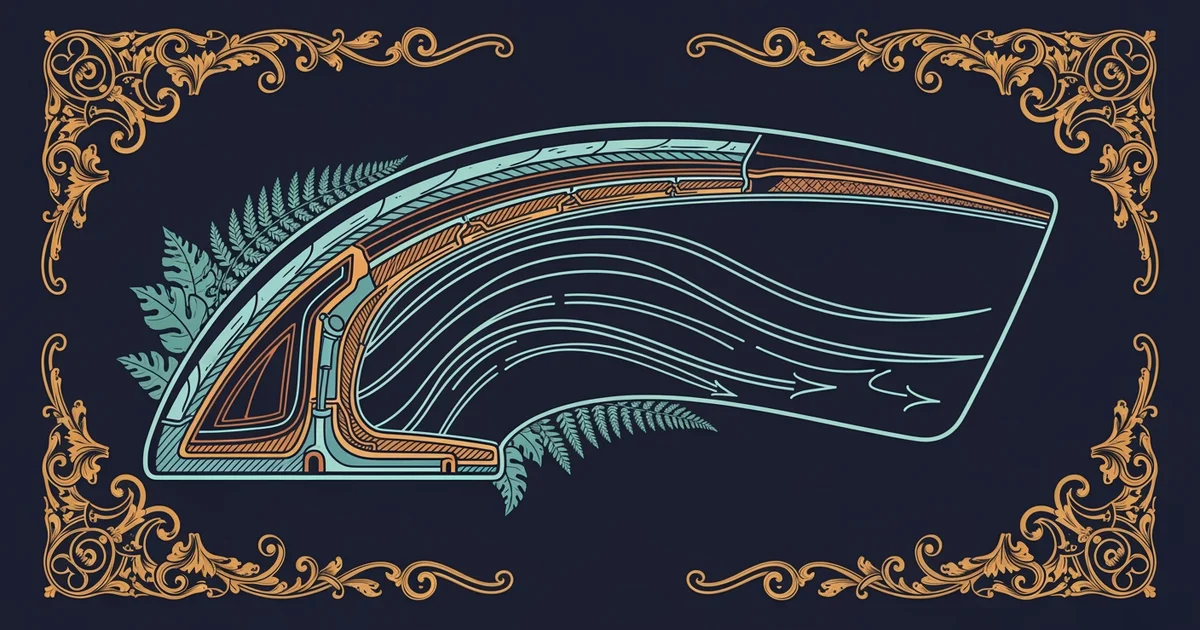
The Mechanics of Fluid Resistance
Fluid resistance within a pipe is primarily governed by the interaction between the moving liquid and the interior surface of the pipe wall. As the liquid travels, it forms a thin layer of slower-moving fluid near the wall, known as the boundary layer. The viscosity of the fluid determines how much internal friction occurs between these layers, influencing the overall energy loss of the system. Engineers use the Darcy-Weisbach equation to quantify these losses, which relates the pressure drop to the length and diameter of the pipe. By using this mathematical tool, designers can predict how much power a pump must provide to maintain a steady flow rate over long distances.
Key term: Darcy-Weisbach equation — a physical formula that relates the pressure loss of a fluid flowing through a pipe to its velocity and physical properties.
When we consider the energy budget of a pipe system, we must account for both major and minor losses. Major losses occur along the straight sections of the pipe due to friction, while minor losses happen at elbows, valves, and junctions where the flow direction changes. Think of this like a long highway commute where the major losses are the constant rolling resistance of your tires, while minor losses are the sudden stops at traffic lights that consume extra fuel. Just as a driver must plan for stop-and-go traffic to reach a destination on time, a fluid engineer must account for every fitting in the pipe layout to keep the system efficient.
Designing Efficient Transport Networks
To optimize a fluid transport network, engineers must select materials and geometries that minimize the disruption to the flow path. The roughness of the pipe interior plays a massive role in determining the friction factor, which is a key variable in our calculations. Smoother surfaces, such as those found in modern plastic or polished steel pipes, allow water to move with much less energy loss than older, corroded iron pipes. Choosing the right material is a strategic economic decision that balances the initial installation cost against the long-term energy savings from reduced pumping requirements.
Effective network design often follows these three fundamental engineering principles:
- Minimize the number of sharp bends in the pipe layout because each change in direction creates turbulence that converts kinetic energy into heat.
- Select pipe diameters that balance the cost of materials against the friction losses, as larger pipes reduce velocity and energy consumption but increase installation costs.
- Install valves and sensors at strategic intervals to manage flow velocity, which prevents the buildup of pressure surges that could damage the structural integrity of the network.
When designing these systems, we often compare different pipe materials based on their performance under pressure:
| Material | Roughness Level | Typical Application | Energy Efficiency |
|---|---|---|---|
| PVC | Very Low | Residential Plumbing | High |
| Copper | Low | Heating Systems | Medium |
| Steel | Moderate | Industrial Supply | Low |
By carefully selecting materials using this data, engineers can create systems that function reliably for decades without requiring excessive maintenance or high electricity costs for pump operation. The goal is to move the maximum volume of fluid with the minimum amount of external force, maintaining a stable state that resists the inherent tendency of fluid to lose energy through friction.
Reliable fluid transport depends on minimizing energy loss by balancing pipe geometry, material roughness, and the physical constraints of fluid viscosity.
But this model of steady flow breaks down when the fluid velocity reaches a threshold where turbulence creates unpredictable chaotic motion.