
Antenna Theory Basics
When the 1901 transatlantic wireless signal reached Newfoundland, it changed how humans communicate across vast distances forever. This historic event relied on the fundamental principles of antenna theory to capture invisible waves traveling through the air. You are now applying the physics of fields from Station 10 to understand how metal wires convert electrical energy into radiation. Designing an effective system requires matching the physical length of the wire to the specific wavelength of the signal being transmitted. This process ensures that the oscillating charges move in perfect harmony with the desired frequency of the electromagnetic wave.
Principles of Wave Propagation
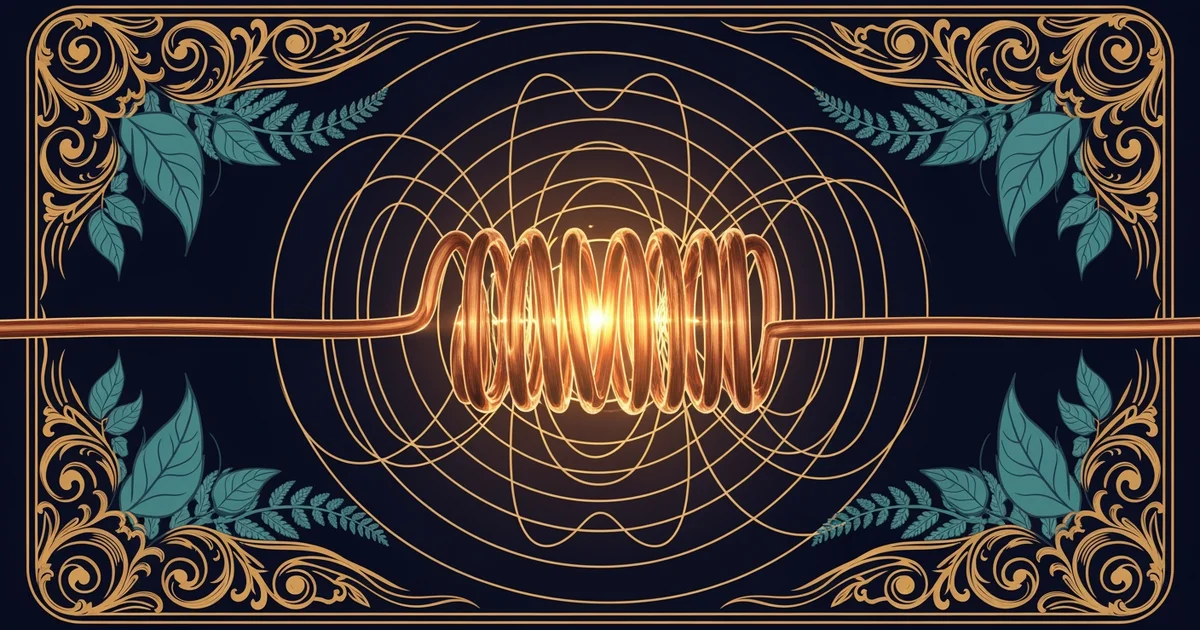
Electromagnetic waves consist of oscillating electric and magnetic fields that propagate through space at the speed of light. When you apply an alternating current to a conductive wire, the electrons inside the metal start to accelerate back and forth rapidly. This acceleration forces the surrounding electromagnetic field to ripple outward as a self-sustaining wave that carries information across space. Think of this like a person shaking a long rope tied to a wall to create waves. The faster you shake the rope, the shorter the distance between each peak of the wave. An antenna functions as the transducer that bridges the gap between guided electrical currents and free-space radiation.
Key term: Dipole — a fundamental antenna type consisting of two conductive elements that are each one-quarter wavelength long.
To achieve efficient energy transfer, the antenna must physically resonate at the frequency of the incoming or outgoing signal. A dipole antenna is the most common design used in basic applications because of its simple structure and predictable radiation pattern. The total length of the wire acts like a tuning fork that vibrates only at specific pitches. If the wire is too short or too long, the energy reflects back toward the source instead of radiating into space. This mismatch represents a loss of efficiency that engineers must avoid when they build communication systems for radio or television signals.
Designing Effective Antenna Systems
Building a functional antenna requires careful attention to the relationship between frequency, wavelength, and the physical dimensions of the conductor. Engineers calculate the required length of the wire using the speed of light and the target frequency of operation. The following table outlines the relationship between common frequency bands and the necessary physical size of a standard half-wave dipole antenna.
| Frequency Band | Wavelength (meters) | Half-Wave Dipole Length |
|---|---|---|
| 100 MHz (FM) | 3.0 meters | 1.5 meters |
| 400 MHz (UHF) | 0.75 meters | 0.375 meters |
| 2.4 GHz (Wi-Fi) | 0.125 meters | 0.0625 meters |
When you design these systems, you must also consider the orientation of the wire relative to the ground. The alignment of the conductive elements determines the polarization of the signal, which dictates how the receiver captures the energy. Most dipole antennas perform best when placed in an open area away from large metal objects that might block or reflect the waves. Proper placement ensures that the radiation pattern remains consistent with your design goals for the communication link. This application of field theory proves that invisible forces are highly predictable when you manage the geometry of the conductive medium correctly.
Consider how the length of the antenna wire directly influences the quality of the signal received by the device. If the wire length does not match the half-wave requirement, the impedance of the system becomes unbalanced. This imbalance causes the electromagnetic energy to bounce off the antenna terminals rather than radiating outward into the atmosphere. You can visualize this as trying to push a swing at the wrong moment, which prevents the swing from reaching its maximum height. By matching the antenna length to the wavelength, you ensure that the electrons oscillate with maximum efficiency and minimal energy loss.
Effective antenna design relies on matching the physical length of the conductor to the specific wavelength of the electromagnetic signal to ensure optimal resonance.
But this model of simple wire antennas struggles when we try to focus signals into narrow beams for long-range satellite communication.