
Faradays Law of Induction
Imagine you are pedaling a bicycle attached to a small generator that lights up your headlight. As you pedal faster, the light glows brighter, but if you stop moving, the light instantly fades away. This simple link between movement and electricity reveals how we can harvest energy from changing magnetic fields. By understanding this process, we unlock the secret to powering everything from massive city grids to tiny handheld devices. This phenomenon is known as Faraday's Law of Induction, which describes how magnetic changes create electrical currents in nearby circuits.
The Mechanics of Magnetic Flux
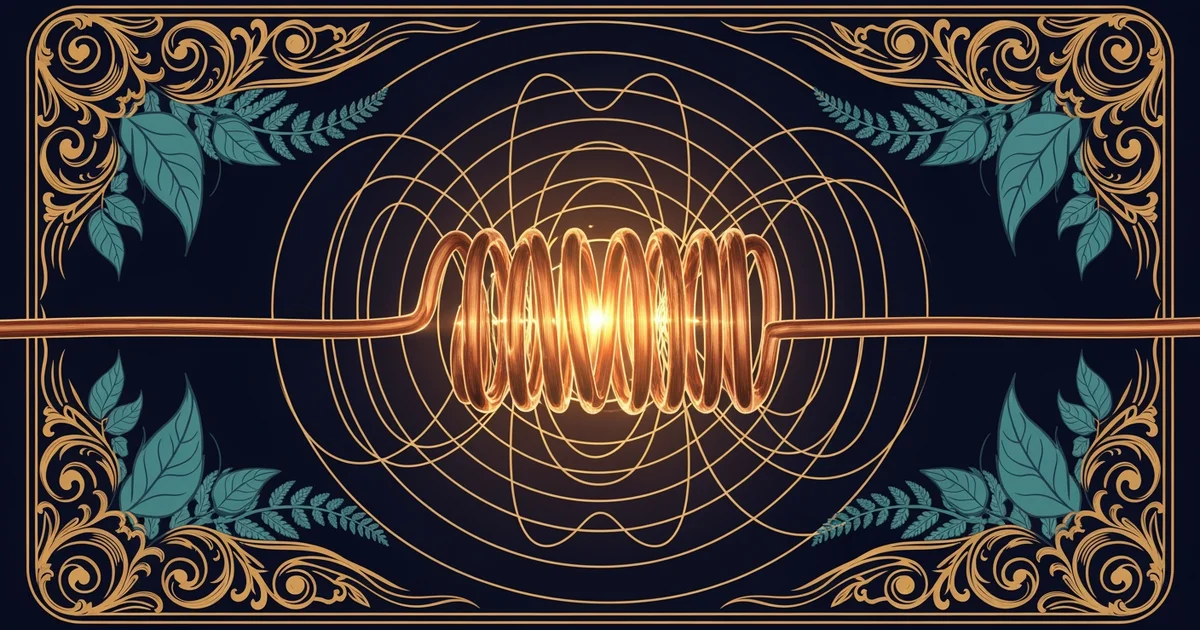
To understand how induction works, we must first look at the invisible field lines passing through a loop of wire. Scientists call this measurement magnetic flux, which represents the total amount of magnetic influence passing through a specific area. Think of it like water flowing through a net held in a river current. If you tilt the net or move it into faster water, the amount of water caught by the netting changes constantly. Similarly, when the magnetic field through a wire loop changes, the system reacts to that shift by creating a force.
Key term: Magnetic flux — the total measure of a magnetic field passing through a given surface area.
This movement of field lines is the essential trigger for generating electricity without a battery. If the magnetic field remains perfectly still and constant, no electricity will ever flow through the wire. The system requires constant motion or a fluctuating field to keep the electrons moving inside the metal. This is the fundamental reason why power plants use spinning turbines to rotate magnets near coils of wire. The constant rotation ensures that the flux is always changing, which forces electrons to stay in motion.
Quantifying Induced Voltage
Once we observe that changing magnetic flux creates an effect, we need a way to measure the resulting electrical pressure. The amount of electricity produced depends entirely on how quickly the magnetic flux changes over time. We represent this relationship using a specific mathematical formula that links the induced voltage to the rate of change. The equation is written as , where is the electromotive force and is the magnetic flux. The negative sign shows that the induced force always opposes the change that created it.
When you increase the number of wire loops in a coil, you multiply the effect of the induction significantly. Each additional loop acts like an extra battery stacked in a series, which boosts the total voltage output. Engineers use this principle to design transformers that can step up or step down voltage levels for long-distance power transmission. By simply changing the number of turns in the secondary coil, they can control the output voltage with great precision. This ability to manipulate energy levels is what allows us to transport power across vast distances without losing too much heat.
Here are three primary factors that determine the strength of the induced voltage:
- The speed of the magnetic movement determines how quickly the flux changes, which directly increases the voltage generated in the coil.
- The total number of wire turns in the coil acts as a multiplier, allowing for higher voltage output from the same magnetic source.
- The strength of the magnetic field itself dictates how much flux is available to be captured by the wire loop during the induction process.
By balancing these three factors, we can build efficient systems that convert mechanical energy into usable electrical power for our daily needs. Whether it is a hand-cranked flashlight or a massive hydroelectric dam, the core logic remains identical. We are simply moving magnets to force electrons through wires, proving that change is the true source of our modern electrical age. Mastering this law allows us to design better motors, sensors, and power systems that sustain our technological lifestyle.
Faraday’s Law proves that a changing magnetic environment is the fundamental requirement for inducing an electrical current in a conductive circuit.
The next Station introduces the Ampere-Maxwell Law, which explains how electric currents create magnetic fields to complete this two-way relationship.