
Electric Fields Explained
Imagine standing near a massive, invisible fan that pushes wind across an open field. Even if you cannot see the air itself, you feel the force pushing against your body from a distance. An electric field acts just like this invisible wind, but it exists wherever an electric charge sits in space. This field serves as a map of the forces that other charges will feel if they enter the area. Every charged object creates this invisible influence, which extends outward in all directions to interact with its surroundings.
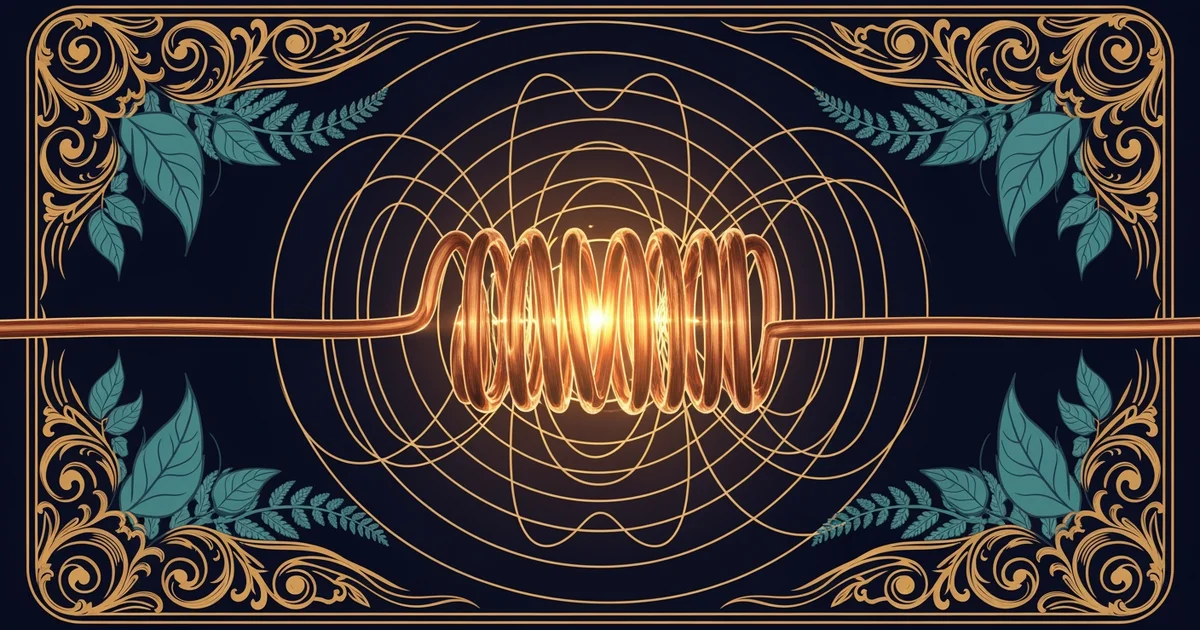
Understanding Field Interactions
When we place a positive charge in a vacuum, it generates a field that points directly away from its center. A negative charge does the opposite by pulling the field lines toward itself like a drain. These lines represent the path a tiny positive test charge would follow if placed nearby. Think of this field as a slope on a hill where a ball would naturally roll down. If the slope is steep, the ball rolls quickly, just as a strong field pushes a charge with greater force.
Key term: Electric field — a region of space surrounding an electric charge where other charges experience a force of attraction or repulsion.
This invisible influence allows objects to exert pressure on each other without ever touching directly. The strength of this field depends on both the amount of charge and the distance from the source. As you move further away from the center, the influence of the field weakens rapidly. This relationship follows a specific mathematical pattern that governs how forces spread out across three-dimensional space. Engineers use this concept to design everything from smartphone screens to large power grids that deliver energy to our homes.
Measuring Field Strength
To calculate the field strength, we use the ratio of the force applied to the charge experiencing it. We express this relationship through the equation , where represents the field, is the force, and is the charge. This formula shows that the field is independent of the test charge itself. By knowing the field value at any point, we can predict exactly how any object will move when placed there.
We can organize these field properties into a simple table to compare how different charges behave in space:
| Charge Type | Field Direction | Effect on Nearby Positives | Effect on Nearby Negatives |
|---|---|---|---|
| Positive | Outward | Repulsion | Attraction |
| Negative | Inward | Attraction | Repulsion |
| Neutral | None | No interaction | No interaction |
This table illustrates how the direction of the field dictates the movement of other particles. If you know the sign of the source charge, you can determine the direction of the field lines. This predictive power allows scientists to map out complex circuits and electromagnetic devices with high precision. By understanding these vectors, we gain control over the invisible forces that shape our physical reality. We essentially learn how to navigate the unseen landscape of electricity that powers our modern world.
When you consider how these fields interact, you might wonder if they ever overlap or cancel each other out. Multiple charges in one area create a combined field that is the sum of all individual contributions. This superposition principle allows us to calculate complex interactions by breaking them down into simpler, manageable parts. It is much like adding the currents of several small streams to find the total flow of a large river. As we continue to study these interactions, we uncover deeper truths about the fundamental nature of the universe.
The electric field functions as an invisible map of force that dictates how charged particles move through space.
Next, we will explore how Gauss Law helps us calculate these electric fields using the concept of total flux.