
Gauss Law for Magnetism
Imagine holding a bar magnet and trying to isolate just the north pole by cutting it in half. You will find that each new piece immediately grows its own north and south pole, no matter how many times you slice the material. This strange behavior happens because magnetic fields are fundamentally different from electric fields, which can easily exist as isolated positive or negative charges. While we can separate an electron from a proton, we have never observed a single magnetic charge existing alone in nature.
The Nature of Magnetic Fields
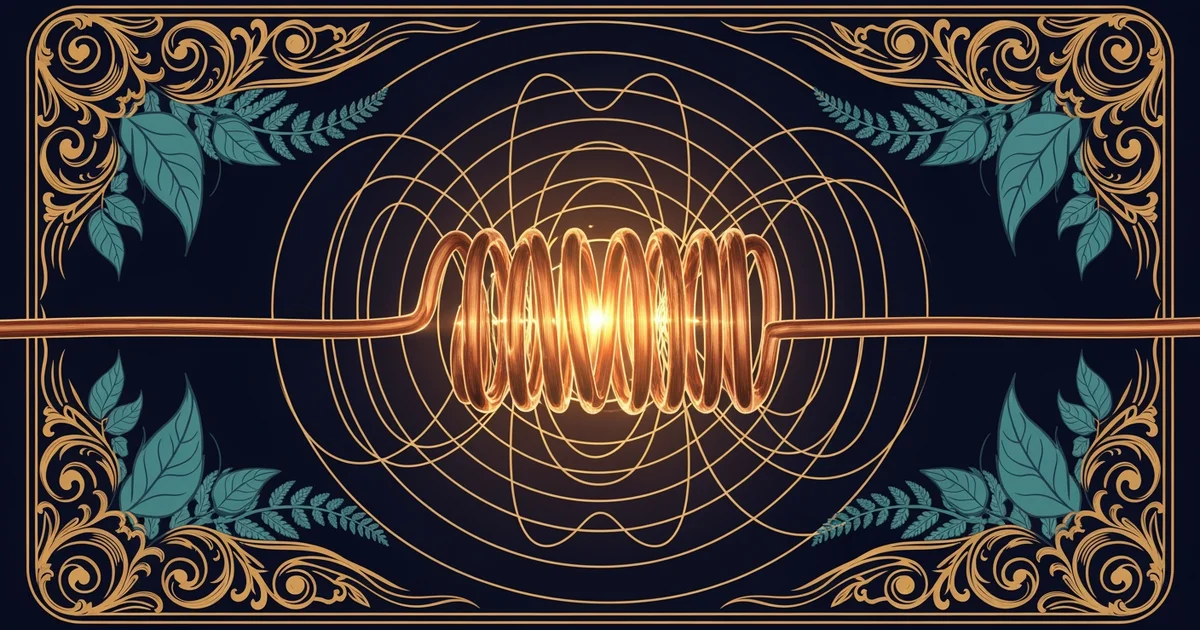
This core principle is known as Gauss Law for Magnetism, which serves as the second of four fundamental rules governing electromagnetism. The law states that the net magnetic flux through any closed surface is always exactly zero. Think of magnetic field lines as continuous loops that must always return to their starting point. If a field line leaves a surface, it must eventually enter that same surface somewhere else to complete its path. Because these lines never begin or end at a single point, we conclude that isolated magnetic sources do not exist in our universe.
Key term: Magnetic Monopole — a hypothetical particle that would act as a single isolated north or south magnetic pole.
To understand this better, consider the analogy of a bank account that only allows balanced transactions. If you withdraw ten dollars from one account, you must deposit that exact same amount into another account at the same time. You can never create or destroy money out of thin air, just as you cannot create a single north pole without a corresponding south pole. The total balance of magnetic charge in any closed container remains perfectly stable at zero. This balance ensures that magnetic fields are always circulating rather than radiating outward from a single point like electric fields do.
Implications of the Zero Flux Rule
Mathematical descriptions of this law use the divergence operator to show that the field flow is always zero. We write this formally as the following equation to describe the total flux through a closed surface:
This equation tells us that the magnetic field vector is solenoidal, meaning it lacks any source or sink points. If we were to discover a magnetic monopole, this entire physical framework would require a massive update to account for the new source. However, experiments conducted over many decades have failed to find any evidence of such particles, reinforcing the validity of the current law. The stability of our magnetic environment relies entirely on this lack of isolated charges, which keeps magnetic forces predictable and consistent across all physical systems.
| Feature | Electric Field | Magnetic Field |
|---|---|---|
| Source | Positive/Negative charge | No isolated source |
| Field Lines | Start and end on charges | Continuous closed loops |
| Net Flux | Proportional to charge | Always equal to zero |
We can summarize the behavior of these fields through the following observations:
- Magnetic field lines always form closed loops that connect north and south poles without ever breaking.
- The total amount of magnetic flux passing into a closed region must equal the flux passing out.
- No experiment has ever successfully isolated a single magnetic pole from a standard dipole magnet.
These observations confirm that magnetism arises from moving charges rather than stationary points. Since every magnetic effect originates from current loops or spin, the absence of monopoles is a direct result of how atoms are structured. This elegant simplicity allows us to design motors and generators with high precision because we know the magnetic field will never spontaneously appear or vanish. The consistency of these fields provides the stable foundation required for all modern electrical engineering and global communication technologies.
The total magnetic flux through any closed surface remains zero because magnetic field lines always form continuous loops without starting or ending at a single point.
The next Station introduces Faradays Law of Induction, which determines how changing magnetic fields create electric current.