
The Fossil Record of Words
Imagine finding a dusty, ancient coin buried deep in your backyard that tells a story about who lived there centuries ago. Words function exactly like that buried treasure, acting as physical artifacts that preserve the history of human movement and cultural change across vast stretches of time. When we examine these linguistic fossils, we uncover the hidden paths our ancestors traveled and the ideas they traded with neighboring tribes. This process allows us to reconstruct a timeline of human development that written history alone often fails to capture completely. By analyzing the structure and sound of words, we turn the past into a living map of human connection.
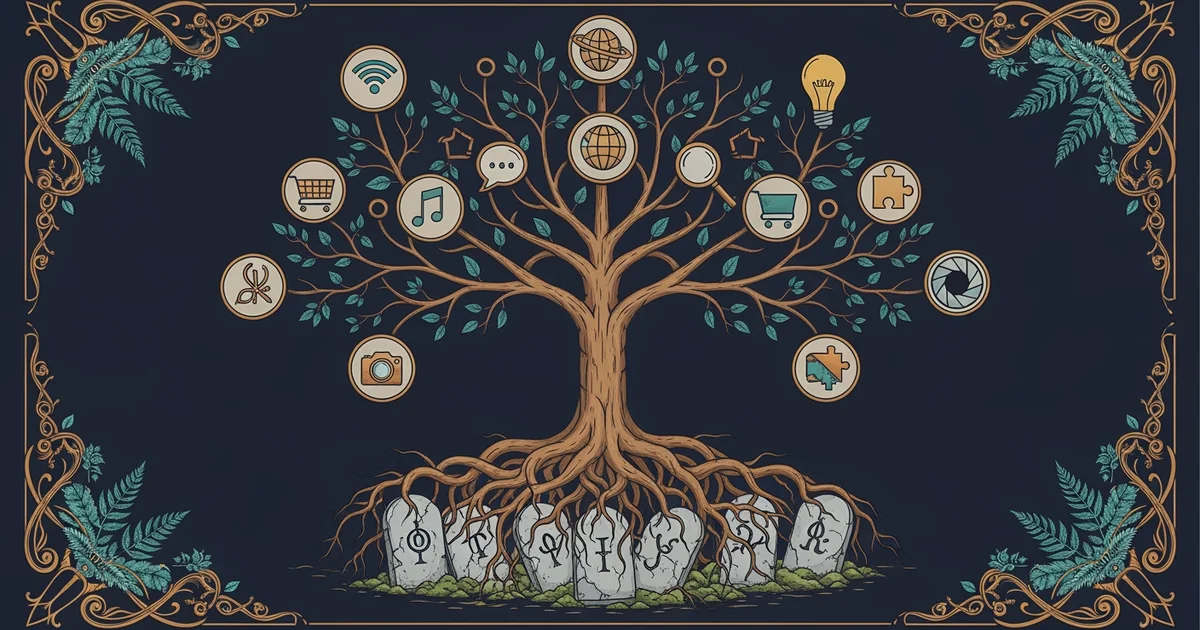
Uncovering the Layers of Linguistic Evidence
To understand how language evolves, we must look at the way specific words change their form over hundreds of years. Just as a geologist studies layers of rock to determine the age of the earth, a linguist examines the layers of vocabulary to determine the age of a language. Some words remain stable for thousands of years, while others morph into entirely new forms through constant daily use. When we compare these forms across different regions, we see clear patterns of migration that suggest how early groups moved across continents. This evidence functions like a trail of breadcrumbs, leading us back to the original source of a language family.
Key term: Etymology — the study of the origin of words and the way in which their meanings have changed throughout history.
Because words are rarely static, they act as a record of the people who spoke them during various historical eras. If a language has many words for specific types of snow or ice, we can infer that the speakers lived in a cold climate for a very long time. This type of analysis helps us build a profile of ancient societies without needing a single written record from that period. Every new word added to a language or every old word dropped tells us something vital about the environment and the priorities of those who lived long ago.
The Economic Analogy of Word Value
We can think of words as a form of currency that changes in value as it travels between different markets. When a word is borrowed from one language to another, it often undergoes a process of inflation or deflation in its meaning and sound. A word that starts as a simple tool for trade might become a complex term for a social concept as it moves through new cultural contexts. Much like money, the value and utility of a word depend entirely on how the local population chooses to spend it in their daily social transactions. This economic movement explains why related languages often share similar roots but possess vastly different vocabularies today.
The following table illustrates how a single root word can evolve into different forms depending on the cultural path it takes through history:
| Original Root | Language Path A | Language Path B | Modern Result |
|---|---|---|---|
| Kwe- (to move) | Quest (search) | Quiver (shake) | Divergent |
| Ped- (foot) | Pedal (cycle) | Pawn (piece) | Specialized |
| Mater (mother) | Matron (leader) | Matrix (source) | Abstract |
This table shows that while the core root remains the same, the specific application of the word shifts based on the needs of the culture. By studying these shifts, we gain insight into the values and technological advancements of the groups who used them. This linguistic record is far more durable than any physical structure because it lives on through the mouths of every generation that learns the language. We are essentially speaking the history of our ancestors every time we open our mouths to communicate with one another.
Understanding the fossil record of words allows us to trace the complex paths of human migration and cultural evolution by analyzing how vocabulary shifts over time.
Next, we will explore how specific sound laws dictate the predictable ways that these linguistic fossils transform across different language families.