
The Roots of Human Language
Imagine trying to explain a complex secret to a friend using only simple hand gestures. You would likely struggle to convey details like time, location, or abstract feelings without a shared system. This challenge represents the core hurdle early humans faced before they developed the complex tools of speech. By observing how we communicate today, we can trace the ancient roots of our linguistic evolution back to basic survival needs. Language acts as a bridge between our internal thoughts and the external world we inhabit daily.
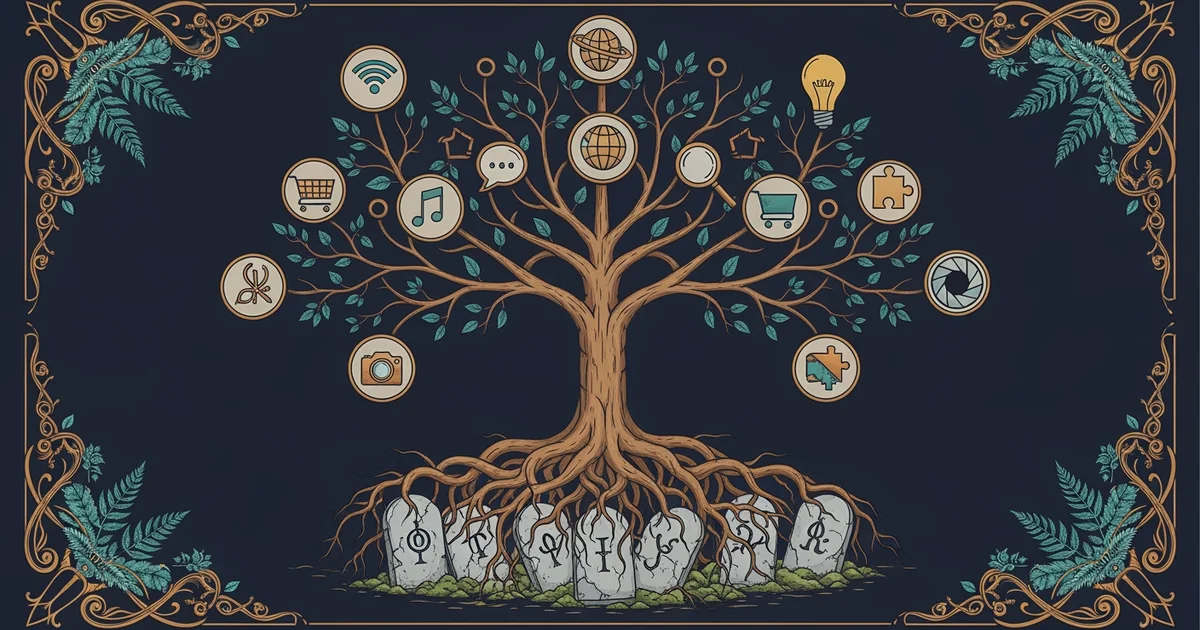
The Evolutionary Necessity of Communication
Because humans are social creatures, we rely on cooperation to survive in harsh, changing environments. Early groups needed to coordinate hunting, share warnings about predators, and organize the gathering of food. If a group member spotted danger, they required a fast way to signal the specific threat to others. This pressure forced the development of sounds that carried consistent meanings across the entire social unit. Think of this process like an early economic market where sounds were the currency traded for safety. Just as money allows us to trade goods, these sounds allowed humans to trade vital information quickly.
Key term: Linguistic evolution — the gradual process by which human languages change, adapt, and diversify over long periods to suit human needs.
Language did not appear overnight as a fully formed system of complex grammar rules. It began as a series of simple calls, gestures, and emotional noises that gained meaning through repetition. Over many generations, these basic signals became more structured as our brains grew and our social needs expanded. We can see this pattern in how children learn to speak today, moving from simple sounds to complex sentences. This development mirrors the history of our species as we moved from basic survival to building advanced societies.
Adapting to Environmental Shifts
As human populations moved across the globe, they encountered new climates, different food sources, and unique social challenges. These environmental shifts forced languages to adapt so that groups could describe their new surroundings and daily realities. If a group moved to a snowy region, they needed specific words to describe ice, snow, and cold conditions. If they stayed in a forest, their language evolved to focus on plants, trees, and animal tracks. This constant adaptation shows that language is a living tool that changes to fit our surroundings.
To understand how these changes occur, we can look at the common mechanisms that drive linguistic shifts in different populations:
- Social Isolation: When groups become separated by geography, their languages begin to drift apart because they stop sharing new words and rules.
- Cultural Contact: When two different groups meet and trade goods, they often borrow words from each other to describe new items or concepts.
- Efficiency Needs: People naturally simplify their speech over time to save energy, dropping sounds or words that are no longer useful for communication.
| Mechanism | Primary Driver | Resulting Change |
|---|---|---|
| Migration | New environment | New vocabulary |
| Trade | Cultural mixing | Loaned words |
| Efficiency | Social habit | Simplified grammar |
These mechanisms ensure that no language stays the same for very long throughout human history. By studying these shifts, we learn how our ancestors moved across continents and interacted with neighbors. This path will show you how to map these changes to uncover the hidden history of human culture. You will gain the skills to trace language families and see how our modern words connect us to the distant past.
Human language evolved as a flexible survival tool that shifts and adapts to meet the changing needs of our environment and social connections.
By the end of this learning path, you will master the methods used to track language evolution and understand how these changes reveal the complex story of human migration across the globe.