
Fiber Optic Transmission
Imagine a flashlight beam traveling through a long, curved garden hose without losing its brightness. This simple image captures the core challenge of sending data across the globe using light. Traditional copper wires struggle with signal loss over long distances because electricity creates heat and resistance. Fiber optics solve this by using pulses of light to carry digital information through glass strands. These strands are thinner than a human hair and use the physics of light to guide signals across oceans. By mastering how light behaves inside these tiny conduits, engineers have built the backbone of the modern internet.
The Principles of Light Confinement
To understand how light stays trapped inside a fiber, we must look at total internal reflection. This phenomenon occurs when light hits the boundary between two materials at a very shallow angle. If the light travels from a dense material into a less dense one, it can bounce back entirely. In a fiber optic cable, the center part is called the core, and the outer layer is the cladding. The core has a higher refractive index than the cladding, which forces the light to stay inside. Imagine a mirror-lined hallway where you shine a laser down the center. Because the walls are perfectly reflective, the light bounces forward rather than escaping through the sides. This allows the signal to travel for miles without needing a boost.
Key term: Total internal reflection — the physical process where light rays hitting a boundary are reflected back into the medium instead of passing through.
Engineers design these cables to ensure that the light reflects at specific angles to maintain signal integrity. If the light hits the boundary at too steep an angle, it will leak out into the cladding. This loss is called attenuation, and it represents a major hurdle in long-distance communication systems. To prevent this, manufacturers draw the glass to extremely precise diameters during production. The quality of the glass is also vital, as any impurities can scatter the light and degrade the data. By controlling the purity and the geometry of the fiber, we ensure that the light pulses reach their destination with high clarity.
Data Transmission and Signal Integrity
Once the light is trapped, it must carry information through a process known as modulation. We convert digital data, which consists of ones and zeros, into rapid pulses of light. A laser source turns on and off millions of times every single second to represent this binary code. The receiving end uses a photodetector to turn those light pulses back into electrical signals for your computer. This system allows for massive amounts of data to move simultaneously without interfering with other signals. The following table highlights the primary components that make this transmission process possible and efficient for global networks.
| Component | Function | Material | Importance |
|---|---|---|---|
| Core | Carries light | Silica glass | Central data path |
| Cladding | Reflects light | Doped glass | Keeps signal inside |
| Buffer | Protects core | Plastic coating | Prevents physical damage |
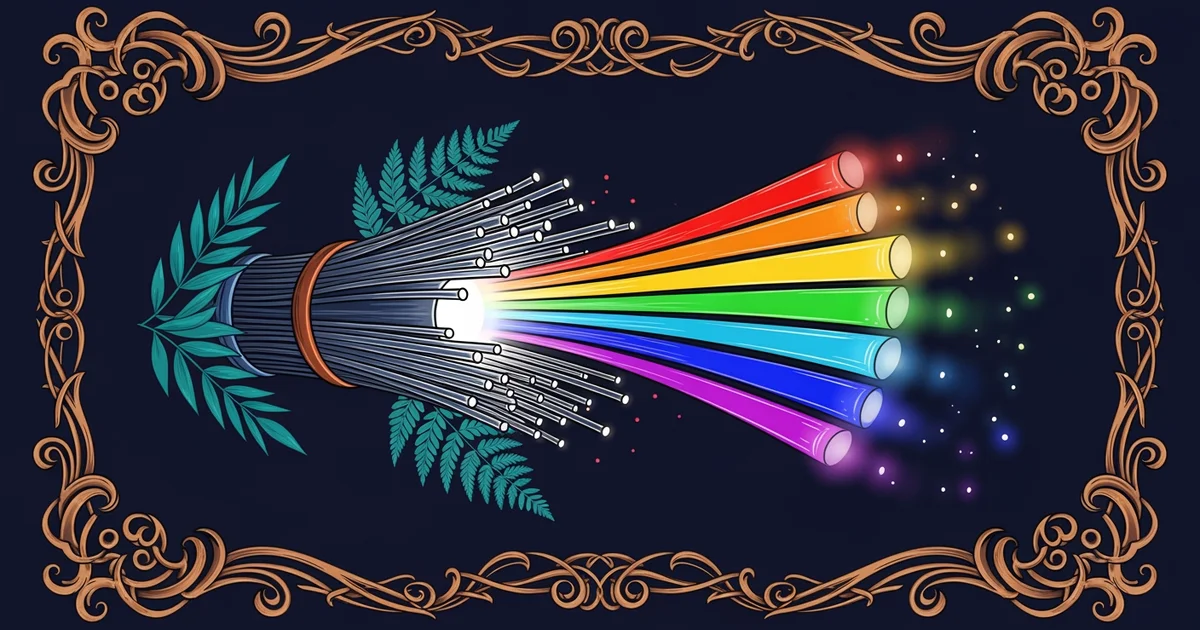
Reliable communication depends on how these layers work together to protect the signal from the outside world. The buffer coating acts as a shield against moisture and mechanical stress that might cause the glass to crack. Without this protective layer, a tiny scratch on the surface of the fiber could disrupt the reflection process. We must also consider how different wavelengths of light interact with the material to maximize bandwidth. By using multiple colors of light, we can send different data streams through the same fiber at once. This technique is known as wavelength division multiplexing and it significantly increases the total capacity of our global infrastructure.
Total internal reflection enables light to travel through glass fibers by acting as a perfect mirror that keeps data signals trapped within the core.
But what does it look like when we generate these high-speed light pulses using a laser source?
Want this with sources you can check?
Premium Learning Paths for Engineering & Robotics are researched against open-access libraries — PubMed, arXiv, government databases, and more — with their distinctive claims cited to real sources and independently checked.
See what Premium includes