
Historical Light Theories
Imagine you are standing on a dark beach watching waves roll toward the shore. You notice how they carry energy across the water, yet the actual ocean water stays in place. This simple observation captures the essence of a debate that once divided the greatest minds in scientific history. Early thinkers struggled to decide if light was a stream of tiny, solid objects or a rhythmic pulse moving through space. Understanding this historical tension is vital because it forms the foundation for how we harness light today.
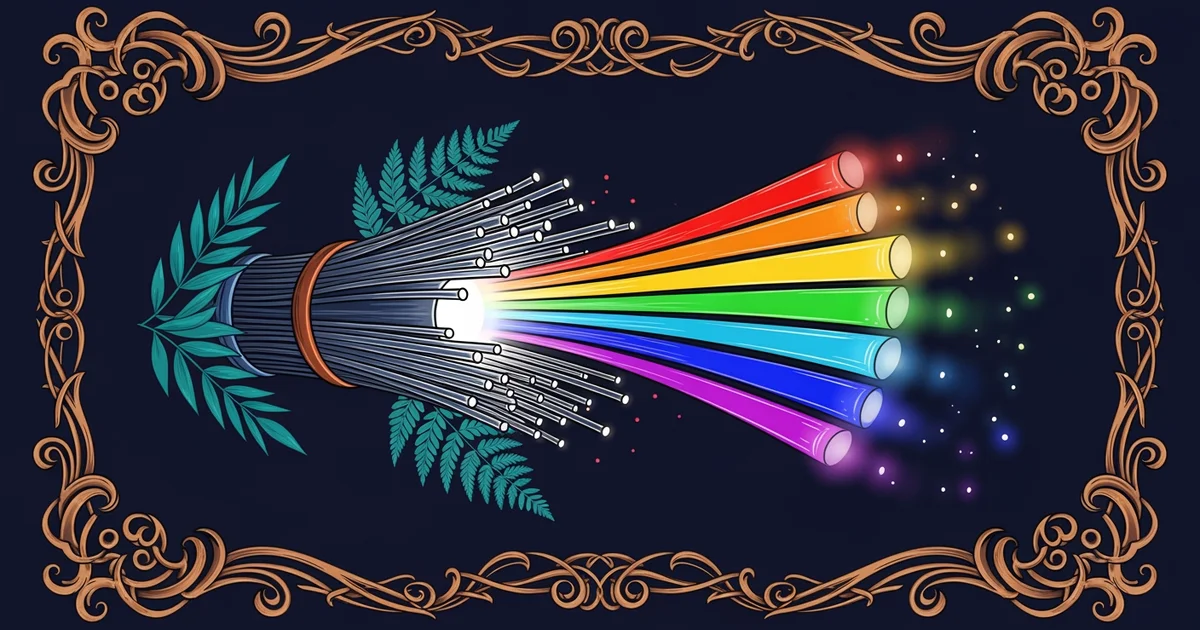
The Battle of Early Light Theories
For centuries, experts debated the fundamental nature of light to explain how we perceive the world. One group argued that light consisted of tiny particles, which they called corpuscles, traveling in straight lines. They believed these particles bounced off surfaces like rubber balls hitting a hard floor. Another group insisted that light behaved like a wave, similar to how sound ripples through the air. This wave theory suggested that light required a medium to travel, much like how waves need water to move forward. The debate was not just about words, but about how we measure and control the energy of light.
Key term: Wave-particle duality — the scientific concept that light exhibits properties of both waves and particles depending on how it is measured.
To visualize this, imagine a delivery truck carrying packages to a customer across a busy city. If you view the truck as a particle, you focus on the individual package being handed over at the door. If you view the delivery as a wave, you focus on the rhythmic flow of traffic moving through the streets to reach the goal. Both views help engineers solve different problems when they build modern tools like lasers or fiber optic cables. Scientists eventually realized that light does not fit into just one category, as it acts differently under various conditions.
Milestones in Optical Discovery
History shows us that scientific progress often moves forward when we test competing ideas with precision. The following milestones highlight how researchers refined their understanding of light through careful observation and experimentation:
- The particle model gained early support because it explained why light creates sharp, clear shadows behind objects.
- The wave model became more popular later because it successfully explained how light bends around corners or small obstacles.
- Advanced experiments eventually showed that light displays interference patterns, which proves that it acts like overlapping water ripples.
- Modern engineering now uses both models, as some devices rely on light as a stream of energy packets while others use its wave-like motion.
These discoveries were not just academic exercises, as they directly enabled the invention of technologies like cameras and medical imaging. When we understand these historical debates, we gain a better grasp of why modern optics requires such complex math and design. Engineering is essentially the art of choosing the right model for the specific task at hand. If you are building a solar panel, you might focus on the particle nature of light to capture energy. If you are designing a communication network, you focus on the wave nature to transmit data across long distances.
| Model Type | Primary Characteristic | Best Use Case |
|---|---|---|
| Particle | Discrete energy packets | Solar power |
| Wave | Rhythmic oscillation | Data signals |
| Combined | Duality of behavior | Advanced optics |
This table summarizes how these two historical views serve as tools for modern engineers. By treating light as a flexible resource, we can design systems that are both efficient and fast. We no longer see these theories as opposing forces, but as two sides of the same coin that help us manipulate the physical world. Every time you use a smartphone screen, you are benefiting from the centuries of work that resolved this ancient debate. The history of light is really the history of how we learned to master the most fundamental energy in the universe.
Scientific progress relies on choosing the best model from historical theories to solve modern engineering challenges.
Now that we understand how light behaves as both a wave and a particle, we can explore the specific energy contained within those tiny packets.