
Refraction and Reflection
Imagine you are standing at the edge of a pool while looking down at your own feet. You might notice that your legs appear shifted or bent compared to where they should be. This common visual distortion happens because light behaves differently when it moves between air and water. Understanding this behavior allows engineers to design cameras, telescopes, and even the tiny sensors inside your smartphone. By mastering how light changes direction, we can control and manipulate the physical world around us.
The Principles of Light Manipulation
When light travels through a single medium like air, it moves in a straight line at a constant speed. This predictable path changes the moment light strikes a surface made of a different material. If the surface is shiny or smooth, the light bounces off in a process called reflection. Think of this like a ball hitting a wall and bouncing back toward you at the exact same angle. This predictable bounce allows mirrors to create clear images by preserving the original path of the light rays.
Key term: Reflection — the process where light waves bounce off a surface and change direction while maintaining their original frequency and speed.
When light moves from air into a denser medium like glass or water, it undergoes refraction. This happens because light slows down as it enters the thicker material, causing the wave front to pivot. Imagine a car driving from a smooth road onto a patch of thick mud with only one side of the tires. The side hitting the mud slows down first, which causes the entire vehicle to turn toward the slower path. This exact bending effect is how lenses focus light to create images on a camera sensor.
Engineering Light Paths with Precision
Engineers use these two behaviors to build complex optical systems that shape our modern digital experiences. By layering different materials with specific shapes, they can force light to bend in exact patterns. This control is essential for creating the high-resolution images we see on screens. Without the ability to predict how light reflects off a mirror or refracts through a lens, modern robotics would lack the vision systems needed to navigate environments. We rely on these physical laws to translate raw light into usable digital data.
To better understand how these behaviors differ, consider the following breakdown of their primary characteristics:
- Reflection occurs when light hits a boundary and bounces back into the original medium, which is the foundational principle used in telescopes and rearview mirrors.
- Refraction happens when light passes through a new medium, causing a change in speed and direction that allows lenses to focus light into a single point.
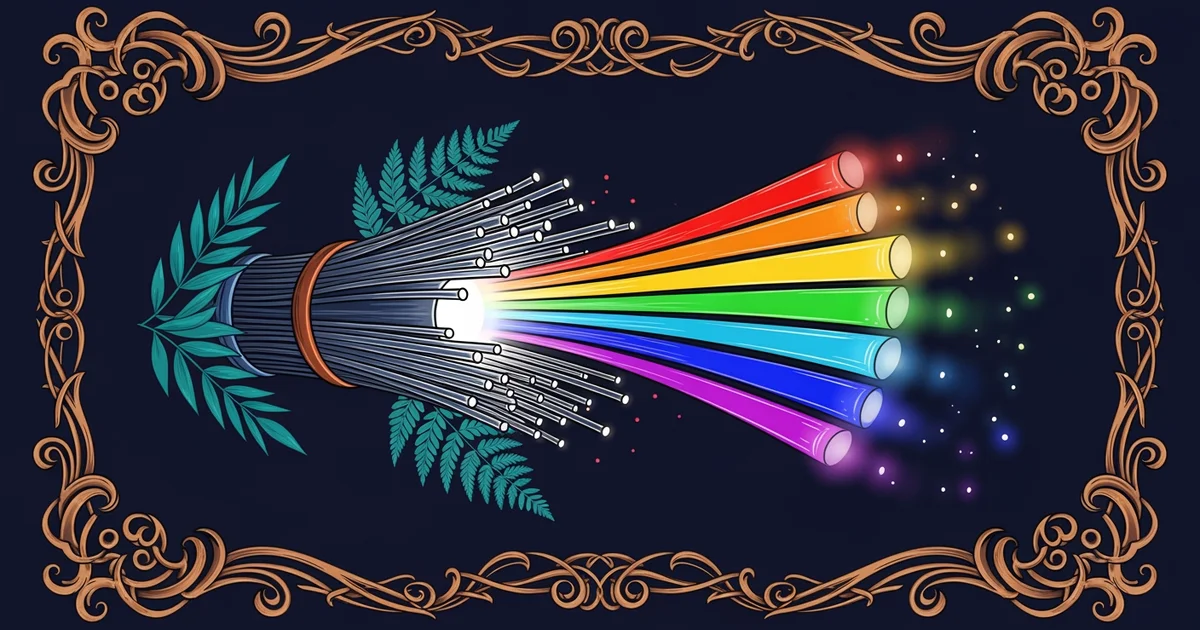
- Total internal reflection occurs when light hits a boundary at a specific angle and stays trapped inside, which is the mechanism that powers high-speed fiber optic internet.
These principles are not just theoretical concepts; they are the tools used to build the hardware of our information age. By stacking lenses to manipulate refraction or using curved mirrors to manage reflection, we can capture light from distant stars or microscopic cells. These systems serve as the eyes for our robots and the lenses for our personal devices. Every time you take a photo, you are witnessing the precise application of these two fundamental optical behaviors working in perfect harmony.
Controlling the path of light through reflection and refraction allows engineers to build the sophisticated optical systems that power modern technology.
The next Station introduces diffraction patterns, which explain how light spreads out when it encounters small obstacles or narrow openings.