
Propulsion System Architecture
Imagine you are driving a heavy truck up a very steep mountain road while carrying a massive load. You must constantly adjust the engine power and gear settings to keep the vehicle moving forward without stalling out or losing control. Massive ships face a similar challenge when they navigate through the deep ocean against strong currents and high waves. Engineers must design complex propulsion systems to ensure these giant vessels move efficiently through the water without breaking down under extreme pressure.
The Mechanics of Marine Power
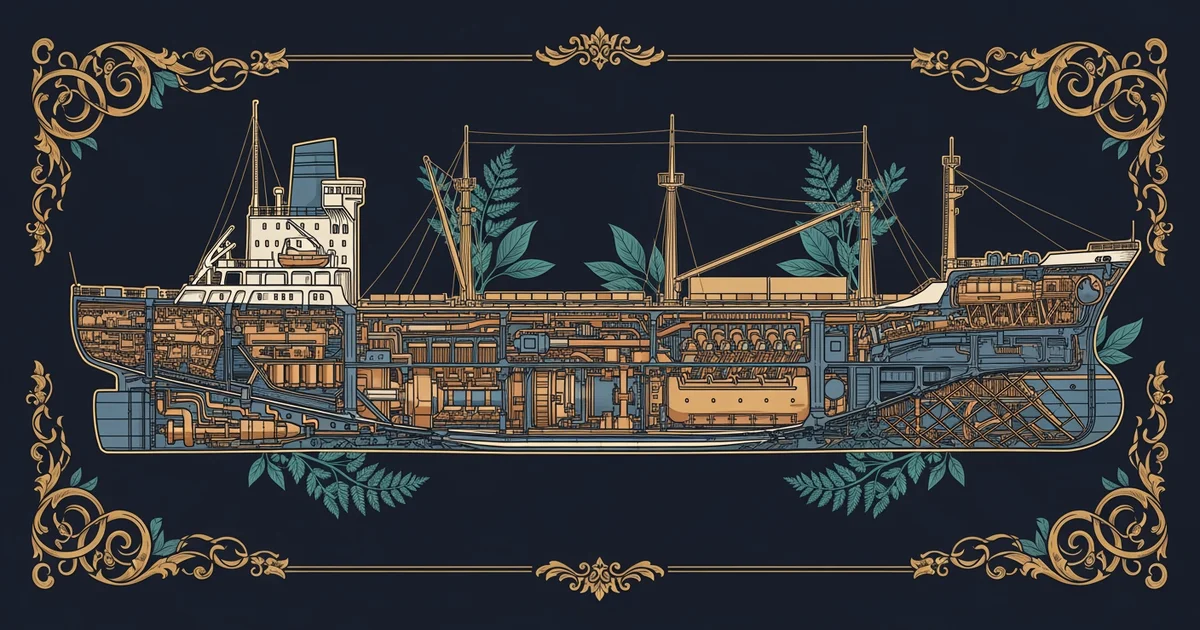
To move a ship across the ocean, engineers rely on the process of internal combustion to generate massive amounts of mechanical energy. This process involves burning fuel inside a closed engine cylinder to create high-pressure gases that push a piston downward. This linear motion is then converted into rotational motion by a crankshaft, which eventually spins the propeller at the rear of the ship. Think of this process like riding a bicycle where your legs provide the energy, but the pedals turn that energy into circular motion to move the wheels forward. Without this conversion from linear force to circular rotation, the engine would not be able to generate the torque needed to spin a massive propeller against the weight of the water.
Key term: Internal combustion — a heat engine where the burning of fuel occurs in a confined space to produce high-pressure gas for mechanical work.
Marine engines are significantly larger than car engines because they must overcome the massive resistance of water instead of air. Water is much denser than air, which means that a propeller must push against a very heavy medium to generate forward thrust. Engineers design these engines to run at lower speeds but with much higher torque than standard automotive engines. This allows the ship to maintain a steady pace even when the ocean conditions become rough or unpredictable. The engine must be robust enough to operate for thousands of hours without needing a major repair, as ships often travel across oceans for weeks at a time without stopping at a port.
Components of the Propulsion System
Propulsion systems consist of several interconnected parts that work together to translate fuel energy into forward movement. Each component must be precisely calibrated to handle the intense heat and mechanical stress produced during long voyages. The following table outlines the primary parts of a standard marine propulsion system and their specific roles in the energy transfer process:
| Component | Primary Function | Energy State |
|---|---|---|
| Fuel Injector | Sprays fuel into cylinders | Chemical energy |
| Piston Assembly | Compresses air and fuel | Thermal energy |
| Crankshaft | Converts motion to rotation | Mechanical energy |
| Propeller | Pushes water for thrust | Kinetic energy |
These components work in a specific sequence to ensure the ship moves efficiently through the water. First, the fuel injector delivers a precise amount of fuel into the combustion chamber where it mixes with compressed air. Second, the combustion process occurs, which forces the piston to move downward with great strength. Third, the crankshaft captures this force and turns it into rotational energy that travels down the drive shaft to the propeller. Finally, the propeller blades shape the water flow to create the necessary thrust that moves the ship forward against the ocean currents.
Engineers must ensure that every part of this system is perfectly balanced to avoid unnecessary vibrations or mechanical failure. If one component is slightly out of alignment, the entire propulsion system can lose efficiency or suffer catastrophic damage over time. This is why marine engineering requires a deep understanding of thermodynamics and material science to ensure that the engine can withstand the harsh conditions of the open sea. By carefully managing the conversion of chemical energy into mechanical thrust, engineers can design ships that conquer the most powerful oceans on our planet.
Propulsion architecture transforms raw chemical energy into rotational force to overcome the immense resistance of water against a ship's hull.
The next Station introduces fluid dynamics, which determines how the shape of the hull interacts with the water to influence overall speed and efficiency.