
Unit Operations
Imagine a massive factory floor where raw materials enter at one end and finished goods emerge at the other. You might wonder how a complex mixture of ingredients transforms into a specific product like shampoo or gasoline. Engineers rely on individual building blocks to manage these physical changes throughout a manufacturing plant. These building blocks are known as unit operations, which serve as the fundamental steps for processing materials. By breaking down a large chemical process into smaller segments, engineers can design systems that are efficient, safe, and scalable for mass production.
The Architecture of Industrial Processing
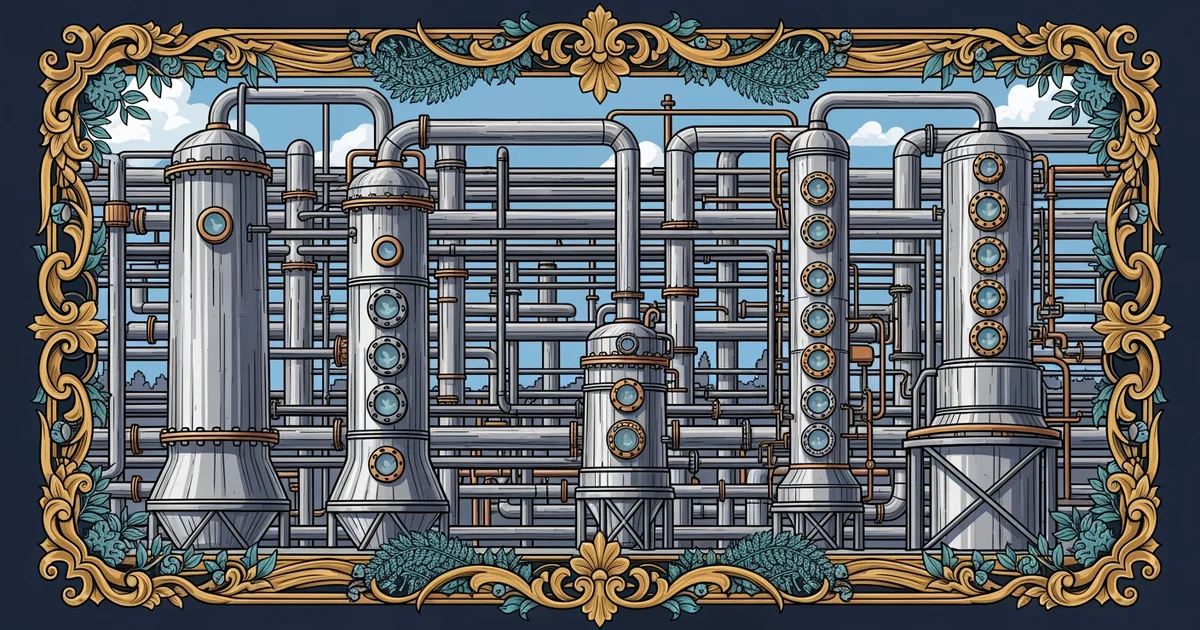
When you look at a chemical plant, you are seeing a series of interconnected vessels and pipes. Each vessel performs a specific task, such as heating a liquid or separating solid particles from a gas. This modular approach allows engineers to isolate different physical phenomena, ensuring that each step happens under optimal conditions. Think of a kitchen where you prepare a meal using different tools like a blender, an oven, and a strainer. Each tool performs a distinct function that changes the texture or state of your ingredients without altering the chemical identity of the food itself. In the same way, unit operations focus on the physical transformation of matter by changing temperature, pressure, or concentration.
Key term: Unit operations — specific physical steps in a chemical process that manipulate raw materials through changes in state, composition, or energy levels.
Engineers classify these operations based on the physical principles they utilize to achieve their goals. Some operations focus on moving energy, while others focus on moving mass between different phases of matter. By standardizing these steps, engineers create a common language that applies across many different industries. Whether a facility produces medicine, plastics, or fuel, the underlying unit operations remain remarkably consistent. This consistency allows for the development of standardized equipment, such as pumps, heat exchangers, and distillation columns, which can be adapted to various production needs with minimal design changes.
Categorizing Essential Plant Processes
To understand how these operations function, we can group them by the physical mechanisms they employ during production. Every operation serves a purpose in the conversion of raw materials into high-value products. The following list highlights the primary categories of these operations:
- Fluid flow processes involve the movement of liquids and gases through pipes, which requires pumps and compressors to maintain consistent pressure and flow rates across the facility.
- Heat transfer operations manage the temperature of materials to facilitate reactions or phase changes, using equipment like boilers and cooling towers to regulate thermal energy levels.
- Mass transfer operations change the composition of mixtures by separating components based on physical properties, such as boiling points or solubility, often using large towers for distillation.
- Mechanical separation processes remove solids from fluids or separate different sized particles, utilizing filters, centrifuges, or screens to ensure the final product meets strict quality requirements.
These operations often work in tandem to ensure the efficiency of the entire plant cycle. For instance, a mixture might first undergo a heating process to prepare it for a separation step. If the separation step is not successful, the material might return to an earlier stage for further refinement. This iterative loop ensures that the plant maximizes its yield while minimizing waste. By carefully mapping these operations, engineers can identify bottlenecks that slow down production or consume too much energy. This systematic oversight is what makes modern industrial manufacturing so incredibly productive and reliable.
Unit operations function as the modular building blocks of industrial production by isolating physical changes into manageable, repeatable steps that transform raw materials into finished goods.
Since these physical steps rely on moving energy and matter, how do engineers ensure these cycles maintain a constant balance of heat and work?
Want this with sources you can check?
Premium Learning Paths for Engineering & Robotics are researched against open-access libraries — PubMed, arXiv, government databases, and more — with their distinctive claims cited to real sources and independently checked.
See what Premium includes