
Hydrological Cycle Basics
Imagine you are holding a glass of water, unaware that the liquid inside has traveled across oceans and through ancient clouds to reach your hand today. This simple drink is part of a massive, endless loop that keeps our entire planet functioning as a living system.
The Continuous Motion of Earth's Water
Water moves through the environment in a process known as the hydrological cycle, which acts like a global plumbing system without a single shutoff valve. Solar energy heats the surface of our oceans and lakes, causing liquid water to turn into invisible vapor. This vapor rises high into the atmosphere where cooler temperatures force it to condense back into tiny droplets. These droplets eventually gather to form clouds, which release water back to the surface as rain or snow. This constant movement ensures that water is recycled across the globe, providing a reliable supply for every living creature on Earth. Think of this cycle like a bank account where deposits and withdrawals happen constantly to maintain a steady balance for everyone.
Key term: Hydrological cycle — the continuous movement of water on, above, and below the surface of the Earth.
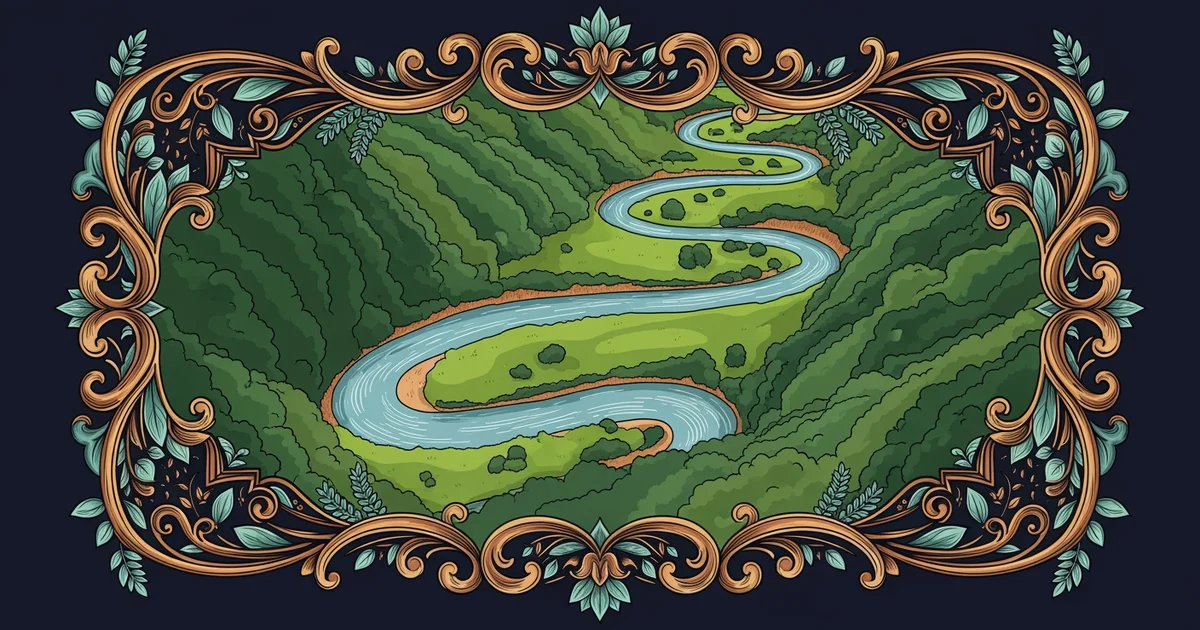
Once water reaches the land surface, it must find a way to return to the larger bodies of water to complete its journey. Gravity pulls this water downhill, creating paths that eventually form small trickles and larger river channels. While some water flows directly over the ground, a significant portion soaks into the soil to become groundwater, which moves much more slowly beneath our feet. This hidden flow acts as a long-term storage system, slowly releasing moisture back into streams during dry periods when rain is scarce.
From Precipitation to Flowing Streams
The transition from falling rain to active streamflow involves several distinct stages that determine how much water actually reaches a river. When rain hits the ground, it may evaporate immediately, soak into the earth, or begin moving across the surface as runoff. The following factors influence how quickly this water makes its way into our river systems:
- Soil saturation levels determine if the ground can absorb more moisture or if it will force water to flow over the surface as runoff.
- Vegetation cover helps slow down the speed of water, allowing more time for the liquid to soak into the ground instead of rushing away.
- Surface slope steepness dictates the velocity of the water, as steeper hillsides force gravity to pull water downward with much greater intensity.
This movement is not always uniform, as the landscape acts like a complex filter that slows, stores, and redirects water flow. If the ground is already soaked, every drop of new rain contributes directly to the volume of local streams. If the ground is dry, the earth acts like a giant sponge, holding onto the water until it can slowly move through the soil. This natural buffering process prevents most rivers from drying up completely between rainstorms, maintaining a steady flow even during hot summer months. By understanding how water transitions from the sky to the soil and finally into the river, we can better predict how landscapes change over time. Every drop of rain is a tiny worker contributing to the massive job of carving out the valleys and plains we see today.
The hydrological cycle serves as a global engine that recycles and distributes the planet's water supply through constant evaporation, storage, and movement.
Understanding how water shifts from the surface into defined channels leads us to explore the specific ways we categorize flowing water systems based on their size and structure.