
The Moving Earth Foundation
Imagine standing on solid ground while the entire floor beneath you slowly drifts away. You might feel like the planet is steady, but the surface is just a thin skin. Deep inside, the Earth is constantly moving in ways we rarely notice. This hidden motion builds mountains and shapes the oceans we see today. Understanding these forces helps us explain why our world looks the way it does. We live on a dynamic, changing planet that never truly sits still.
The Layers of Our Planet
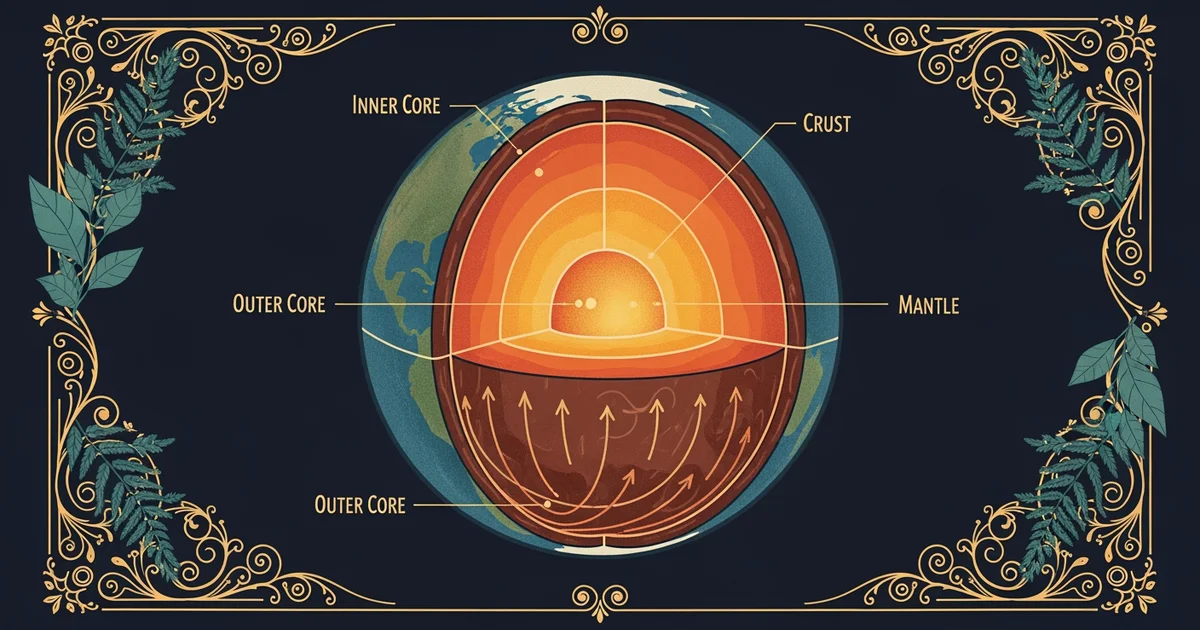
Our planet consists of several distinct layers that act like the ingredients in a massive, slowly cooking meal. The outermost layer is the crust, which is the cool, hard shell where we build our homes. Below this sits the mantle, a thick layer of hot, semi-solid rock that moves very slowly over time. The core sits at the very center, providing the intense heat that drives all these movements. Think of this structure like a giant hard-boiled egg with a shell, a thick white, and a dense yolk. The shell is brittle and thin, while the white is flexible and moves under the surface pressure.
Key term: Lithosphere — the rigid outer layer of the Earth, consisting of the crust and the upper mantle.
This layered design explains why the surface of the planet behaves in such a strange way. The heat from the core rises toward the crust, creating currents that push the surface rocks around. Just as a pot of thick soup bubbles on a stove, the mantle churns and shifts the plates above. This movement happens on a scale that is hard to imagine because it takes millions of years. Even though the pace is slow, the results are massive and permanent.
Understanding Internal Dynamics
We can organize these layers by their physical state to see how they interact during geological events. The way these materials behave under extreme heat and pressure determines how the surface changes.
| Layer | Physical State | Role in Movement |
|---|---|---|
| Crust | Brittle solid | Forms the stable ground |
| Mantle | Plastic solid | Drives plate shifting |
| Core | Liquid/Solid | Provides internal heat |
The table above shows how each part of the Earth plays a specific role in our geography. The crust is the part we walk on, but it is actually broken into many large, floating pieces. These pieces drift because the mantle beneath them is not a perfectly solid block of stone. Instead, the mantle acts like thick, warm honey that can flow if you give it enough time. This flow is the engine that moves continents across the globe.
When we look at the history of the planet, we see that these layers have always been in motion. The heat from the core forces the mantle to cycle, which pushes the crustal plates in different directions. This cycle is similar to how money moves through a global economy, constantly shifting from one region to another to maintain balance. The crust must adjust to these shifts, which causes earthquakes, volcanoes, and the slow rise of mountain ranges. Every feature on our map is a direct result of this deep, internal energy being released.
By learning these basics, we gain a clear view of how our home functions as a living system. We will explore how these movements create the landscapes we see and how they continue to change the world beneath our feet.
The Earth acts as a complex, layered machine where heat from the deep interior drives the constant, slow movement of the outer surface.
By understanding these internal layers, we will soon discover the historical evidence that proves our continents are drifting.